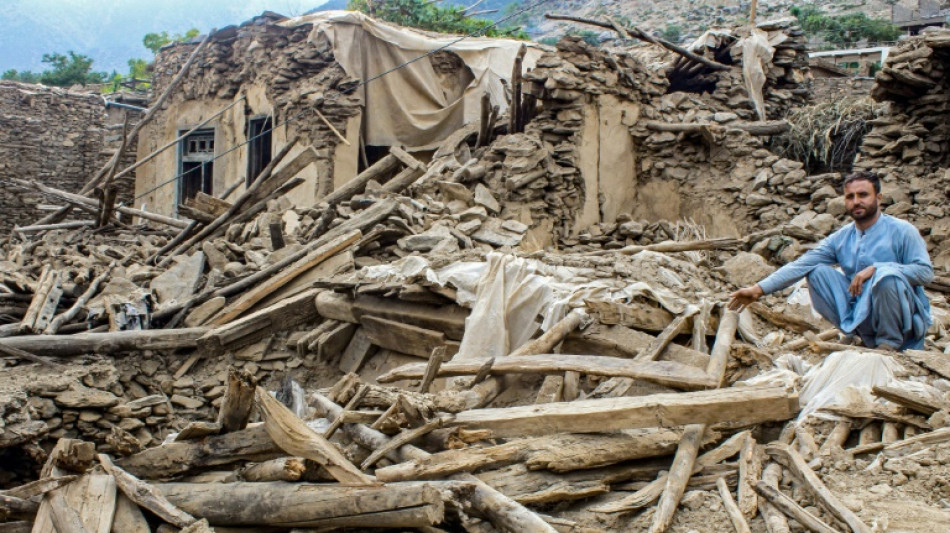
Rain adds to misery of Afghan quake survivors / Photo: © AFP

 Trump blames 'terrible vandals' for Washington pool renovation woes

 Man charged over suspected anti-Muslim attacks in Edinburgh

 Britain's King Charles to reveal personal tax bill: reports

 Fly-half Love ready for All Blacks start after Super Rugby heroics

 Saudis seek to repeat Argentina World Cup 'miracle' against Spain

 Nagelsmann says Germany has higher ambitions than advancing to knockout stage
 US and Iran set for new talks after delay and deadly strikes

 Germany into World Cup last 32 after late comeback, Dutch thrash Sweden

 Albanian protests against Trump-linked resort swell

 Burn dons cowboy boots as England unwind at World Cup

 France's Saliba says playing through the pain at World Cup
 Counter-terror cops probe suspected anti-Muslim 'attacks' in Edinburgh

 Clark begins with bogey as McIlroy charges at US Open
 Specter of military escalation hangs over Colombia vote

 Jamieson strikes as New Zealand eye series-levelling win despite Root heroics

 Netherlands thump Sweden in Houston to get World Cup liftoff

 Jamieson strikes as New Zealand eye series-levelling win against England

 Ronaldinho coming out of retirement to join Italian 3rd division side

 Real Madrid say no contact with Bayern's Olise

 Heartbreak for Japanese ace Satono Reve as Almeraq wins Royal Ascot thriller

 Injured Doris out of Ireland's Nations Championship squad

 Meloni hits back as Trump escalates G7 photo spat

 Pogacar pips Van der Poel to Swiss Tour TT win
 Ukraine's Zelensky, top officials return Polish awards in WWII row

 Spanish judge bans PM's wife from leaving country

Four nights and days since the earth shook and levelled his home in eastern Afghanistan, Khan Zaman Hanafi thought he had endured the worst, until the rain came.
The 35-year-old farmer says his village has "been forgotten by the government and aid groups".
"It's raining and we're being left to live in the open," he told AFP from a cornfield where he has been sleeping with his family, away from the wreckage of their village, Shelt.
In these valleys -- once known as smuggling routes and corridors for fighters moving to and from Pakistan before the Taliban returned to power -- mud houses are built into the mountainsides, stacked one above another.
On Sunday night, when the magnitude 6.0 quake struck, the homes collapsed in a giant domino effect.
Kunar province, famous for its forests, was the hardest hit by the quake -- one of the deadliest in the country's history, having already claimed over 2,200 lives.
- 'It's chaos' -
"In Shelt, there were 350 houses and 300 in Mama Gol, and we heard only 68 tents were distributed," said Hanafi, adding he has yet to see one.
"This place is unlivable, but we have no choice," he said. "We are poor. We want the government and aid groups to help us rebuild our homes."
But the Taliban authorities have already admitted they cannot cope alone.
For their part, the United Nations and NGOs say their resources are already overstretched, as they face a sharp drop in international aid and the return of millions of migrants expelled from neighbouring countries.
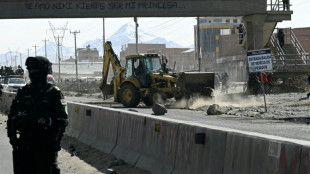
For now, authorities are sending bulldozers onto Kunar's steep slopes to clear the few narrow, winding roads as quickly as possible.
Khan Saeed Deshmash was spared from the rough roads, his injuries meaning he was flown by helicopter, along with a dozen injured relatives, from his village of Minjegale, to a hospital in Jalalabad, the capital of neighbouring Nangarhar province.
The 47-year-old grain farmer lost six family members in the quake, along with all his cows and sheep.
"Everyone is traumatised, it's chaos -- we can't even think straight anymore," he said.
- Every house destroyed -
Only one thing is certain now, Deshmash said: "It's no longer possible to live in these villages. There are still aftershocks, every house is destroyed, and we need to be relocated elsewhere."
But Abdul Alam Nezami, 35, said he wants to stay in his village of Massoud, where he inherited his father's cornfields.
He would be starting from zero to repair everything that was brought down in the quake or damaged by landslides and rockfall, in a country where around 85 percent of people already live on a dollar a day according to the UN.
Work is underway to clear the blocked roads, but "the irrigation canals and water reservoirs also need to be rebuilt so the harvests are not completely lost", Nezami said.
For now, he is focused on his immediate living situation.
"There is only one tent for two to three families, and some leak when it rains," he said.
And the rain has not stopped, with downpours "last night and again this morning".
In Mazar Dara too, the tarpaulins salvaged from the rubble to create makeshift shelters "have holes" and "don't protect us from the rain", said 48-year-old farmer Zahir Khan Safi.
"We keep them for the children," he told AFP, but they still end up in wet clothes. "And have nothing to change into."
N.Schaad--VB