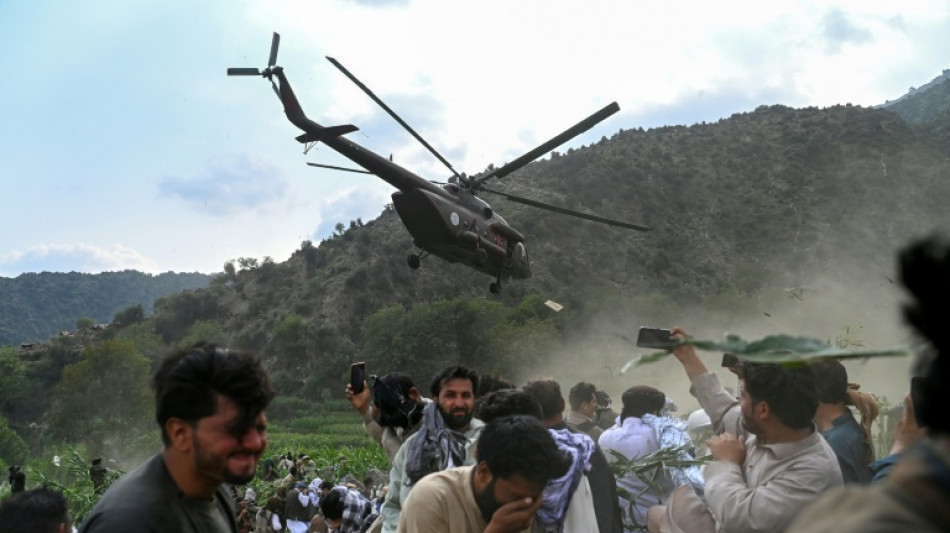
With aid slashed, Afghanistan's quake comes at 'very worst moment' / Photo: © AFP

 Russian barrage on Kyiv kills 17 as Ukraine fails to down single missile
 'Lost': Migrants despair after Britain expels them back to France

 Cathay Pacific's profit soars 71% despite Iran war driving up fuel costs

 Russian barrage on Ukraine kills 15, wounds dozens more
 South Korea police raid Starbucks HQ over 'Tank Day' fiasco
 Tech back in fashion as Asian markets extend rebound

 Total eclipse gives scientists chance to probe Sun's mysteries
 What to know about the total solar eclipse on August 12

 'Like the end of the world': the eclipse chasers flocking to Spain

 Taiwan begins military drills as China pressure grows
 UK mansion where 'listeners' spied on Nazi generals becomes museum
 Sabalenka tops Uchijima in WTA Toronto opener

 Kgatlana strikes as South Africa reach WAFCON quarter-finals

 Pakistan close on series-levelling win against West Indies

 Paramount CEO says politics fueling Warner Bros. merger battle

 Trump's sale of access to Truth Social raises eyebrows

 SpaceX rocket stage expected to slam into Moon
 US hopeful Hormuz strait deal will be done 'today or tomorrow'

 Michigan primary puts Democratic divide on the ballot

 South Africa captain Kolisi to make Test return in Argentina

 Cuba's famed resilience comes at a growing mental cost

 Swiss Reusser wins Tour de France Femmes time-trial

 Hundreds flee homes after Guatemala's Fuego volcano erupts
 Thousands pay tribute to Italian football legend Baresi

 Oil drops, stocks hit records on hopes of Hormuz opening
Afghanistan was already facing severe crises when it was rocked by another devastating earthquake, but this time there are fewer resources to muster after foreign funding was slashed to the bone this year.
Less international aid "means fewer ambulances, fewer doctors, fewer nurses, fewer midwives" to send into the battered farming communities of Afghanistan's mountainous east, said Arthur Comon, deputy director of operations at the non-governmental group Premiere Urgence Internationale (PUI).
The humanitarian sector has issued repeated calls since the start of the year for help in Afghanistan, which faces soaring poverty, worsening drought and the mass return of migrants expelled from neighbouring countries.
The 6.0-magnitude earthquake that struck around midnight on Sunday killed more than 1,400 people and injured over 3,000, a toll that was still rising.
It hit "in the very worst moment", said Rahmat Nabi Shirzad, communications officer for the UK-based NGO Islamic Relief in Afghanistan.
"The impact of these global cuts to humanitarian aid is very clear," especially in health services for the hardest-hit province of Kunar, said Shirzad, who was also on the ground after deadly earthquakes in Herat province in 2023 and Paktika in 2022.
Compared to the support provided after those disasters, the resources for Kunar are "not at that level".
- 'Already bled dry' -
"This earthquake is a crisis within a crisis," United Nations Resident and Humanitarian Coordinator in Afghanistan Indrika Ratwatte told AFP.
"Survivors now face overcrowded clinics, long waits and severe shortages of doctors and medicines -- just when emergency trauma care is needed most."
Funding cuts forced the closure of 400 health facilities, Ratwatte said.
The United States had been Afghanistan's main donor, providing $3.71 billion in aid since the Taliban takeover in 2021. It cut all but a sliver of funding in January.
"The Americans had put the country on a drip feed, and then pulled it out before the patient was healed," said a source at a French NGO.
"The earthquake is now ravaging a population that was already bled dry."
Beyond Washington, the UN said in June that it was drastically scaling back global humanitarian aid due to the "deepest funding cuts ever".
Afghanistan's aid had already been dwindling as donors hesitated, in part due to the Taliban's restrictions on women.
A senior official in the Taliban's information and culture ministry called on the international community to help.
"We are providing basic services... but the rehabilitation of those impacted and reconstruction of their homes is not in the capacity of the Islamic Emirate alone," said Atiqullah Azizi.
Half of Afghanistan's 48 million people are already in need of humanitarian aid, one in five goes hungry, and 3.5 million children under five are acutely malnourished, according to the UN.
The earthquake is "a key moment to see how donors react", International Rescue Committee's Vice President of Emergencies Bob Kitchen told AFP.
"What comes next will be very different -- we would ordinarily be already on the phone to US government colleagues," working to deploy funding for the earthquake response, he said.
- 'Lost interest in Afghanistan' -
PUI's Comon said it was "unlikely" that new funding would be secured for the post-earthquake response beyond perhaps only "small top-ups to cover the most urgent needs".
The French NGO, which closed 60 health centres and laid off 480 staff this year after the US cuts, has deployed mobile clinics in the quake-hit provinces but fears for the long term.
"It's been a long time since the general public lost interest in Afghanistan," the staff member said, adding that he hopes for aid from the European Union but expects little from the Americans, who are "completely out of the picture".
UN agencies have launched fundraising appeals, and an initial $5 million has been released from the emergency response fund.
But even before the earthquake, the UN estimated it had only $606 million available for its operations across Afghanistan out of the $2.79 billion required.
"With these cuts, we are being forced to make ever-tougher choices, concentrating scarce resources on those most vulnerable, while leaving many needs unmet," Ratwatte said.
P.Staeheli--VB