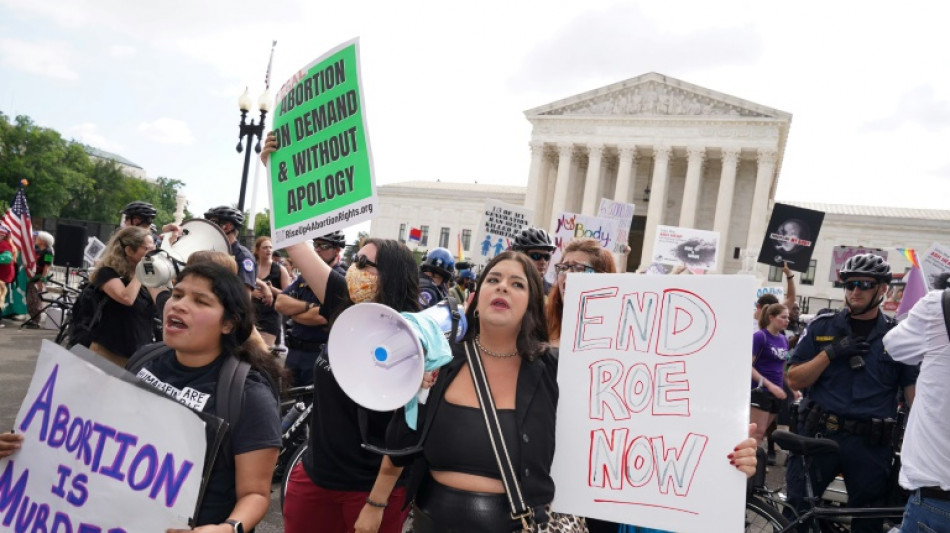
US Supreme Court strikes down constitutional right to abortion / Photo: © AFP

 Istanbul mayor ejected from court in corruption case

 Landslide kills eight at refugee school in Bangladesh

 Cleary leads NSW past Queensland to regain State of Origin crown

 MEXC Adds Nine Ondo Tokenized Stock and ETF Trading Pairs Tied to AI Infrastructure Demand

 Oil prices surge, stocks slide as Trump says Iran ceasefire over

 Sunken wrecks, hot seas threaten fishermen on Italian isle

 Rescuers search for survivors of China storms as super typhoon nears

 Egypt file complaint against referee after controversial World Cup exit

 Apple loses challenge against EU digital competition rules

 Trump says Iran ceasefire 'is over'

 Rescuers search for missing in China storms after 100,000 flee

 OpenAI to launch new model after US freeze

 UK museums at 'sharp end' of climate change challenge

 In Mauritania, Imraguen people's desert-ocean paradise under threat
 Iraq's holy cities host funeral processions for Khamenei

 Rescuers search for missing in China storms after 100,000 evacuated

 Ex-Australia cricketer MacGill loses appeal against cocaine conviction

 Oil prices extend rally as US strikes on Iran revive geopolitical fears

 Iraq's holy cities to host funeral processions for Khamenei

 In Venezuela's quake ruins, a baby is born

 What to know about the total solar eclipse due in August

 Trump, NATO allies to begin key talks at Turkey summit

 Former Real Madrid coach Arbeloa named Fulham manager

 Messi inspires Argentina great escape over Egypt, Swiss advance

 US strikes Iran after Hormuz attacks, Tehran threatens response

The US Supreme Court on Friday ended the right to abortion in a seismic ruling that shreds half a century of constitutional protections on one of the most divisive and bitterly fought issues in American political life.
The conservative-dominated court overturned the landmark 1973 "Roe v Wade" decision that enshrined a woman's right to an abortion, saying that individual states can now permit or restrict the procedure themselves.
"The Constitution does not confer a right to abortion; Roe and Casey are overruled; and the authority to regulate abortion is returned to the people and their elected representatives," the court said.
In the majority opinion, Justice Samuel Alito said "abortion presents a profound moral issue on which Americans hold sharply conflicting views.
"The Constitution does not prohibit the citizens of each State from regulating or prohibiting abortion," he said.
Dissenting were the three liberals on the court.
The ruling will likely set into motion a cavalcade of new laws in roughly half of the 50 US states that will severely restrict or outright ban and criminalize abortions, forcing women to travel long distances to states that still permit the procedure.
The opinion shredded the 1973 Roe v. Wade ruling by the nation's highest court that said women had the right to abortion based on the constitutional right to privacy over their own bodies.
Alito's opinion largely mirrors his draft opinion that was the subject of an extraordinary leak in early May, sparking demonstrations around the country and tightened security at the court in downtown Washington.
Barricades have been erected around the court to keep back the protesters gathered outside -- after an armed man was arrested on June 8 near the home of conservative justice Brett Kavanaugh.
The court's ruling goes against an international trend of easing abortion laws, including in such countries as Ireland, Argentina, Mexico and Colombia where the Catholic Church continues to wield considerable influence.
- Victory for religious right -
It represents a victory of 50 years of struggle against abortion by the religious right but the anti-abortion camp is expected to continue to push for an outright nationwide ban.
The ruling was made possible by the nomination of three conservative justices to the court by former Republican president Donald Trump -- Neil Gorsuch, Kavanaugh and Amy Coney Barrett.
The case before the court was a Mississippi law that would restrict abortion to 15 weeks but during the hearing of the case in December several justices indicated they were prepared to go further.
According to the Guttmacher Institute, 13 states have adopted so-called "trigger laws" that will ban abortion following the move by the Supreme Court.
Ten others have pre-1973 laws that could go into force or legislation that would ban abortion after six weeks, before many women even know they are pregnant.
Women living in states with strict anti-abortion laws will either have to continue with their pregnancy, undergo a clandestine abortion or obtain abortion pills, or travel to another state where the procedure remains legal.
Several Democratic-ruled states, anticipating an influx, have taken steps to facilitate abortion and clinics have also shifted their resources.
Travel is expensive, however, and abortion rights groups say abortion restrictions will severely impact poor women, many of whom are Black or Hispanic.
M.Odermatt--BTB