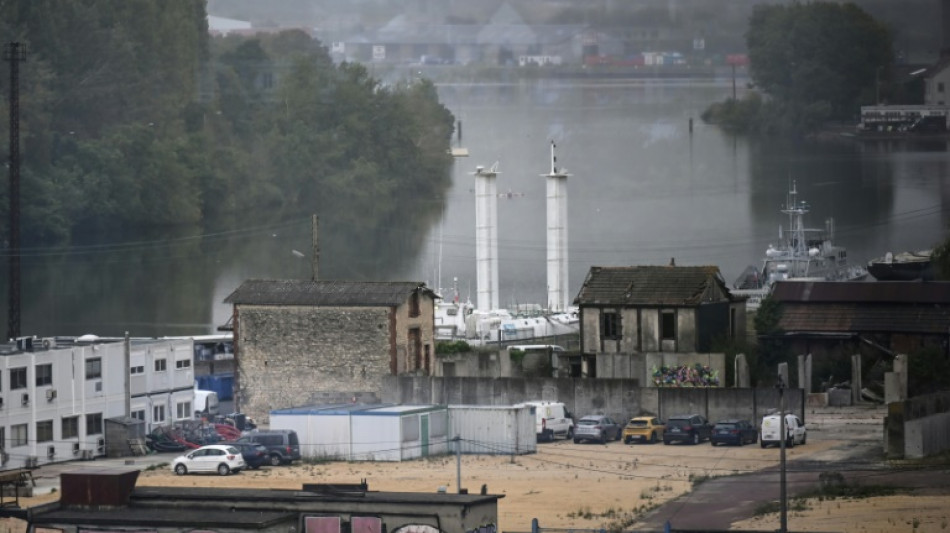
Vast France building project sunk by sea level rise fears / Photo: © AFP

 Trent Perry’s Late Heroics Lift No. 7 UCLA Past Cal State Fullerton

 2027 Hyundai Elantra Review: Brutalist Design and Expanded Dimensions

 Malta Maritime Forum Study Reveals €1 Billion Economic Contribution Amid Growth Concerns

 China Condemns Chile-Belgium Joint Bid for High Seas Treaty Headquarters

 Dún Laoghaire-Rathdown €335m Budget Faces Mixed Reaction Over Housing and Cost of Living

 Dubai Police Expand Luxury Patrol Fleet with 525-hp Defender

 Iran Strikes US Sites in Kuwait Following US Airstrikes on Qeshm Island
An ambitious housing project in the northwestern French city of Caen has run aground over worries that rising waters driven by climate change could make the area unlivable within the century.
Conceived in the early 2010s, the development was to transform a strip of industrial wasteland between the River Orne and the canal linking Caen to the sea into 2,300 homes, as well as tens of thousands of square metres of office space.
But the construction "will not happen", said Thibaud Tiercelet, director general of the "Caen Peninsula" planning society in charge of the "Nouveau Bassin" (New Basin) project.
In 2023, just as all the authorisations to start work on the project had been obtained, Tiercelet was alerted by a group of experts tasked with determining the impact of climate change on the Normandy region.
That group's findings were stark enough to convince then-Caen mayor Joel Bruneau to sink the development.
"In 2017, the estimated rise in sea level was 20 centimetres (eight inches) by 2100," Tiercelet recalled of the data.
But "in 2020 it was 60 centimetres, and in 2023 it was one metre".
The UN Intergovernmental Panel on Climate Change (IPCC) projects a "likely" sea level rise of 40 to 80 centimetres by 2100.
But it also notes this estimate does not take into account poorly understood drivers that could push sea levels significantly higher, such as the rapid disintegration of the polar ice sheets.
In any case, the IPCC advises that urban planners in coastal cities "may wish to consider global-mean sea level rise above the assessed likely range".
- 'It will flood every week' -
At present, the 17-kilometre-long (11-mile-long) strip, dubbed Caen's "peninsula", is only 70 centimetres above the canal's water level.
"If the sea rises by one metre, it will flood here every week," urban planner Tiercelet said.
While climate scientists stress that there is uncertainty about the extent and pace of the rise in water levels, the fact is that they will happen.
As for the level of the canal, it is currently regulated by a lock "which only has 50 centimetres of leeway at high tide", noted Tiercelet.
So in a few decades, it may no longer be able to fulfil its role.
Plans for the development have been shelved as a result, with improvements to the promenade on the "peninsula" scheduled instead -- pending a study into the water dynamics of the entire Orne river estuary.
- 'Temporary uses' -
Besides the project, the sea level rise projections also scuppered "the extension of the tramway and an access footbridge" to the strip, said Emmanuel Renard, vice-president for land use and development in the Caen-la-Mer urban community.
Renard said they were looking at "transitional urban planning for 40 years with temporary uses" for the area -- which could include student housing or craft workshops on the land where disused warehouses are awaiting demolition.
As seawater rises more frequently through the estuary and groundwater, the strip's freshwater ecosystem will gradually become saline and brackish.
The tree species that will soon be planted around the promenade, which is currently being cleaned up, have been chosen to suit this future ecosystem.
"It's the end of a 170-year-old model, of the technological explosion that allowed the era of large-scale construction and mastery over our environment," Tiercelet said.
And now we're going to have to adapt."
K.Hofmann--VB