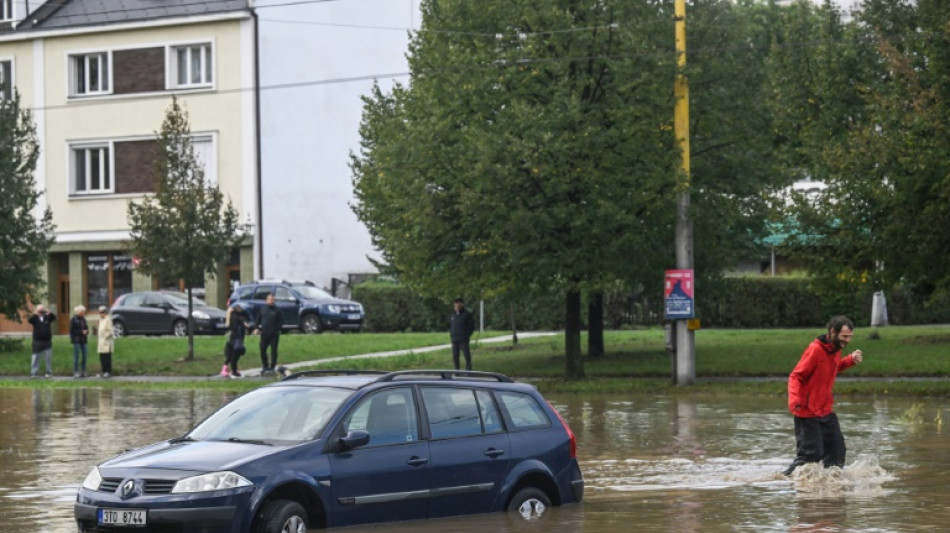
Czech city awaits the inevitable as floodwave looms / Photo: © AFP

 Arizona Superintendent Tom Horne to Leave Office, Plans Law Practice and Charter School

 Japan and Peru Mark 150 Years of Diplomatic Ties Amidst Trade and Investment Talks

 Ian Jackson Scores Game-High 22 Points After Rick Pitino's Prank Suspension

 Khan Welcomes Milburn’s Youth Employment Reforms Amid High NEET Rates

 Shinde Clarifies Torn Photo Controversy Amid Sonia Gandhi Book Protest

 BMW i3 vs Mercedes C-Class Electric vs Hyundai Ioniq 6: The Ultimate Premium EV Showdown

 BING X: 22,624.66 SNC have disappeared at BingX – how safe are tokens on BingX? Will BingX’s MiCAR licence be suspended?

 Urban Company Raises Rs 2,500 Crore via QIP to Expand InstaHelp
The sun was shining and the sky was bright blue with just a few white clouds, but in downtown Opava in the Czech Republic, most people only talked about the weather with concerned frowns.
Local people gathered on bridges and the embankment in the city centre to watch the eponymous Opava river gradually rise level with the banks, fed by heavy rain that started on Friday and only stopped on Sunday morning.
Police vans and fire trucks blocked roads to the local Katerinky housing estate, from which thousands of people had been ordered to evacuate on Saturday.
Standing outside a prefab block of flats with a friend, purchase manager Marie Lasak Blokesova assessed the situation, reflecting on the devastating floods that hit the region in 1997.
Back then, floodwater killed 50 people and caused damage worth $3 billion -- especially in the eastern parts of the Czech Republic, an EU country of 10.9 million people.
"Since we all expected this, I hope everyone is as ready as we are, and since we had already experienced the 1997 flood, we are basically just waiting," Lasak Blokesova told AFP.
"We had enough information suggesting what will come. These days with Facebook and Instagram, you know what is happening around you and so you can calm down a bit in that you know what's going on."
The water kept rising as she watched -- a car park where cars were safe at 9:30 (0730 GMT) was covered with water reaching above the sills an hour later.
"My boyfriend has recalled the 1997 flood so we have made stocks of drinking water and prepared a camping gas cooker in case they switched off gas and electricity," said Lasak Blokesova.
"We also recharged all the electrical devices we have and we are hoping we just won't need this all."
- Evacuate or not? -
Since Friday, over 10,000 people have been evacuated across the Czech Republic.
More than 250,000 households were without electricity on Sunday, four people were reported missing and firefighters had attended almost 15,000 incidents.
In Opava, several people braved the high water in the street on foot, many in Wellington boots.
Some even rode bicycles through the floodwater, while one maverick driver rode his Volkswagen into the waves before changing his mind and returning in a U-turn.
Some in the upper stories watched out of their windows -- deaf to the firefighters' pleas to evacuate.
Dustbins and containers floated freely along the Opava, navigating between flooded bus stops and road signs.
- 'Watching this in horror' -
The river in Opava, a city some 240 kilometres (150 miles) east of the Czech capital Prague, was expected to culminate at around 1700 GMT on Sunday, forecasters said.
Twenty kilometres upstream, the city of Krnov was 80-percent flooded by 1230 GMT, said its deputy mayor Miroslav Binar.
In Velke Hostice -- a village about five kilometres down the stream from Opava -- local volunteers were frantically trying to perfect an improvised wall of sandbags stretching for 500 metres (550 yards) on a jetty built after the 1997 floods for protection.
Visibly tired, local hunter Jaroslav Lexa told AFP the men had worked on the sandbag barrier until 1:00 am on Saturday night, and resumed work at 7:00 am on Sunday, patching holes in the impressive work.
"I'm watching this in horror. If we don't stop the wave, it will flood the lower part of the village," he said.
O.Schlaepfer--VB