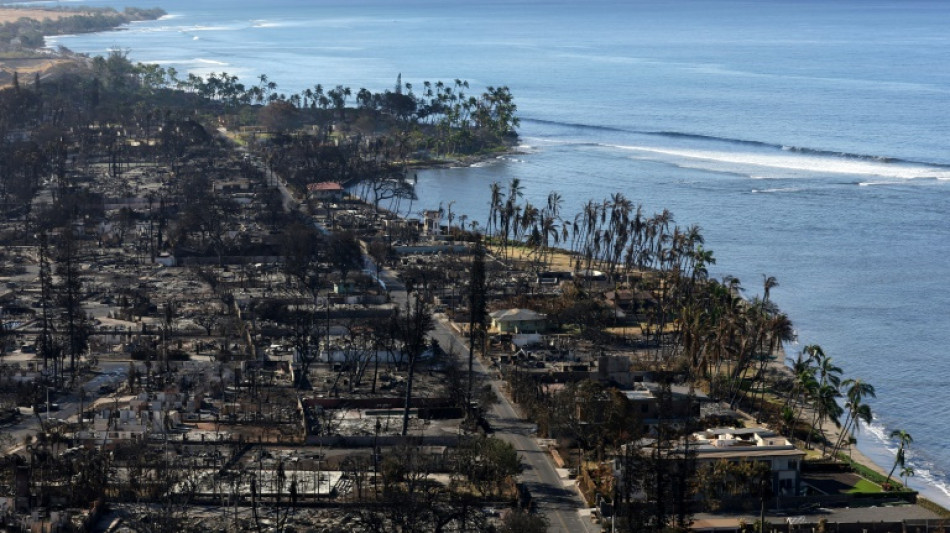
Hawaii wildfire tragedy was 'years in the making,' probe says / Photo: © GETTY IMAGES NORTH AMERICA/AFP

 Arizona Superintendent Tom Horne to Leave Office, Plans Law Practice and Charter School

 Japan and Peru Mark 150 Years of Diplomatic Ties Amidst Trade and Investment Talks

 Ian Jackson Scores Game-High 22 Points After Rick Pitino's Prank Suspension

 Khan Welcomes Milburn’s Youth Employment Reforms Amid High NEET Rates

 Shinde Clarifies Torn Photo Controversy Amid Sonia Gandhi Book Protest

 BMW i3 vs Mercedes C-Class Electric vs Hyundai Ioniq 6: The Ultimate Premium EV Showdown

 BING X: 22,624.66 SNC have disappeared at BingX – how safe are tokens on BingX? Will BingX’s MiCAR licence be suspended?

 Urban Company Raises Rs 2,500 Crore via QIP to Expand InstaHelp
The scale of a tragic wildfire that swept through a Hawaiian island last year, killing over 100 people, was the result of a complex interaction of factors that were "years in the making," an official report said Friday.
Downed power lines are believed to have set fire to vegetation on the holiday idyll of Maui on August 8, with the rapidly spreading blaze leveling the historic town of Lahaina.
Fast moving flames caught islanders unaware, with some people only learning there was a fire when they saw it for themselves, leading to criticism that authorities had mishandled the disaster.
Days after the blaze and amid fierce criticism that the island's warning sirens had not been sounded, the head of Maui's emergency management agency resigned.
The second phase of a report ordered by the state's attorney general was published Friday, and concluded that a confluence of factors and institutional failings had contributed to the heavy toll in both life and property.
"The devastation caused by the Lahaina fire cannot be connected to one specific organization, individual, action or event," said Steve Kerber of the Fire Safety Research Institute, an independent agency appointed by the state to examine the disaster.
"The conditions that made this tragedy possible were years in the making," he told reporters in Honolulu on Friday.
The report said local governments, businesses and the population at large did not sufficiently understand the risk from wildfires, often ignoring so-called "red-flag" days when wind conditions allow a fire to spread rapidly.
It also concluded that infrastructure standards, including how communities are planned, were decades out of date, and insufficient attention was paid to keeping populated areas free of combustible vegetation that feeds fires.
And it said the emergency response to the blaze once it broke out was uncoordinated.
"Maui county incident management operations... consisted of a siloed command structure that contributed to a lack of communication both to the public and responding agencies," the report said.
The report, which was published online alongside more than 850 gigabytes of material collected during the investigation, comes just over a year after the blaze, the deadliest wildfire in the United States in at least a century.
A mammoth legal settlement announced last month between victims' representatives and a coalition of the state of Hawaii, Maui County, and Hawaiian Electric will see $4 billion paid out for losses.
Hawaii Governor Josh Green has previously said recovery from the devastation will cost $12 billion and could take years.
Attorney General Anne Lopez said the report issued Friday was not intended to lay blame, but instead to improve the way that Hawaii as a whole prepares for extreme events.
She said the over 100 recommendations it made were timely because of the growing threat from fires, whose ferocity and prevalence is being exacerbated by human-caused climate change.
"There have been over 1,500 wildfire ignitions requiring a department response since August 8, 2023, of those, seven... resulted in significant fires," she told reporters.
"I think the risk is real and it's a present danger, and climate change will only continue to make these things worse."
B.Wyler--VB