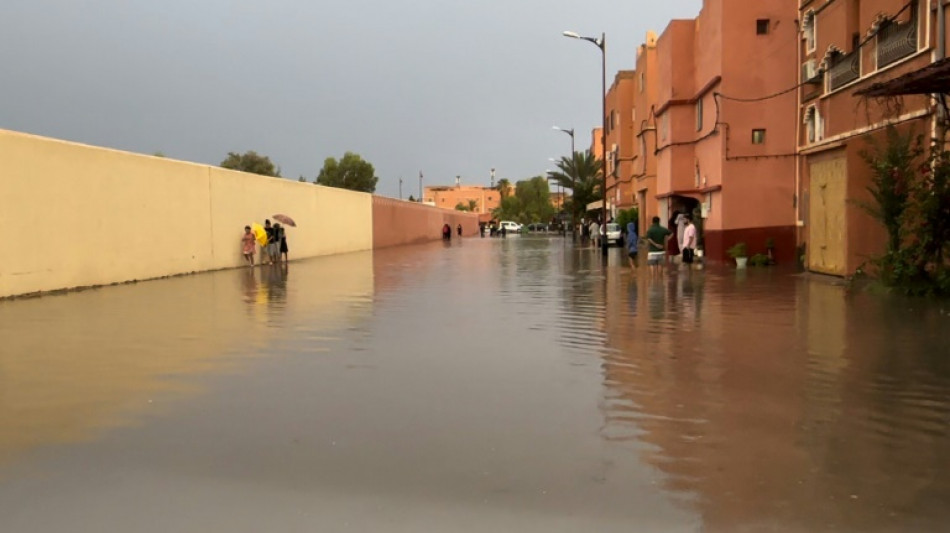
Deadly floods bring relief to Moroccan farmers / Photo: © AFP/File

 Arizona Superintendent Tom Horne to Leave Office, Plans Law Practice and Charter School

 Japan and Peru Mark 150 Years of Diplomatic Ties Amidst Trade and Investment Talks

 Ian Jackson Scores Game-High 22 Points After Rick Pitino's Prank Suspension

 Khan Welcomes Milburn’s Youth Employment Reforms Amid High NEET Rates

 Shinde Clarifies Torn Photo Controversy Amid Sonia Gandhi Book Protest

 BMW i3 vs Mercedes C-Class Electric vs Hyundai Ioniq 6: The Ultimate Premium EV Showdown

 BING X: 22,624.66 SNC have disappeared at BingX – how safe are tokens on BingX? Will BingX’s MiCAR licence be suspended?

 Urban Company Raises Rs 2,500 Crore via QIP to Expand InstaHelp
When powerful thunderstorms hit Morocco's arid south, they brought deadly floods but also provided some relief to farmers as the country grapples with its worst drought in nearly 40 years.
The torrential rains at the weekend triggered floods that killed at least 18 people in areas of southern Morocco that straddle the Sahara desert.
While the rain was devastating in part, it also brought some relief to farmers growing crops like almonds, dates and cereals.
"These rains will bring a breath of fresh air" to the south, said agronomist Mohamed Taher Srairi.
"But it has not rained elsewhere, and the country remains under a heavy structural drought."
The unusual rainfall resulted from a tropical air mass shifting northward, according to Lhoussaine Youabd, spokesman for Morocco's General Directorate of Meteorology.
Experts say climate change is making extreme weather, such as storms and droughts, more frequent and intense.
Morocco is one of the world's most water-stressed nations, with frequent droughts affecting a third of the population employed in agriculture.
Near areas of the northwest African country lashed by the weekend's rain, water levels in dams have risen and groundwater is expected to replenish.
The four Draa Oued Noun dams, which supply areas impacted by the floods in the Ouarzazate region, saw water levels increase by 19 percent to 191 million cubic metres, according to Youssef Ben Hamou, director of the agency managing the barrages.
The region of Ouarzazate, located in Morocco's south, sits between the Atlantic Ocean, the Atlas Mountains and the Sahara.
Water levels of the large Ouarzazate dam climbed to 69 million cubic metres, roughly 70 percent of its capacity, while levels at the Fask dam rose by 10 million cubic metres in just 24 hours.
- Rains bring hope -
"The rains have proved to be a boon for the region, because these reserves will be able to ensure drinking water supply which remains a priority," said Ben Hamou.
Mohamed Jalil, a water resources consultant, said the downpours would help to replenish soil saturation levels, although that usually requires rainfall over time after a long drought.
"This will bring respite to the oases, particularly for agriculture," he said.
The psychological impact of the long-awaited rains was also significant, he said, especially after a harsh, dry summer.
The massive rainfall had "brought hope" to the drought-hit area, he said.
The Moroccan government has pledged financial aid to the flooded areas.
During a visit to Ouarzazate this week, Agriculture Minister Mohammed Sadiki announced the allocation of $4.1 million to repair damaged infrastructure, support agriculture and help those affected by the floods.
Although no further downpours are expected in the immediate future, climatologists warn that Morocco must better prepare for weather disasters driven by global warming.
Moroccans should be ready "for new phenomena whose frequency and violence are unknown, given the effects of climate change", said Mohamed Said Karrouk, a climatology professor at Hassan II University in Casablanca.
F.Mueller--VB