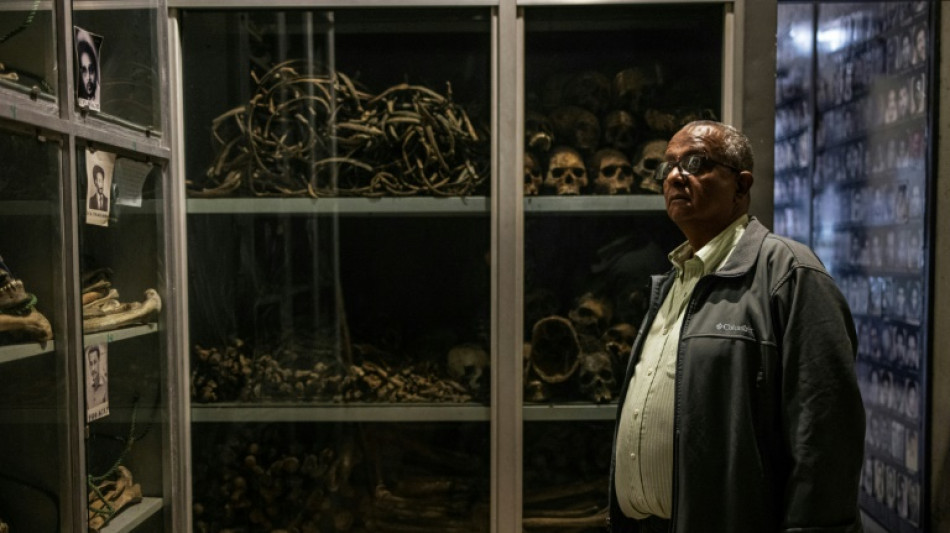
'Justice not done' 50 years after Ethiopia revolution / Photo: © AFP

 Voting opens in Alaska's annual Fat Bear Week

 MLS coach axed for telling female ref 'It's a man's game'

 US refuses to give Sudan's de facto leader visa for UN
 Man City hold Bayern to start Women's Champions League, Arsenal win late

 Trump threatens Iran with 'hell' but reveals fresh talks
 Trump signs security deal with Greenland, Denmark at UN
 Trump threatens Iran with 'hell' but unveils fresh talks

 Chile's Atacama Desert blossoms with life after El Nino rains

 Sri Lanka hands 220-year jail terms to 15 convicted of Easter bombings

 Typhoon Dujuan leaves 7 dead in Japan from landslides, flooding: media

 Ganna and Borghini lead Italy to mixed relay gold at cycling worlds

 Drug cocktail killed former child star Hayden Panettiere: coroner
 Moldova declares energy, water emergency
 French Holocaust denier jailed for eight months

 Oil prices slide, AI stock buzz fades
 Trump threatens to 'annihilate' Iran in bombastic UN speech
 Prada's skirts take centre stage as Milan Fashion Week begins
 Quoin Pharmaceuticals Announces FDA Fast Track Designation for QRX003 for the Treatment of Peeling Skin Syndrome
 Brazil's Flavio Bolsonaro turns scandal into poll gains
 Republican senator seeks probe of Trump Jr Russian-funded wedding
 Memoir by Diana's brother goes on sale after rocking UK monarchy
 Newcomers South Korea face holders Italy in Davis Cup finals

 Japan's Kojima sounds Marchand warning with Asian Games gold

 England rugby star Pollock signs new Northampton deal
 STARTRADER Expands Its Chinese Equity CFD Range with CXMT and Unitree Robotics

In his apartment in Ethiopia's capital, Ermias Woldeamlak stares at the photos of his three older brothers, all of them killed during a period of military terror a generation ago.
"Elias was 20 or 21, Thomas was 19, Berhan was 18," he says.
Half a century has passed, "but I still feel very sad," Ermias adds. "I remember it as fresh as something that happened yesterday."
Thursday marks 50 years since a Marxist-Leninist military junta known as the Derg seized power in Ethiopia, overthrowing Emperor Haile Selassie and a monarchy that had ruled Ethiopia for 700 years.
Tens of thousands died at the hands of the new regime, which ruled with callous brutality until its own overthrow in 1991.
Its 87-year-old leader Mengistu Haile Mariam lives on quietly in Zimbabwe despite being convicted of genocide and sentenced to death in absentia in 2008.
For Ermias, that impunity is impossible to stomach.
Without the extradition of the regime's "greatest criminal", and without financial reparations for the victims' families, "justice has not been done", said the 64-year-old documentary filmmaker.
- 'I saw a lot of killing' -
Ermias was just a teenager when the revolution happened.
Initially led by left-wing students, it was quickly overtaken by the army which established the Provisional Military Administration Council (its local acronym spells Derg) on September 12, 1974.
Ermias's brothers were among the young rebels in the Ethiopian People's Revolutionary Party (EPRP) who tried to seize back control from the army.
The clashes triggered the rise of Mengistu, a hardline colonel, to the leadership in 1977, and unleashed a two-year period of brutal repression that became known as the "Red Terror".
Ermias's oldest brother, Elias, was arrested in November 1976 after being found in their grandmother's home with red paint -- illegal because it was used for rebel slogans.
Elias spent months in prison and was tortured, his brother says.
The family would regularly bring him food and clothes until one day in March 1977, the prison guards said they should no longer bother coming.
The next brother Thomas was executed on the steps of a church in Addis Ababa and his body put on public display as a warning.
The family only learned of the death of Berhan, who had been in hiding, after the fall of the Derg in 1991.
Ermias says he was also imprisoned and tortured after being caught with pro-rebel leaflets.
He was often left hanging with his feet and hands bound to a wooden stick, an excruciating position that left him with pain in his arms for years afterwards.
"I saw a lot of killing," he recalls. "I remember seeing bodies of people who were with me the night before (who had been) taken out and killed.
"Those things, you can't forget."
- 'Tens of thousands' murdered -
The exact scale of the Derg's crimes remains unknown.
Jacob Wiebel, a historian at Durham University in Britain who specialises in the subject, says "tens of thousands" were murdered, and many more tortured.
Dozens of the junta's leaders were later convicted for rights abuses, but the trials "were insufficiently funded, drawn out and lacking in due process," Wiebel told AFP.
Zimbabwe refuses to extradite Mengistu and in 2011, many Derg leaders saw their death sentences commuted to life imprisonment, including such notorious figures as Legesse Asfaw, known as the "Butcher of Tigray", a region in northern Ethiopia that suffered particular repression.
Ermias says he wishes that Ethiopia could follow the example of Rwanda where trials over the 1994 genocide encompassed not just leaders, but many lower-level perpetrators.
Nor, he says, have Ethiopian leaders made any real effort to help victims work through their trauma with a Truth and Reconciliation Commission or offer any kind of financial compensation.
He worries this has allowed Ethiopia to fall back into war and ethnic division in recent years.
"The extent and the way it's happening is different, (but) if people don't learn from history, they repeat the same mistakes," he said.
S.Spengler--VB