App helps Mexican tortilla makers join digital economy / Photo: © AFP

 Russia probes bear attacks, as official says town under 'siege'

 Robertson tells Spurs to 'forget' past woes

 Italy police find 3 million euros stashed in mobster's house
 Renard versus Queiroz in AFCON qualifying blockbuster

 Former Mexico boss Aguirre returns to Spain with Valencia

 China swimmer, 13, seals Games hat-trick as North Korea win first gold

 China's Xi heads to US for talks with Trump: state media

 Azerbaijan pardons Frenchman after EU lifts sanctions on oligarchs

 Hadjar extends Red Bull contract for 2027 F1 season

 Black Sea drone attacks spell terror for Turkish sailors

 Canada judge to decide prison term for suicide poison seller

 Weinstein faces resentencing in New York for 2006 sex assault

 Outgoing UN chief makes climate push at New York summit
 AI risks, Iran war to take center stage at UN
 Badminton no.1 An tells dad to keep it down at Asian Games

 Runaway leader Antonelli eyeing third straight win

 Schoolgirl Yu, 13, fastest again in bid for third Asian Games gold

 Oil prices fall after Trump hails 'good' talks with Iran

 AI political ads warp reality ahead of US midterms

 Kenneth Branagh embraces action hero role -- to get in shape

 'New one' Klopp promises fresh approach as Germany reign begins

 Milne returns to New Zealand squad for India T20 series

 US-led Americas coalition backs sanctions against crime groups

 'Star Wars' fans and art lovers line up for new Lucas museum

 Trump renames AI 'super intelligence' as leaders jostle over dangers

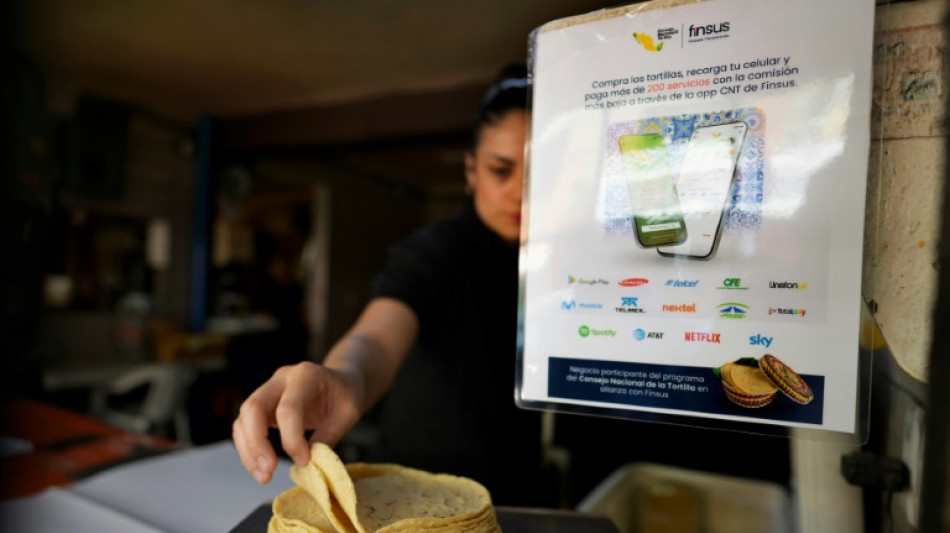
Long marginalized by the banking industry, Mexico's neighborhood tortilla producers are cautiously embracing financial technology, in a country where cash is still king for many.
The National Tortilla Council and technology firm Finsus have developed a mobile application that allows vendors of the staple food to charge customers using cards, QR codes or a cellphone number.
"It's revolutionizing the industry," said the organization's president, Homero Lopez Garcia, whose ambitious goal is for 90 percent of tortilla makers to use the app within three years.
The feedback from those who have tried it has been positive: "They say 'I like it, I understand it'," he said.
The hope is that the app will also enable tortilla producers to generate additional income by offering their clients cellphone top-up and bill payment services.
For many, the app is their first link to the formal financial industry.
Only around half of Mexico's 129 million inhabitants have a bank account and most tortilla shops operate informally.
Although it is still in the testing phase, the app is already making life easier for tortilla producer Abel Garcia, who has been in the business for 25 years.
The 60-year-old said that he started out using family savings after failing to get a bank loan, and now owns several stores.
"It was difficult to get credit -- very, very difficult!" Garcia said, in the working-class district of Iztapalapa.
His success finally gave him access to banks, but with restrictions that put him off using them.
"That's why we tore up the checkbook," he said.
- Informal economy -
Tortillas are consumed by millions of Mexicans every day and an estimated 110,000-135,000 businesses are involved in their production, according to official and industry figures.
Most of them operate in the informal economy, as do many Mexican workers.
Mexico City for example is home to around 18,000 tortilla shops, according to the national statistics institute INEGI.
But only around 10 percent of them are legally registered, figures from City Hall show.
Without access to the formal financial system, many of them prefer dealing in cash.
A 2021 survey by the banking regulator CNBV found that 64 percent of Mexicans preferred notes and coins over debit or credit cards.
Maria Adelaida Francisco, who works in a tortilla shop in Mexico City, had never used a financial application until her boss Jorge Ramirez suggested she try the new one.
Now the 40-year-old uses it to pay her electricity bill, she said.
Some tortilla producers avoid banks for fear of paperwork or debts.
"They're a bit scared of the tax issue or they don't know about it," said Ramirez, 35.
Several of his eight employees now use the application to collect their salaries.
The change reflects a wider embrace of financial technology in Latin America's second-largest economy.
According to a study by the Inter-American Development Bank and the venture capital company Finnovista, Mexico is home to 20 percent of the region's financial technology ventures, behind only Brazil.
The number of fintech startups in Latin America and the Caribbean increased more than four-fold between 2017 and 2023, to 3,069 across 26 countries, the report said.
Despite the advances, the financial inclusion of Mexico's tortilla makers is still "zero," Lopez Garcia, the National Tortilla Council president, said.
"The banks don't believe in the industry," he said.
T.Germann--VB