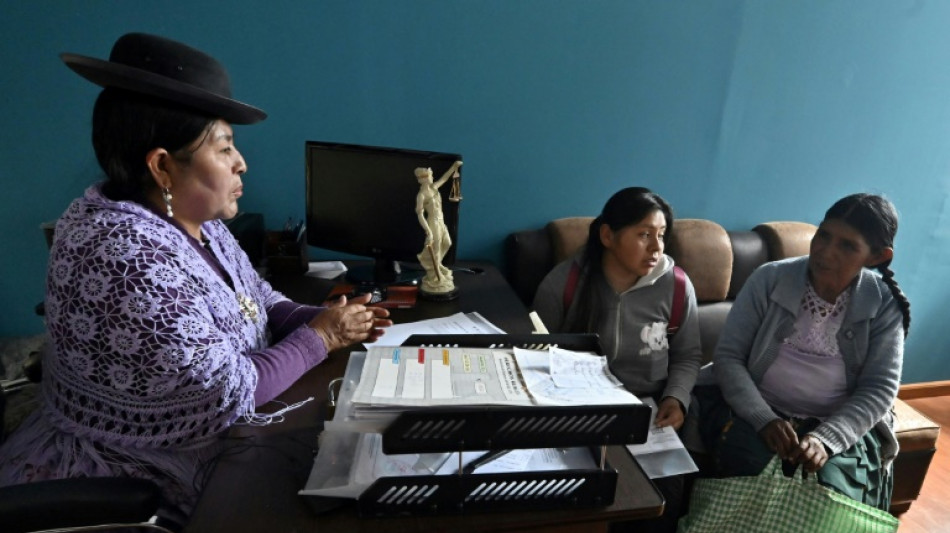
Bolivian lawyer defends Indigenous women in their language / Photo: © AFP

 Ukraine claims US missile holdup ahead of reported talks

 Niners hold off Commanders to stay perfect in NFL

 Tech firms bear brunt of selling as Asian stocks drop

 Reese scores 30 as Dream stun Valkyries to level WNBA finals

 Horror and disbelief after lawmaker attacked in rural Australia

 Ukraine races to secure energy supplies ahead of winter

 Vote count begins in Alberta secession referedum, testing Canada unity
 Ukraine claims US missile holdup as Trump floats summit without Zelensky

 Detained Suu Kyi receives UK royal package: Myanmar govt

 Japan successfully launches probe in historic Mars moon mission

 US to auction deep sea mining leases off American Samoa

 Australian lawmaker hurt in car attack underwent surgery overnight: PM

 Japan launches rocket for potential world first Mars moon mission
 Ethiopia PM warns Eritrea of 'severe consequences' if supports enemies

 Boland grabs opportunity for Australia as South Africa struggle in second Test

 Ronaldo handed 30-day suspension: Portuguese federation

 France announces curfews as government grapples with unrest

 Boland sets pace as South Africa struggle
 Ukraine on back foot as Kremlin moots US, China meeting
 'Stay home!': Tourists find themselves in a France convulsed by protests

 Kenyan cult leader guilty on all charges over 191 starvation deaths

 Eagles star Hurts to miss rest of NFL season: reports

 Oil-rich Alberta votes on Canada breakup

 Israel announces arrests after West Bank settler attacks on Westerners
 Guehi insists players have 'trust and belief' in Man City after charges

Bertha Aguilar is harvesting potatoes on the shores of Lake Titicaca when her phone rings.
On the line, a woman speaking in the Indigenous Aymara language explains that she was beaten up by her brothers-in-law in a land dispute and needs a lawyer.
Aguilar, Aymara herself, is on the case.
The 56-year-old mother-of-two is one of the rare lawyers in Bolivia who represents women who only speak Aymara, the country's third most-used language after Spanish and Quechua.
"It's different when you speak to them in Aymara, they are better able to tell you what happened to them," Aguilar says as she tucks her phone away and returns to her harvest.
The Aymara represent 9.6 percent of Bolivians. And although the country counts 36 recognized languages, court proceedings are only held in Spanish and there is no obligation to provide an interpreter.
For the 41 percent of the population who identify as Indigenous, some of whom speak only their mother tongue, this is a barrier to justice.
"We would like to know how many judges and prosecutors speak an Indigenous language," said Lucia Vargas of the Women's Coordinator group of feminist NGOs.
"If the Aymara do not understand Spanish, they have greater difficulty understanding the complexity of a judicial process that is in Spanish."
- 'All kinds of bruises' -
Aguilar proudly dons the traditional shawl, hat, and pollera -- a long woolen skirt -- worn by Aymara women, even when she is in court.
Most of her clients are women, many seeking her counsel after experiencing a wide range of sex-based violence.
"I have seen all kinds of bruises, punches in the eye, in other words, all kinds of abuse," she told AFP.
Although there are no statistics on Indigenous victims of gender-based violence, "the Aymara world... is part of a national reality where there is a strong tradition of machismo since time immemorial," said historian Sayuri Loza.
In 2023, Bolivia registered 51,000 complaints of physical, sexual, psychological and economic abuse against women. The cases include 81 femicides, according to data from the prosecutor's office.
- 'They defended the man' -
Aguilar decided to become an attorney after experiencing stigma and discrimination at home and within the legal system.
She suffered physical violence and economic abuse at the hands of her ex-husband, a descendant of the Aymara people who grew up in the city and was university educated.
He and his family would often insult her, she said, using derogatory terms aimed at Indigenous women.
They separated in 2005, but it was a struggle to find a lawyer who would handle her divorce.
She said she spoke to "about four, but I couldn't make myself clear... and they defended the man."
Aguilar herself only learned to speak Spanish informally after moving to La Paz at the age of 16 from her home in Chachapoya, 170 kilometers (105 miles) away.
A few years after her divorce, she entered the Public University of El Alto, a city adjacent to the Bolivian capital, where she obtained her law degree in 2012, studying in Spanish.
Only 10 percent of the almost 800,000 women who identify as Aymara in Bolivia access higher education, according to a study by the Catholic University.
- Divorce to property spats -
Now, Aguilar has a small office in front of the El Alto Court of Justice, with a sign outside reading: "If I am not in, call."
When she is not litigating, she tends to her small farm in Chachapoya, but she never rejects an incoming call.
"In the courts ... there are many women who cannot speak Spanish," she said.
She is currently handling 40 cases, from women in divorce proceedings to property conflicts, among others.
"Nayax aka divorciox doctorat mistunap munta" -- (I want that divorce to come through), client Silveria Palle, 57, says in Aymara, desperate to escape a partner who has beaten her for years.
Aguilar has the same message for all of her clients: "If I escaped the abuse... why can't you?
U.Maertens--VB