Dozens dead in Papua New Guinea tribal violence / Photo: © ROYAL PAPAU NEW GUINEA CONSTABULARY/AFP

 Melania Trump says secured ceasefire in Ukrainian city of Oleshky

 Carrick 'confident' he can turn around Man Utd slump
 PSG v Lyon French Ligue 1 game postponed due to Paris protests

 Meghan Markle 'distressed' over claims father had child abuse images

 Gunman kills one, wounds four in town outside Paris

 France to deploy 70,000 police ahead of new protests

 Mekies hails Verstappen as Red Bull's driving force amid revival
 Tanker with Russian diesel heads to New York under Trump deal

 New centre puts focus on Portuguese dictator Salazar's legacy

 Oil nears $115 with stocks mixed on earnings, AI

 Asian football endorses Infantino re-election in apparent U-turn

 Ukraine says two soldiers died after arrested girl sent Russian poison

 New Greece law bans social media for under-15s

 Netanyahu orders West Bank closure as attack wounds Israelis before election

 Asian stocks mixed ahead of weekend as tech recovers early losses
 How five Boeing 777s linked Madagascar's power elite to Iran
 South Korea proposes holding border talks with North
 Ukraine's young figure skaters twizzle on despite Russian threat
 Asian football endorses Infantino re-election as FIFA president

 Complete Kane hopes for 'special night' as Ballon d'Or rumours swirl

 Rooney calls United squad 'selfish babies' after Fernandes criticism

 Teddy Wilson, son of World Cup-winner David, gets Wallabies call-up

 New Zealand military chief resigns over 'inappropriate relationship'

 Man Utd's Carrick on borrowed time, free-scoring Brighton face Liverpool
 Asian stocks head into weekend on a low as tech extends losses

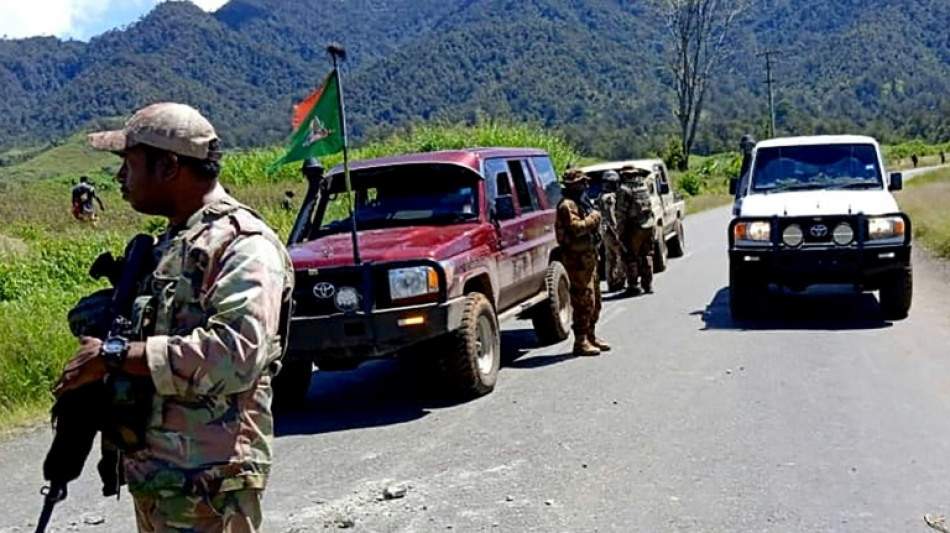
Dozens of bloodied bodies have been found along a remote stretch of road in Papua New Guinea's highlands, police said Monday, a gruesome escalation of long-running violence between warring clans.
Police said as many as 64 tribal fighters had been killed in an ambush by a rival group in the early hours of Sunday, although officials later said the number was still unclear.
The incident occurred near the village of Wapenamanda, about 600 kilometres (370 miles) northwest of the capital Port Moresby.
The rugged and lawless area has been the scene of tit-for-tat mass killings between rival Sikin, Ambulin, Kaekin and other tribesmen for years -- with each retaliatory attack fuelling a fresh round of atrocities.
Graphic police images from the scene showed dozens of stripped and bloodied bodies lying by the side of the road and piled up on the back of a flatbed truck.
Some men had limbs hacked and were left naked by the road with beer bottles or cans placed on their chests.
Police reported gunfights were ongoing in nearby valleys and bodies were still being recovered, leading to confusion about the number of people killed.
Senior police and cabinet officials said the toll was between 49 and 64 tribesmen.
"The total number of dead and injured is still being assessed as police recover further remains from dense scrubland," Police Commissioner David Manning said late Monday.
Describing the incident as a "disgraceful act of barbarity", Manning said additional security personnel had been deployed to the area to restore order.
"These personnel have clear instructions that are to use any level of force required to prevent further violence and payback," he said.
"This includes the use of up to deadly force when the lives of civilians or security personnel are threatened."
- Mass killings -
Clans have fought each other in Papua New Guinea's highlands for centuries, but an influx of mercenaries and automatic weapons has made clashes more deadly and escalated the cycle of violence.
Police said the gunmen had used a veritable armoury, including SLR, AK-47, M4, AR15 and M16 rifles, as well as pump-action shotguns and home-made firearms.
The province's acting police commander Patrick Peka said many of the dead were believed to be mercenaries -- men who roam the countryside offering to help tribes settle scores with their rivals.
"The police and government cannot do much when leaders and educated elites supply arms, ammunitions and engage the services of gunmen from other parts of the province," Peka said.
Papua New Guinea's government has for years tried suppression, mediation, gun amnesties and a range of other strategies to control the violence, with little success.
The military had deployed to the area but their impact has been limited and the security services remain outnumbered and outgunned.
Police privately complain that they do not have the resources to do the job, with officers so badly paid that some of the weapons that end up in the hands of the attackers have come from the police force.
- 'Very disturbing' -
The murders are often extremely violent, with victims hacked with machetes, burned, mutilated or tortured.
Civilians, including pregnant women and children, have been targeted in the past in a cycle of retaliatory violence that has stretched over years.
Local member of parliament Miki Kaeok called for a state of emergency to be declared.
"Hundreds of lives have been lost. Properties worth millions... have been ransacked and destroyed. I don't want this to continue. It must stop now," he said.
The killings come at a difficult time for Prime Minister James Marape following deadly January riots in the capital Port Moresby and the city of Lae that prompted opponents to launch a motion of no confidence in his leadership.
Papua New Guinea's population has more than doubled since 1980, placing increasing strain on land and resources and deepening tribal rivalries.
Anthony Albanese, the prime minister of neighbouring Australia, described the incident as "very disturbing" and said on Monday Canberra would "provide whatever support we can."
P.Staeheli--VB