Hawaii's deadly wildfire: what we know / Photo: © AFP

 Ayuso happy to fly under radar at Tour de France

 Curran ready to fill England gap left by Stokes exit

 Djokovic has history on the line at Wimbledon

 Hamilton sparkles in Silverstone sunshine

 Swift and Kelce set to tie the knot in glitzy arena extravaganza

 Police hunt for Ukrainian woman over Monaco bomb attack

 Kenya's abortion taboo is killing thousands of women

 Madonna returns to form with dancefloor filler "Confessions II"

 Dean says Australia final a 'fresh start' for England

 Wimbledon giving Serena 'as much time' as possible for doubles

 Chinese investors flock to Hong Kong as trading curbs tighten
 Projected 'super typhoon' heads for US Pacific islands

 UN warns of strong looming El Nino
 Hunt for last signs of life in Venezuela quake zone

 Asian markets rise as beaten-down tech stocks enjoy bounce

 David v Goliath as Cape Verde face Messi's Argentina at World Cup

 Nagelsmann quits as Germany coach after World Cup exit: reports

 All Blacks return to Christchurch 'a blessing', says Savea

 'Not a museum': Slovak UNESCO village strains under tourism

 DR Congo opposition builds against presidential third-term bid
 China sports brands score NBA stars to assist global ambitions

 Man dies after setting self ablaze outside UN in New York: police

 VAR 'taking joy' from football says Croatia coach Dalic after loss
 Afghans come home but risk exclusion without any ID

 'Coincidence of life' says Ronaldo after Jota tribute a year from death

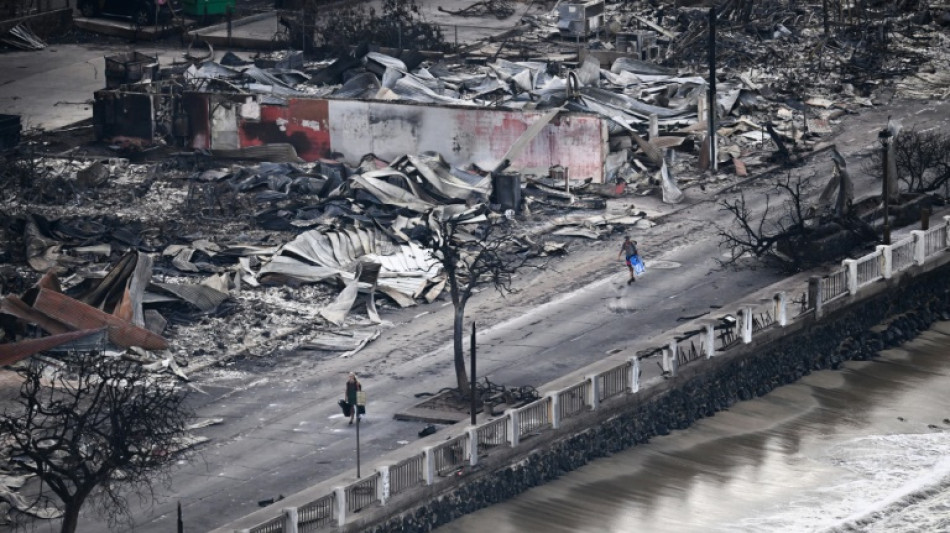
The terrifying wildfire that destroyed a historic Hawaiian town seems to have caught many occupants unaware.
Here's what we know about the fire that razed Lahaina, a town on Maui's west coast popular with tourists, and why it was so deadly.
- How did the fire start? -
A brush fire was initially reported in the Lahaina area around 6:30 am Tuesday, sparking a limited evacuation.
Maui County officials said the blaze was contained a few hours later, but warned high winds had brought down power lines, and electricity was out. The county said on Facebook the cause of the blaze was under investigation.
By late afternoon, the fire was reported to have flared up again, forcing an evacuation warning for some residents, with others "advised to shelter in place."
Over the following hours the fire spread, and near midnight, Maui County was warning all people living in West Maui to stay where they were, unless ordered to evacuate.
- Why were people caught unaware? -
Residents say panic spread through Lahaina as flames began to appear in neighborhoods that were previously untouched.
Claire Kent described scenes of panic as people in the town realized they had to leave immediately.
"It was all just word of mouth, like people running down the street saying 'you need to get out.'
"There were guys riding around on bicycles, just screaming at people to leave."
By Wednesday morning, much of Lahaina lay in ruins.
Crystal Kolden, a fire specialist at the University of California, Merced, said residents appeared to have had no notice that there was a dangerous blaze.
People's "first inkling that there's a fire outside their house is to see flames through the windows. And it's too late," Kolden said, according to the Los Angeles Times.
"It's very different than... the vast majority of wildfires involving evacuations for most of the 20th century (that) are slow enough moving, where people have several hours, sometimes even days, to evacuate."
- Why did the fire spread so quickly? -
The western side of Maui doesn't get much rain because it is sheltered by an extinct volcano, but this year has been particularly dry.
The way it is used has also changed.
"The rural land to the east of Lahaina was once intensely managed plantations, with irrigation ditches and terracing," said Thomas Smith, a specialist in Environmental Geography at the London School of Economics.
Farmed land would have been fire resistant -- frequently watered and without long-established plants.
But "since most of this land has been abandoned, long grasses, shrubs and young trees had taken root, substantially increasing the amount of flammable vegetation surrounding the town."
So whatever sparked the blaze, it had plenty of fuel to burn through.
Crucially, powerful winds were whipping the island, fueled by a hurricane churning in the ocean hundreds of miles (kilometers) to the southwest.
The island's topography -- the volcano slopes down towards Lahaina -- was also a significant factor.
"Downslope winds are dry and warm, further reducing the moisture in the vegetation and driving more extreme fire behavior," said Smith.
- Has climate change played a part? -
The unchecked burning of fossil fuels since the start of the industrial revolution has released billions of tonnes of planet-warming gases into the atmosphere.
This has caused higher average global temperatures -- the Earth just experienced its hottest month ever -- which in turn is changing our weather patterns.
While wildfires are a natural phenomenon, scientists say our warming atmosphere is making disasters like these worse.
"Climate change is leading to warmer atmosphere everywhere, which has more drying power," said Yadvinder Malhi, Professor of Ecosystem Science at the University of Oxford.
"So the same fire that would have been moderate a few decades ago will be more intense now."
D.Schneider--BTB