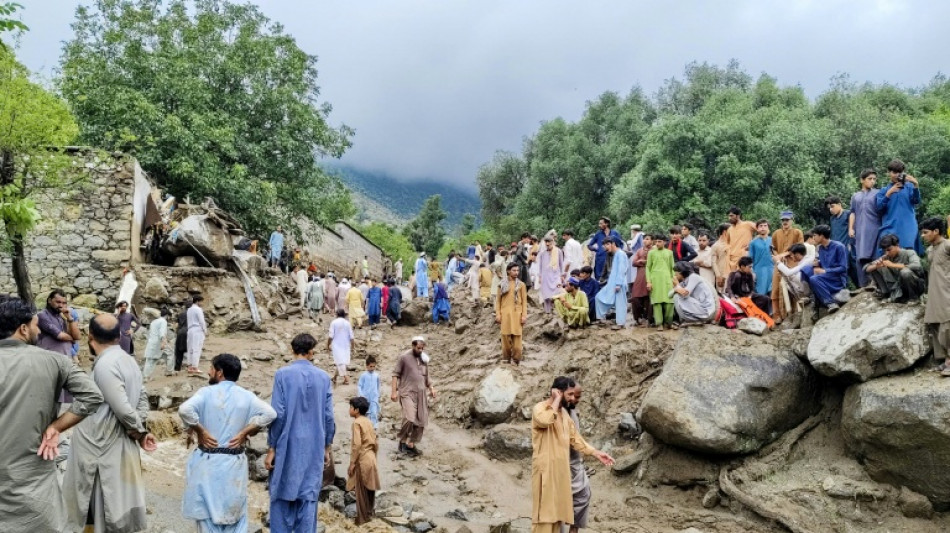
'Doomsday' monsoon rains lash Pakistan, killing almost 200 people / Photo: © AFP

 North Korea touts dog soup and other home-cooked recipes to beat the heat

 UK observatory nervously watches growing space junk threat

 Meta ordered to pay US state $567 mn to abate 'public nuisance' and child harm

 Houthi missile attacks kill 58 Saudi-backed Yemeni govt forces: source

 No.1 Sabalenka and Pegula advance at Toronto

 China missile test top of agenda as Pacific diplomats meet in Fiji

 Most UK teens to opt out of planned social media curfew: poll

 Venezuela's political transition talks launch in Caracas

 2 killed, 13 wounded in bus blast near Syrian capital: state media

 All Blacks skipper Taylor cautiously recovering from calf strain

 UN chief denounces Russia, Ukraine for civilian deaths

 UEFA turn up the pressure on Infantino and repeat boycott threat

 Rodri approves Barcelona transfer talks with Man City: Barca source to AFP

 Venezuela unable to tally missing from cataclysmic quakes
 Le Court sprints to stage six Tour de France Femmes win

 Doping body says Parker's positive cocaine test caused by nutritionist

 UEFA says boycott of World Cups stands despite FIFA backdown on private investment

 Rheinmetall sales keep surging despite cancelled naval frigate project

 Pogacar teammate Del Toro gets new UAE deal after Tour podium
 Stocks tread water with earnings, tech in focus

 Forex Expo Dubai Announces Opportunity to Win Up to 150 Grams of Gold This September 2026

 Forlan named new Uruguay head coach

 UEFA chief Ceferin: 'Underdog' leader taking fight to FIFA's Infantino

 Salah completes move to Turkey's Trabzonspor
 UK clears Paramount's takeover of Warner Bros

Landslides and flash floods triggered by heavy monsoon rains across northern Pakistan have killed at least 199 people in the past 24 hours, national and local officials said on Friday.
Of those killed, 180 were recorded in the mountainous Khyber Pakhtunkhwa province, where one resident likened the disaster to "doomsday".
Another nine people were killed in Pakistan-administered Kashmir, along with five in the northern Gilgit-Baltistan region, the National Disaster Management Authority said.
Most were killed in flash floods and collapsing houses, with the dead including 19 women and 17 children. At least 28 others were injured.
Another five people, including two pilots, were killed when a Khyber Pakhtunkhwa government helicopter crashed due to bad weather during a relief mission, the province's chief minister, Ali Amin Gandapur, said in a statement.
The provincial government has declared the severely affected mountainous districts of Buner, Bajaur, Mansehra and Battagram disaster-hit areas.
In Bajaur, a tribal district abutting Afghanistan, a crowd gathered around an excavator digging through a mud-soaked hill, AFP photos showed.
Funeral prayers began in a paddock nearby, with people grieving in front of several bodies covered by blankets.
"I heard a loud noise as if the mountain was sliding. I rushed outside and saw the entire area shaking, like it was the end of the world," Azizullah, a resident of Buner district, where there have been dozens of deaths and injuries, told AFP.
"I thought it was doomsday," he said.
"The ground was trembling due to the force of the water, and it felt like death was staring me in the face," said Azizullah who, like many in the region, uses only one name.
The meteorological department has issued a heavy rain alert for Pakistan's northwest, urging people to avoid "unnecessary exposure to vulnerable areas".
In the Indian-administered part of Kashmir, a region divided with Pakistan, rescuers pulled bodies from mud and rubble on Friday after a flood crashed through a Himalayan village, killing at least 60 people and washing away dozens more.
- Prolonged monsoon -
The monsoon season brings South Asia about three-quarters of its annual rainfall, vital for agriculture and food security, but it also brings destruction.
Landslides and flash floods are common during the season, which usually begins in June and eases by the end of September.
Syed Muhammad Tayyab Shah, a representative of the national disaster agency, told AFP that this year's monsoon season began earlier than usual and is expected to end later.
"The next 15 days... the intensity of the monsoon will further exacerbate," he said.
The provincial government has declared Saturday a day of mourning, chief minister Gandapur said.
"The national flag will fly at half-mast across the province, and the martyrs will be laid to rest with full state honours," the statement from his office said.
Scientists say that climate change has made weather events around the world more extreme and more frequent.
Pakistan is one of the world's most vulnerable countries to the effects of climate change, and its population is contending with extreme weather events with increasing frequency.
The torrential rains that have pounded Pakistan since the start of the summer monsoon, described as "unusual" by authorities, have killed more than 500 people, including 159 children.
In July, Punjab, home to nearly half of Pakistan's 255 million people, recorded 73 percent more rainfall than the previous year and more deaths than in the entire previous monsoon.
Monsoon floods in 2022 submerged a third of the country and killed around 1,700 people.
T.Germann--VB