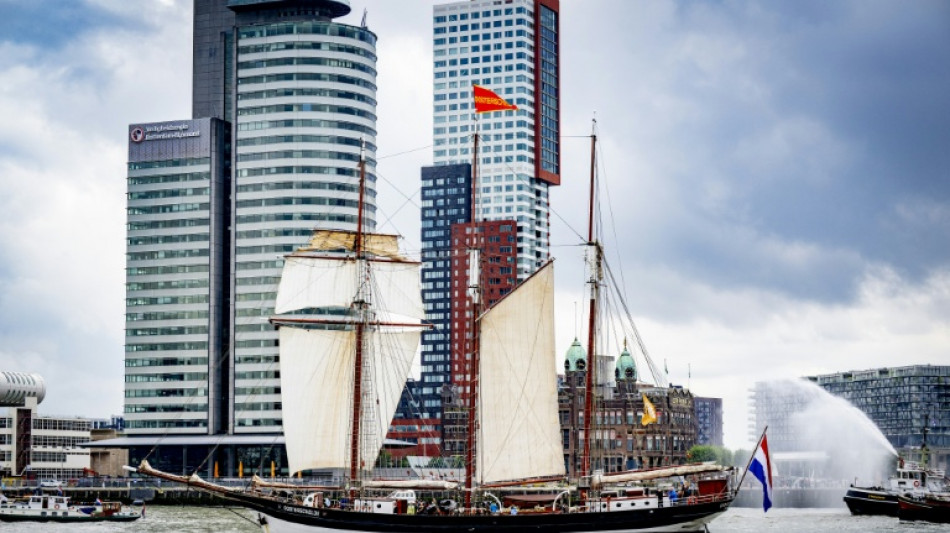
In Darwin's wake: Two-year global conservation voyage sparks hope / Photo: © ANP/AFP

 Ukraine's Zelensky visits Russian ally Serbia as Moscow pounds Kyiv

 Ukraine's Zelensky visits Russian ally Serbia for talks
 Defending champion Shelton storms to Montreal win

 Exodus: West Bank hardships drive out Palestinian Christians

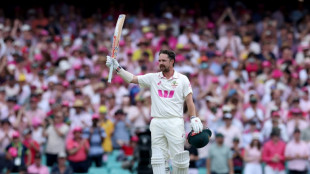 Travis Head wins Australian cricketer of the year gong

 Colombia's new president vows to 'defeat narco-terrorists'

 Call for Infantino to resign comes amid wave of support

 Trump ally Abelardo de la Espriella sworn in as Colombia president

 FIFA chief Infantino gets backing of South American football

 Amazon behind massive private gas plant for new data centers

 Apple and OpenAI escalate legal battle over devices

 All Blacks strike late to secure opening win against Stormers

 Saudi Arabia, Turkey, Pakistan sign defence pact amid regional war

 Trump renews effort to remove US Fed Governor Lisa Cook

 Abelardo de la Espriella, the flamboyant millionaire taking power in Colombia

 Germany holds security meeting over explosive drone amid Russia protest

 Austrian writer Stefan Zweig, who fled Nazis, honoured in London
 Mexico and Peru reestablish ties after asylum spat
 Dollar drops, stocks climb as weak US jobs data eases rate fears

 Japan defender Tomiyasu joins Crystal Palace

 Celtic boss O'Neill out of hospital after 'small procedure'

 Man City reject Barcelona bid for Rodri - reports
 US unexpectedly loses jobs in blow to Trump ahead of midterms

 Dollar drops, stocks climb after surprise US jobs miss

 Thai students in disbelief after deadly school shooting

After a two-year around-the-world ocean voyage inspired by Charles Darwin, scientists and crew sailed home on a historic vessel into Rotterdam Thursday bearing a warning about climate change -- but also a message of hope.
The majestic three-masted Oosterschelde, the last remaining vessel from a fleet of Dutch schooners that criss-crossed the globe in the early 20th century, arrived to a welcome befitting a voyage of more than 40,000 nautical miles (74,000 kilometres, 46,000 miles).
Ceremonially escorted by more than a dozen vessels ranging from tall ships to steamships, all blaring horns, the Oosterschelde received a "water cannon salute" from fire service boats, as hundreds waved and cheered from the banks.
Like Darwin in 1831, the Oosterschelde departed the British port of Plymouth in August 2023 to embark on a voyage of discovery that took in the major stops explored during the British naturalist's world-changing mission aboard the HMS Beagle.
From the Falkland Islands to the southern tips of Africa, South America and Australia, the trip closely shadowed Darwin's voyage that inspired his groundbreaking theory of natural selection described in "On the Origin of Species".
Aboard the Oosterschelde at various points of the voyage were some of the world's best young conservationists, 100 scientists aged 18-25, selected to study a species also observed by Darwin, himself aged 22 at the time of his trip.
Giant tortoises, Chilean dolphins, and howler monkeys were just some of the weird and wonderful creatures the young "Darwin Leaders" investigated, tracking changes since their appearance in "Origin of Species" two centuries ago.
With "online classrooms" onboard and slick social media output, the mission also hoped to inspire a new generation around the message: "Conservation isn't about what we've lost, it's about protecting what we still have."
- 'Barely anything left' -
One of the Darwin Leaders, 23-year-old Lotta Baten, spent a week on the ship and conducted a study into the impact of tourism on forests in Tenerife, Spain.
She said only roughly four percent of the forest that Darwin would have seen from the Beagle is still alive today, with much torn down to support the tourism industry.
"There's barely anything left, mainly the strips around the coast," the Dutch-German scientist told AFP.
She said it was "quite something" to follow in the footsteps of Darwin, but noted that the botanist's legacy is divided, as a European in colonial times.
"He basically explored and discovered things that maybe had already been explored and discovered by people at the places themselves. And then he claimed he discovered them," said Baten.
Science co-ordinator Rolf Schreuder admitted that "it's not a rosy picture", with habitat loss and climate change all transforming the environment beyond what Darwin would have recognised.
"You see the natural world degrading in many places," the 55-year-old told AFP.
But Schreuder, like many on board, found the mission inspiring rather than depressing.
He ran more than 100 local projects during the trip with people seeking to preserve their landscapes.
"We met so many great people that are actually on the ground working on the survival of those species," he said.
He found himself inspired too by the young scientists, "full of ideas, full of commitment and determination to really make a difference."
- 'Do another tour' -
Crew member Daan van Roosmalen was a boy of 17 when he set sail on the Oosterschelde. He returned to his native Netherlands having just turned 19.
"I've just been to so many places. To the Galapagos Islands, French Polynesia. We went so far away and to then sail back up this river and see the skyline of Rotterdam again is just super special," he told AFP.
He said he hoped the round-the-world voyage completed by scientists and crew his age would send a message to his generation.
"I think it's very important that we keep inspiring young people to look after our world, because we are going to be the ones taking over," he said.
"So to see all these young conservationists putting so much effort in Mother Earth... I think that should inspire more people to also take care of our planet."
And what of Darwin, the inspiration behind the mission?
"I would say he would have been enthused by his fellow young people taking care of this natural world, which he described so nicely," said Schreuder.
"I think he would hop on this boat again and do another tour."
G.Frei--VB