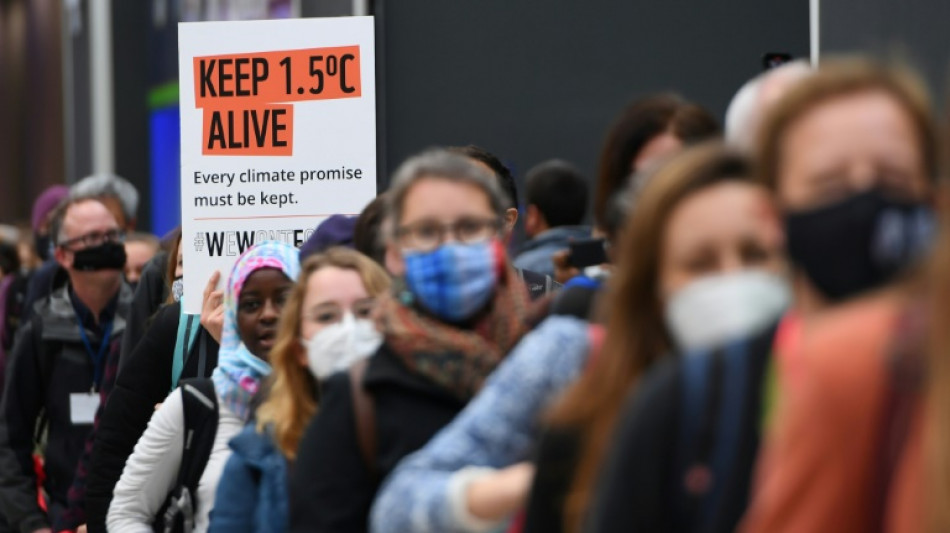
Top climate scientist declares 2C climate goal 'dead' / Photo: © AFP/File

 UK chalks up hottest summer on record for second year running

 China's Xi visits Egypt as US sanctions threat looms over Iran links

 RISE Robotics Awarded $100,000 MassVentures Grant to Accelerate Commercialization of Beltdraulic Technology

 Global bond sell-off deepens on inflation concerns

 Germany's far-right AfD promises 'boom' but economists fear worst

 Former England captain Stokes signs for Adelaide Strikers

 Pakistan selector and ex-captain Misbah resigns after coach sacked

 Shein flattens on Hong Kong debut facing global headwinds

 Eurozone inflation hits three-year high at 3.3% in August
 Man City chase Fernandez, Arsenal eye Alvarez on deadline day

 El Nino hammering Peru anchovy fishing: industry officials

 Mass Russian barrage kills 12 in Kyiv

 PineX Capital Launches MetaTrader 5 as Prop Firm Expands Trading Platform Offering
 Women survivors face sanitation woes in Nepal relief camp

 Oil extends gains, stocks mixed as Trump issues fresh Iran warning

 Thai resort readies for US carrier's 5,000 sailors

 AI startup Manus says resumes independent operations

 'Massive' Russian missile, drone attack on Kyiv kills 8
 Defence tech hub Munich booms as Europe rearms

 Nigeria rethinks criminalisation of suicide

 Osaka channels NBA icon Iverson to reach US Open second round

 Fast-fashion giant Shein plunges 10% on Hong Kong debut

 South Korea hire former Spain boss Moreno as interim coach

 China-Taiwan friction clouds Pacific summit

 Two dead after stabbing in New York's Times Square

Holding long-term global warming to two degrees Celsius -- the fallback target of the Paris climate accord -- is now "impossible," according to a stark new analysis published by leading scientists.
Led by renowned climatologist James Hansen, the paper appears in the journal "Environment: Science and Policy for Sustainable Development" and concludes that Earth's climate is more sensitive to rising greenhouse gas emissions than previously thought.
Compounding the crisis, Hansen and colleagues argued, is a recent decline in sunlight-blocking aerosol pollution from the shipping industry, which had been mitigating some of the warming.
An ambitious climate change scenario outlined by the UN's climate panel, which gives the planet a 50 percent chance of keeping warming under 2C by the year 2100, "is an implausible scenario," Hansen told a briefing Tuesday.
"That scenario is now impossible," said Hansen, formerly a top NASA climate scientist who famously announced to the US Congress in 1988 that global warming was underway.
"The two degree target is dead."
Instead, he and co-authors argued, the amount of greenhouse gases already pumped into the atmosphere by burning fossil fuels meant increased warming is now guaranteed.
Temperatures will stay at or above 1.5C in the coming years -- devastating coral reefs and fueling more intense storms -- before rising to around 2.0C by 2045, they forecast.
They estimated polar ice melt and freshwater injection into the North Atlantic will trigger the shutdown of the Atlantic Meridional Overturning Circulation (AMOC) within the next 20–30 years.
The current brings warmth to various parts of the globe and also carries nutrients necessary to sustain ocean life.
Its end "will lock in major problems including sea level rise of several meters -- thus, we describe AMOC shutdown as the 'point of no return,'" the paper argued.
The world's nations agreed during the landmark Paris climate accord of 2015 to try to hold end-of-century warming to 1.5C above pre-industrial levels.
Scientists identified the threshold as critical to preventing the breakdown of major ocean circulation systems, the abrupt thawing of boreal permafrost, and the collapse of tropical coral reefs.
The 1.5C target has already been breached over the past two years, according to data from the EU's climate monitoring system Copernicus, though the Paris Agreement referred to a long-term trend over decades.
At 2C, the impacts would be even greater, including irreversible loss to Earth's ice sheets, mountain glaciers and snow, sea ice and permafrost.
The authors acknowledged the findings appeared grim, but argued that honesty is a necessary ingredient for change.
"Failure to be realistic in climate assessment and failure to call out the fecklessness of current policies to stem global warming is not helpful to young people," they said.
"Today, with rising crises including global climate change, we have reached a point where we must address the problem of special interests," they added, stressing they were "optimistic" for the future.
R.Fischer--VB