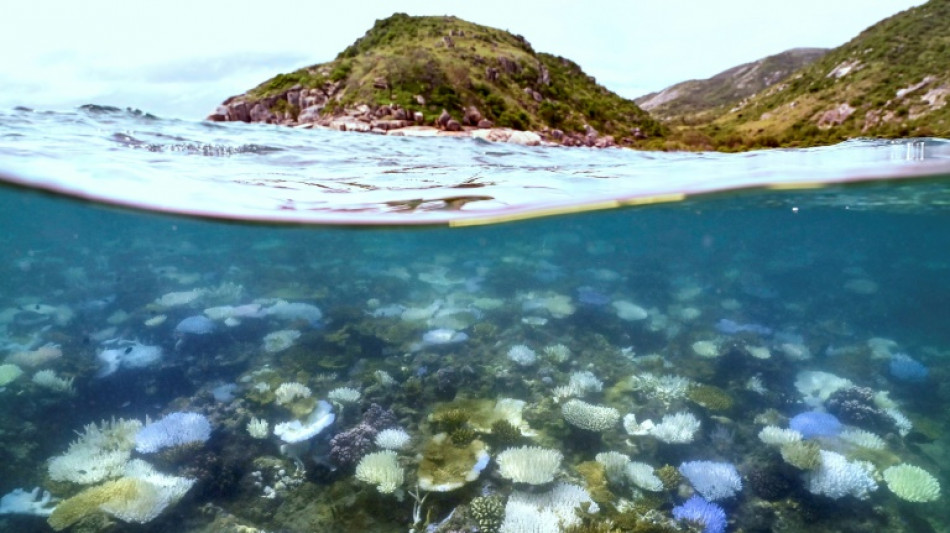
Nearly half of tropical coral species face extinction: report / Photo: © AFP/File

 Leftwing opposition seen leading Sweden election, far-right losing ground

 Senegal goalkeeper Mendy retires from international football

 Carrick 'worried' by decision to award Man City winner

 Lobotka eases pressure on Allegri with Napoli winner

 Trump watches as Lowry wins Irish Open in record-breaking style

 Poland, Ukraine slam Russian strikes near border as 'escalation'

 Haaland fires 10-man Man City to memorable win over Man Utd

 I miss the adrenaline, but it's not my moment - Bolt

 Championship leader Antonelli to 'keep pushing' for title

 Yamal double helps Barca edge Levante thriller

 Brighton run rampant against 10-man Coventry
 Late Mbappe goal sends Lille top of Ligue 1

 Five-star Brighton crush 10-man Coventry

 Team Europe beat United States to reclaim Solheim Cup

 US House Speaker warns curbing AI too sharply could leave China ahead

 張國榮70歲誕辰音樂會西九舉行 唐鶴德錄音致意

 Iran's economic ties to Dubai hard to break despite war

 iPhone 18預購後出現可疑扣款 四間銀行調查未授權交易

 《浪花男女》辦特別謝票場 馮志強談票房與導演客串拍攝

 Former captain De Villiers hails 'fantastic' Springboks

 Galaxy Tab S12系列效果圖曝光 Ultra擬配雙鏡頭及瀏海螢幕

 فليك يضم حمزة عبد الكريم إلى قائمة برشلونة بعد أربعة أهداف في الإعداد

 بزشكيان يؤكد رفض الاستسلام وسلطات إيران تعلن مقتل شخص في استهداف سفينة

 Altman tells Fortune OpenAI will not go public in 2026
 China, Russia, India seek economic cooperation at BRICS

Almost half of all warm-water species of coral are threatened with extinction -- and climate change is the chief culprit, a new report said on Wednesday.
The updated risk assessment from the International Union for Conservation of Nature (IUCN) was announced at the COP29 climate summit in Azerbaijan, which is being skipped by the leaders of many top polluting nations.
Oceans have absorbed around 90 percent of the excess heat in the atmosphere due to the release of carbon dioxide and other greenhouse gases.
Rising ocean temperatures have spurred mass bleaching events at coral reefs across the world, threatening crucial ecosystems for marine life as well as the livelihoods of people who rely on them.
The updated assessment of the IUCN's Red List of Threatened Species looked at reef-building corals, which live in warm, shallow waters in tropical areas.
Its analysis found that 892 reef-building coral species are now considered threatened, representing 44 percent of the total.
This marked a significant increase from the last assessment in 2008, when a third of all species was listed as threatened.
The organisation is still assessing the extinction risk for cold-water coral, which lives in deeper, darker ocean waters, making it difficult to study.
The IUCN called on negotiators at the COP29 conference to act quickly to reduce planet-heating fossil fuel emissions.
"Healthy ecosystems like coral reefs are essential for human livelihoods -- providing food, stabilising coastlines, and storing carbon," IUCN chief Grethel Aguilar said in a statement.
"Climate change remains the leading threat to reef-building corals and is devastating the natural systems we depend on."
As well as global warming, pollution, disease, unsustainable fishing and agricultural runoff also threaten the world's coral.
Most reef-building coral is found across the Indo-Pacific region, such as Australia's Great Barrier Reef which suffered one its worst-ever bleaching events this year.
The IUCN's updated assessment included results from a study about reef-building coral in the Atlantic Ocean, which was published in the PLOS One journal on Wednesday.
That study found that almost one in three -- or 23 out of 85 -- species of Atlantic coral is critically endangered, more than previously thought.
Staghorn coral and elkhorn coral were given as examples of two critically endangered species in the Caribbean that have been hit hard by warming waters, pollution -- and hurricanes.
"Without relevant decisions from those with the power to change this trajectory, we will see the further loss of reefs, and progressive disappearance of coral species at larger and larger scales," warned IUCN coral specialist David Obura.
E.Gasser--VB