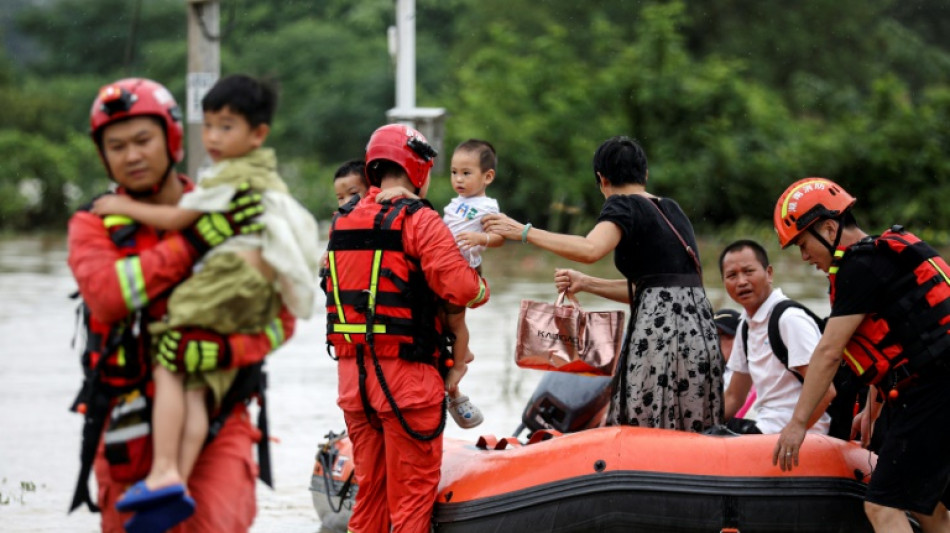
Climate change fuelled deadly Typhoon Gaemi: study / Photo: © AFP

 EU calls Russia 'reckless' after flares fired at Danish helicopter

 US Treasury chief says to meet Chinese counterpart at weekend

 Trump slams 'horrible' Supreme Court mail-in ballot ruling

 Brazil's crisis-hit Supreme Court probes judge's ties to jailed banker

 Sterling admits dangerous driving after Lamborghini crash

 Ambassador to Thailand plays down anti-Israeli protests

 BingX Evolves into a Multi-Asset Trading Platform, Connecting Users to Global Opportunities

 Flick supporting 'self-confident' Yamal Ballon d'Or bid

 As Ballon d'Or vote nears, stars campaign for the award

 Markets on edge as US Fed meets to tackle high inflation

 International Trading Institute Expands Professional Trader Development Beyond the Master’s in Trading

 Nairobi to host 2029 world athletics championships in African first

 Ukraine winemakers defy war to make a splash at home

 Prominent Greek neo-Nazi exits prison, vows return to politics: AFP

 Saudi Arabia vows to respond 'firmly' to Houthi attacks

 'We unleashed the beast': the world's fears and hopes about AI

 Carragher sees Manchester City’s winning start as challenge to Arsenal

 Oasis fans weigh ticket costs and reunion memories ahead of 2027 tour

 EastEnders previews Kat’s grief after Zoe’s death

 US military confirms Iran war has led to munitions shortfall

 SkySail Strategies Outperforms Wall Street's 30-Year Risk Standard With Proprietary AI Inference Model

 Canada ends refugee family sponsorship exemption over integrity concerns

 Berlin's run-down public spaces at heart of election campaign

 Ribeiro and Richie among celebrity birthdays for September 20–26

 Bob Mackie, costume designer for Cher and Madonna, dies aged 87

Climate change turbocharged the winds and rain of Typhoon Gaemi, which killed dozens of people across the Philippines, Taiwan and China earlier this year, a group of scientists said Thursday.
Gaemi skirted the Philippines in July, triggering floods and landslides that killed at least 40 people, before making landfall in Taiwan and China.
In China, the weather system caused torrential downpours that killed 50 people and prompted authorities to evacuate 300,000.
World Weather Attribution (WWA), a network of scientists who have pioneered peer-reviewed methods for assessing the role of climate change in extreme events, looked at three regions worst affected by the typhoon: the northern Philippines, Taiwan and China's Hunan province.
It found the system's wind speeds were seven percent more intense due to man-made climate change, and its rainfall was 14 percent heavier in Taiwan and nine percent heavier in Hunan.
The study could not draw definitive conclusions about the role of climate change on the rainfall in the Philippines, because of the region's complex monsoon rain patterns.
Still, they found the warm seas that helped form and fuel Typhoon Gaemi "would have been virtually impossible" in a world that had not warmed to the current 1.2 Celsius above pre-industrial levels.
And the group's modelling found this warming has already increased the number of similarly strong storms by 30 percent -- up from around five a year to six or seven.
"This study confirms what we've expected –- hotter seas and atmospheres are giving rise to more powerful, longer-lived and deadlier typhoons," said Ralf Toumi, director of the Grantham Institute-Climate Change and the Environment, at Imperial College London.
Teasing out the impact of climate change on tropical cyclones is complicated, but scientists are focusing more work on these weather systems.
WWA's method involves assessing how unusual an extreme event is, then modelling the likelihood of a similar event and its intensity in two scenarios: today's world, and one without current levels of warming.
The scientists used that method and a new approach developed by Imperial College London that is tailored specifically to tropical storms.
It uses computer modelling to overcome the relative lack of historical data on tropical cyclones.
While the Asia-Pacific region has long dealt with typhoons, the scientists warned that their work highlighted "gaps in typhoon preparedness and the massive impacts caused by Gaemi."
They called for better urban flood management and targeted warnings that offer more information on the likely impacts of a storm.
The study was released as Typhoon Shanshan made landfall in Japan, which issued its highest level warning for wind and storm surges.
F.Stadler--VB