Athens faces new dangers as forest fires edge closer / Photo: © AFP

 EU calls Russia 'reckless' after flares fired at Danish helicopter

 US Treasury chief says to meet Chinese counterpart at weekend

 Trump slams 'horrible' Supreme Court mail-in ballot ruling

 Brazil's crisis-hit Supreme Court probes judge's ties to jailed banker

 Sterling admits dangerous driving after Lamborghini crash

 Ambassador to Thailand plays down anti-Israeli protests

 BingX Evolves into a Multi-Asset Trading Platform, Connecting Users to Global Opportunities

 Flick supporting 'self-confident' Yamal Ballon d'Or bid

 As Ballon d'Or vote nears, stars campaign for the award

 Markets on edge as US Fed meets to tackle high inflation

 International Trading Institute Expands Professional Trader Development Beyond the Master’s in Trading

 Nairobi to host 2029 world athletics championships in African first

 Ukraine winemakers defy war to make a splash at home

 Prominent Greek neo-Nazi exits prison, vows return to politics: AFP

 Saudi Arabia vows to respond 'firmly' to Houthi attacks

 'We unleashed the beast': the world's fears and hopes about AI

 Carragher sees Manchester City’s winning start as challenge to Arsenal
 Oasis fans weigh ticket costs and reunion memories ahead of 2027 tour

 EastEnders previews Kat’s grief after Zoe’s death

 US military confirms Iran war has led to munitions shortfall

 SkySail Strategies Outperforms Wall Street's 30-Year Risk Standard With Proprietary AI Inference Model

 Canada ends refugee family sponsorship exemption over integrity concerns
 Berlin's run-down public spaces at heart of election campaign

 Ribeiro and Richie among celebrity birthdays for September 20–26

 Bob Mackie, costume designer for Cher and Madonna, dies aged 87

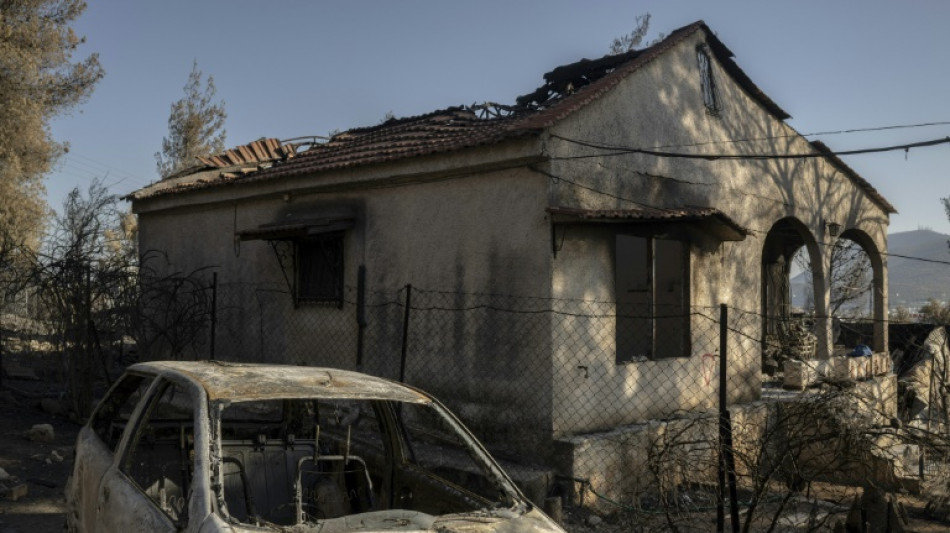
With the smell still lingering in its suburbs after Greece's worst wildfire this year, floods and pollution now threaten Athens, experts say.
Thousands were forced to flee their homes as the massive blaze raged out of control for three days towards the capital earlier this month, swallowing up houses and cars and killing one woman.
Fanned by strong winds, the inferno that began at Varnavas, 40 kilometres (25 miles) northeast of Athens, reached suburbs at the foot of Mount Penteli, devastating some 10,000 hectares (24,700 acres).
With more than a third of the Mediterranean country's population of 10 million crammed into the capital's region of Attica, and the fires edging closer and closer to the city, experts are warning that the situation is becoming critical.
The National Observatory says 37 percent of forests around Athens have been consumed by fire over the past eight years alone.
"Attica has lost most of its forest, and now there is imminent danger for the people of Athens, in terms of polluted environment and risk of flooding" from soil erosion, said Alexandros Dimitrakopoulos, of the Aristotle University of Thessaloniki.
"Where 100 years ago there were vigorous forests of pines, now forest vegetation is of weak and low pines and evergreen shrubs," the professor of forest fire science told AFP.
Fire meteorologist Theodore M. Giannaros, of the National Observatory, said the situation is aggravated by the "torrential rainfalls which unfortunately we are getting quite frequently".
He warned of soil erosion and flash floods which "I believe we will face during the coming winter".
Dimitrakopoulos said the loss of the forests will push Greece's already sweltering summer temperatures higher. This year the country saw its hottest June and July on record.
- 'Repeatedly burnt' -
Scientists say human-caused fossil fuel emissions are increasing the length, frequency and intensity of global heatwaves, raising the risk of wildfires.
"Attica can't lose more forest," fire ecology expert Dimitris Kazanis told AFP.
"The percentage is diminishing year by year. A solution must be found.
"In an area with so much cement, so many roads, so much noise, we need forests," said the lecturer from the National and Kapodistrian University of Athens.
But the frequent fires are impacting the forest's ability to regenerate.
The Varnavas blaze struck an area covered by Aleppo pine -- a species that has evolved to cope with fire but which requires at least 15 to 20 years between fires to regenerate naturally.
"The area burnt has experienced many fire events in the past, some in very frequent intervals," said ecology professor Margarita Arianoutsou, also of the National and Kapodistrian University.
"This has already caused a serious problem. There are patches repeatedly burnt which need our intervention in order to be restored."
Reforestation and fire prevention studies were among measures unveiled this month by Prime Minister Kyriakos Mitsotakis.
- Pines 'demonised' -
Some have called for the planting of other types of trees altogether, as pines burn very quickly because of their naturally flammable resin.
But forester Nikos Georgiadis, from the World Wide Fund for Nature, said people "have demonised the pines".
"If nature decides that the pines must be there, it's not easy to change."
The trick is to create a more resilient, mixed forest -- with some broadleaf or less flammable species -- and build green belts, said Georgiadis.
"You try to set these zones around settlements, so as to protect both forest and humans," he added.
Rather than blame the pines, experts fault the encroachment of urban areas into forest land.
"Where trees are burned, houses grow," said Dimitrakopoulos.
"It was very common in areas of high demand such as Athens... to burn forest in order to create land for construction," he said.
Most Greek fires are human-caused, through arson or neglect, he added.
Investigators believe a faulty electricity pole may have sparked the Varnavas fire.
"Where there are people, there is fire," said Dimitrakopoulos.
J.Marty--VB