'Alarming' rise in deadly lightning strikes in India: scientists / Photo: © AFP

 EU calls Russia 'reckless' after flares fired at Danish helicopter

 US Treasury chief says to meet Chinese counterpart at weekend

 Trump slams 'horrible' Supreme Court mail-in ballot ruling

 Brazil's crisis-hit Supreme Court probes judge's ties to jailed banker

 Sterling admits dangerous driving after Lamborghini crash

 Ambassador to Thailand plays down anti-Israeli protests

 BingX Evolves into a Multi-Asset Trading Platform, Connecting Users to Global Opportunities

 Flick supporting 'self-confident' Yamal Ballon d'Or bid

 As Ballon d'Or vote nears, stars campaign for the award

 Markets on edge as US Fed meets to tackle high inflation

 International Trading Institute Expands Professional Trader Development Beyond the Master’s in Trading

 Nairobi to host 2029 world athletics championships in African first

 Ukraine winemakers defy war to make a splash at home

 Prominent Greek neo-Nazi exits prison, vows return to politics: AFP

 Saudi Arabia vows to respond 'firmly' to Houthi attacks

 'We unleashed the beast': the world's fears and hopes about AI

 Carragher sees Manchester City’s winning start as challenge to Arsenal

 Oasis fans weigh ticket costs and reunion memories ahead of 2027 tour

 EastEnders previews Kat’s grief after Zoe’s death

 US military confirms Iran war has led to munitions shortfall

 SkySail Strategies Outperforms Wall Street's 30-Year Risk Standard With Proprietary AI Inference Model

 Canada ends refugee family sponsorship exemption over integrity concerns

 Berlin's run-down public spaces at heart of election campaign

 Ribeiro and Richie among celebrity birthdays for September 20–26

 Bob Mackie, costume designer for Cher and Madonna, dies aged 87

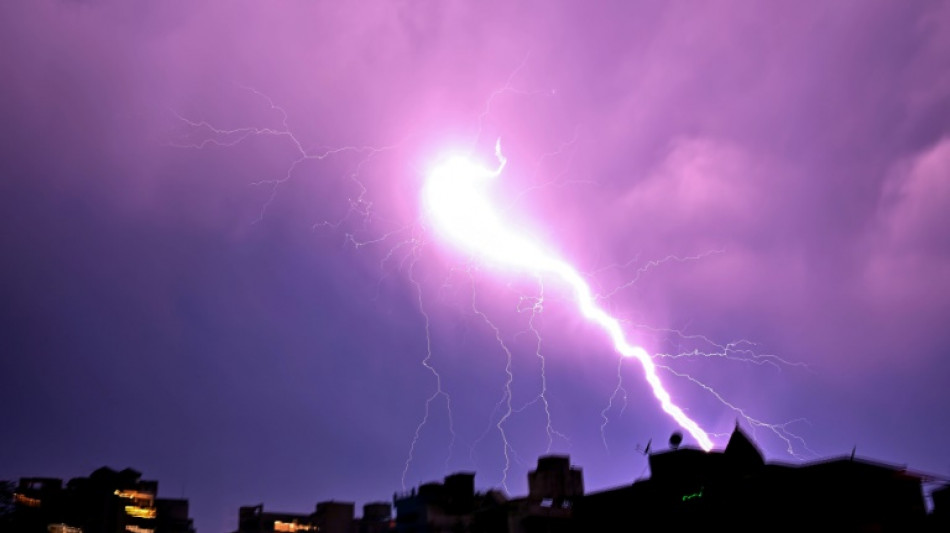
Climate change is fuelling an alarming increase in deadly lightning strikes in India, killing nearly 1,900 people a year in the world's most populous country, scientists warn.
Lightning caused a staggering 101,309 deaths between 1967 and 2020, with a sharp increase between 2010 and 2020, a team of researchers led by Fakir Mohan University in the eastern state of Odisha said.
"The results indicate a steady increase in lightning activity in India, positioning it as a major killer among climate change-induced natural disasters," it said.
While the report looked at data on deaths, not the number of strikes, it said "lightning activity in India is becoming increasingly unpredictable".
Data showed that the average annual fatalities per Indian state rose from 38 in the period 1967 to 2002, to 61 from 2003 to 2020 -- a period when the country's population has also rapidly grown to 1.4 billion people.
Lightning strikes are common in India during the June-September monsoon rains, which is crucial to replenishing regional water supplies.
But scientists say their frequency is increasing due to rising global temperatures, unleashing a cascade of extreme weather events.
Higher air temperatures create more water vapour, which after it cools at altitude, creates electric charges that spark lightning.
The high number of fatalities in India is also due to ineffective early warning systems and a lack of awareness of how to reduce the risk, the report added, published in the international journal of Environment, Development and Sustainability.
Mass fatalities from a single strike are common, such as when farmers shelter in groups from lashing rain under a tree.
The report said the data on recorded deaths from lightning indicates "an increasing trend, with the last two decades showing the highest increase", calling it "an alarming development".
The "rising trend of extreme climate conditions is likely to exacerbate the situation", it added, with a "pressing need" for policy changes to mitigate the impact.
K.Sutter--VB