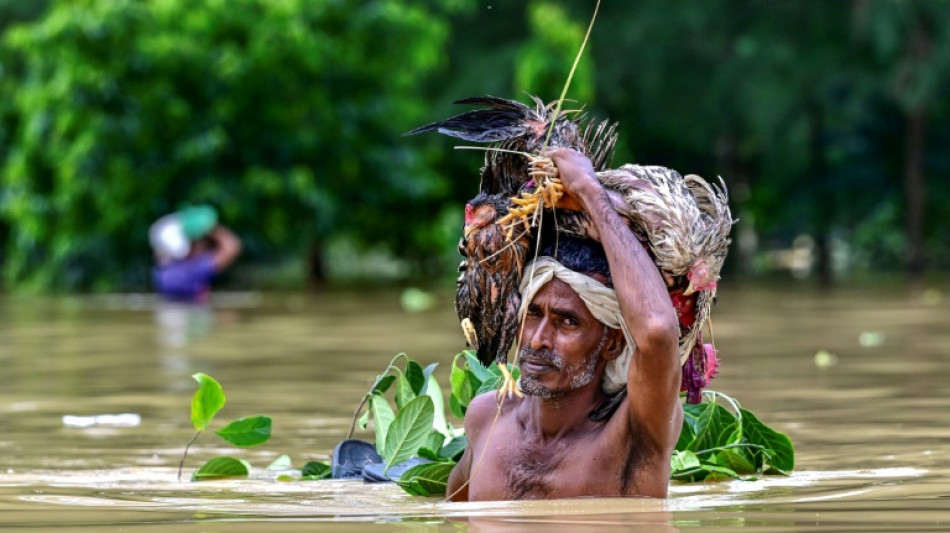
Nearly 300,000 Bangladeshis in emergency shelters after floods / Photo: © AFP

 EU calls Russia 'reckless' after flares fired at Danish helicopter

 US Treasury chief says to meet Chinese counterpart at weekend

 Trump slams 'horrible' Supreme Court mail-in ballot ruling

 Brazil's crisis-hit Supreme Court probes judge's ties to jailed banker
 Sterling admits dangerous driving after Lamborghini crash

 Ambassador to Thailand plays down anti-Israeli protests
 BingX Evolves into a Multi-Asset Trading Platform, Connecting Users to Global Opportunities

 Flick supporting 'self-confident' Yamal Ballon d'Or bid

 As Ballon d'Or vote nears, stars campaign for the award

 Markets on edge as US Fed meets to tackle high inflation

 International Trading Institute Expands Professional Trader Development Beyond the Master’s in Trading

 Nairobi to host 2029 world athletics championships in African first

 Ukraine winemakers defy war to make a splash at home

 Prominent Greek neo-Nazi exits prison, vows return to politics: AFP

 Saudi Arabia vows to respond 'firmly' to Houthi attacks

 'We unleashed the beast': the world's fears and hopes about AI

 Carragher sees Manchester City’s winning start as challenge to Arsenal

 Oasis fans weigh ticket costs and reunion memories ahead of 2027 tour

 EastEnders previews Kat’s grief after Zoe’s death

 US military confirms Iran war has led to munitions shortfall

 SkySail Strategies Outperforms Wall Street's 30-Year Risk Standard With Proprietary AI Inference Model

 Canada ends refugee family sponsorship exemption over integrity concerns
 Berlin's run-down public spaces at heart of election campaign

 Ribeiro and Richie among celebrity birthdays for September 20–26

 Bob Mackie, costume designer for Cher and Madonna, dies aged 87
Nearly 300,000 Bangladeshis were taking refuge in emergency shelters Saturday from floods that inundated vast areas of the low-lying South Asian country, disaster officials said.
The floods were triggered by heavy monsoon rains and have killed at least 42 people in Bangladesh and India since the start of the week, many in landslides.
"My house is completely inundated," Lufton Nahar, 60, told AFP from a relief shelter in Feni, one of the worst-hit districts near the border with India's Tripura state.
"Water is flowing above our roof. My brother brought us here by boat. If he hadn't, we would have died."
The nation of 170 million people is crisscrossed by hundreds of rivers and has seen frequent floods in recent decades.
Monsoon rains cause widespread destruction every year but climate change is shifting weather patterns and increasing the number of extreme weather events.
Highways and rail lines were damaged between the capital Dhaka and the main port city of Chittagong, making access to badly flooded districts difficult and disrupting business activity.
The flooding also comes just weeks after a student-led revolution toppled Bangladesh's government.
Among the worst affected areas is Cox's Bazar, a district home to around a million Rohingya refugees from neighbouring Myanmar.
Tripura state disaster agency official Sarat Kumad Das told AFP that 24 people had been killed on the Indian side of the border since Monday.
Another 18 had been killed in Bangladesh, according to disaster management ministry secretary Md Kamrul Hasan.
"285,000 people are living in emergency shelters," he said, adding that 4.5 million people in total had been affected.
- Recovering from unrest -
When the floods hit, Bangladesh was recovering from weeks of civil unrest that culminated in the August 5 toppling of autocratic ex-leader Sheikh Hasina.
With an interim government led by Nobel Peace Prize laureate Muhammad Yunus still finding its feet, ordinary Bangladeshis have been crowdfunding relief efforts.
They have been organised by the same students who led the protests that sparked the ouster of Hasina, who remains in India after fleeing Dhaka.
Crowds visited Dhaka University on Friday to offer cash donations as students loaded rice sacks and crates of bottled water onto vehicles for areas affected by the deluge.
Much of Bangladesh is made up of deltas where the great Himalayan rivers, the Ganges and the Brahmaputra, wind towards the sea after coursing through India.
Several tributaries of the two transnational rivers were still overflowing.
However, forecasts showed rain was likely to ease in the coming days.
- 'Creating a flood' -
India was Hasina's biggest patron and benefactor and many Bangladeshis have since been openly critical of their bigger and more powerful neighbour for backing her 15-year rule.
Asif Mahmud, a leader of the student protests who is now in Yunus' caretaker cabinet, accused India on Wednesday of "creating a flood" by deliberately releasing water from dams.
Hundreds of people also gathered at Dhaka University on Friday to protest against India's "water aggression", featuring a banner showing Indian Prime Minister Narendra Modi supposedly delighting at the sight of drowning people.
India's foreign ministry has rejected the charge, saying its own catchment area this week had experienced the "heaviest rains of this year" and that the flow of water downstream was due to "automatic releases".
The impact of floods remains severe in India's Tripura state, with around 65,000 people sheltering across 450 relief camps, according to local media reports.
H.Weber--VB