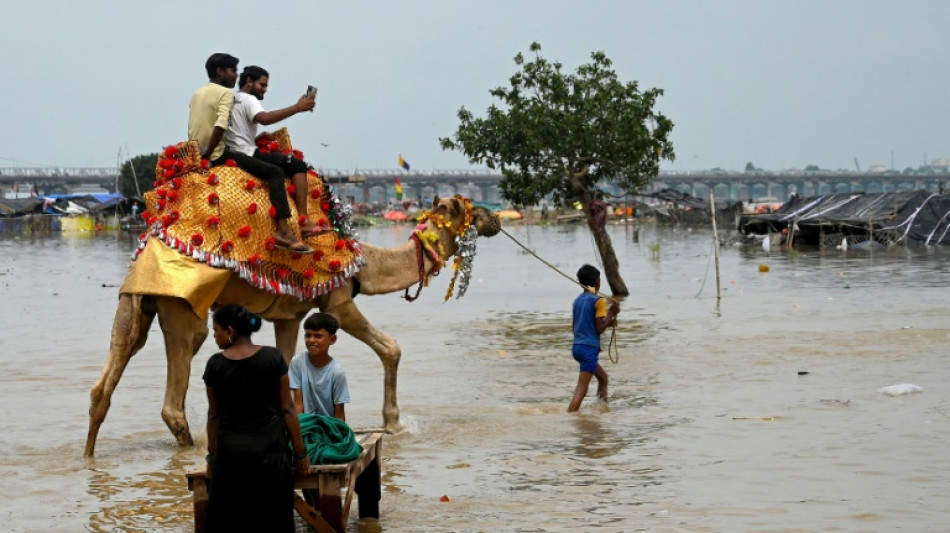
Death toll mounting from South Asia's devastating monsoon / Photo: © AFP

 EU calls Russia 'reckless' after flares fired at Danish helicopter

 US Treasury chief says to meet Chinese counterpart at weekend

 Trump slams 'horrible' Supreme Court mail-in ballot ruling

 Brazil's crisis-hit Supreme Court probes judge's ties to jailed banker

 Sterling admits dangerous driving after Lamborghini crash

 Ambassador to Thailand plays down anti-Israeli protests

 BingX Evolves into a Multi-Asset Trading Platform, Connecting Users to Global Opportunities

 Flick supporting 'self-confident' Yamal Ballon d'Or bid

 As Ballon d'Or vote nears, stars campaign for the award

 Markets on edge as US Fed meets to tackle high inflation

 International Trading Institute Expands Professional Trader Development Beyond the Master’s in Trading

 Nairobi to host 2029 world athletics championships in African first

 Ukraine winemakers defy war to make a splash at home

 Prominent Greek neo-Nazi exits prison, vows return to politics: AFP

 Saudi Arabia vows to respond 'firmly' to Houthi attacks

 'We unleashed the beast': the world's fears and hopes about AI

 Carragher sees Manchester City’s winning start as challenge to Arsenal

 Oasis fans weigh ticket costs and reunion memories ahead of 2027 tour

 EastEnders previews Kat’s grief after Zoe’s death

 US military confirms Iran war has led to munitions shortfall

 SkySail Strategies Outperforms Wall Street's 30-Year Risk Standard With Proprietary AI Inference Model

 Canada ends refugee family sponsorship exemption over integrity concerns

 Berlin's run-down public spaces at heart of election campaign

 Ribeiro and Richie among celebrity birthdays for September 20–26

 Bob Mackie, costume designer for Cher and Madonna, dies aged 87

Torrential storms lashing India and Nepal have killed hundreds of people since June, official data showed Tuesday, with flooding and landslides causing widespread devastation during the treacherous monsoon season.
The deaths include scores in India this month alone, and at least 171 overall in neighbouring Nepal.
Weather-related disasters are common during the monsoon season from June to September, but experts say climate change is increasing their frequency and severity.
In India, just months after the country baked in its longest-ever heatwave, according to government weather experts, ferocious rainstorms have triggered widespread flooding and landslides.
The crushing heatwave in May and June saw temperatures in New Delhi match the capital's previous record high: 49.2C (120.5F) clocked in 2022.
Now the heat has been replaced by rains.
India's weather department this week warned of "heavy rainfall" over much of the south and northeastern states.
On Tuesday, rescue teams searched for two missing people after nine drowned when a surge of water smashed through the Una district of Himachal Pradesh state.
"The search continues for the missing people," district official Shikha Rana told AFP.
Witnesses saw a car being swept away like a toy by the swollen muddy river.
"Several people tried to stop the car...as the current was increasing but the car sped past and soon the car was swept away by the strong current," Rajendra Kumar said.
- Floods in deserts -
In India's northern Uttar Pradesh state, at least 17 people have died in floods triggered by heavy rains since last week, official data said.
The usually hot deserts of Rajasthan have been swamped, with local media reporting at least 22 people killed in the floods since Sunday.
Surging waters in Uttarakhand have killed at least 51 people since June, according to state government figures.
And more than 200 people died in the southern state of Kerala last month, when landslides hit villages and tea plantations.
In Nepal, 171 people have died since monsoon rains began in mid-June, including 109 people in landslides.
Other deaths have been caused by floods and lightning, according to the disaster authority.
More than 40 people are missing, and over 200 have been injured.
Searches continue in central Nepal's Chitwan district for two busses swept over concrete crash barriers in a raging river on July 12, killing around 50 people.
Monsoon rains across the region from June to September offer respite from the summer heat and are crucial to replenishing water supplies.
They are also vital for agriculture, and therefore the livelihoods of millions of farmers and food security for South Asia's nearly two billion people.
India is the world's third-biggest emitter of greenhouse gases but has committed to achieve a net zero emissions economy by 2070 -- two decades after most of the industrialised West.
For now, it is overwhelmingly reliant on coal for power generation.
strs-pa-ash/pjm/fox
R.Kloeti--VB