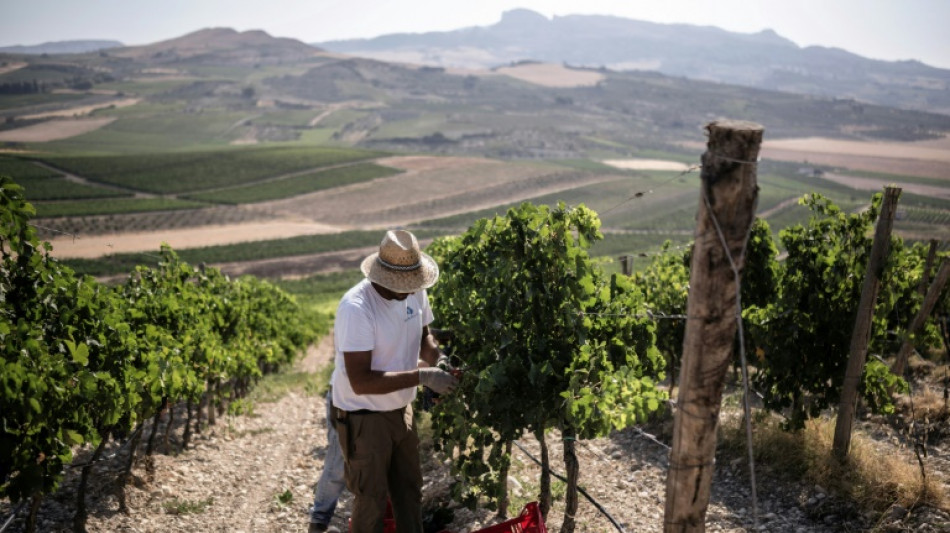
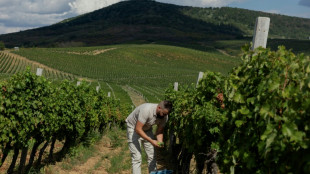
Harvest starts very early in Sicily's drought-hit vineyards / Photo: © AFP

 EU calls Russia 'reckless' after flares fired at Danish helicopter

 US Treasury chief says to meet Chinese counterpart at weekend

 Trump slams 'horrible' Supreme Court mail-in ballot ruling

 Brazil's crisis-hit Supreme Court probes judge's ties to jailed banker

 Sterling admits dangerous driving after Lamborghini crash
 Ambassador to Thailand plays down anti-Israeli protests

 BingX Evolves into a Multi-Asset Trading Platform, Connecting Users to Global Opportunities

 Flick supporting 'self-confident' Yamal Ballon d'Or bid

 As Ballon d'Or vote nears, stars campaign for the award

 Markets on edge as US Fed meets to tackle high inflation

 International Trading Institute Expands Professional Trader Development Beyond the Master’s in Trading

 Nairobi to host 2029 world athletics championships in African first

 Ukraine winemakers defy war to make a splash at home

 Prominent Greek neo-Nazi exits prison, vows return to politics: AFP
 Saudi Arabia vows to respond 'firmly' to Houthi attacks

 'We unleashed the beast': the world's fears and hopes about AI
 Carragher sees Manchester City’s winning start as challenge to Arsenal
 Oasis fans weigh ticket costs and reunion memories ahead of 2027 tour

 EastEnders previews Kat’s grief after Zoe’s death

 US military confirms Iran war has led to munitions shortfall

 SkySail Strategies Outperforms Wall Street's 30-Year Risk Standard With Proprietary AI Inference Model

 Canada ends refugee family sponsorship exemption over integrity concerns
 Berlin's run-down public spaces at heart of election campaign

 Ribeiro and Richie among celebrity birthdays for September 20–26

 Bob Mackie, costume designer for Cher and Madonna, dies aged 87
On the hills of the Contessa Entellina vineyard in western Sicily, the harvest is already well underway, the grapes ripening earlier than usual because of drought and high temperatures.
The prestigious Donnafugata vineyards, which span the Italian island from the slopes of Marsala to the mantle of Mount Etna, began their harvest on July 22, an unprecedented two weeks early.
At Contessa Entellina, the company's main estate in the province of Agrigento, there has been almost no rain since May.
"Between October and the end of July, there has been 35 percent less rain," said Antonino Santoro, the estate's technical director and oenologist.
In 2022, the harvest had already begun on July 29.
The Sicily of myth is a fertile orchard blessed with rivers of pure water, but the modern day Mediterranean island suffers more and more from global warming.
Since the end of spring, water has stopped flowing, the soil and the springs parched.
Farmers here are used to the naturally arid territory, but they are being tested.
Even citrus fruits and olive trees are suffering from the drought and scorching temperatures which in 2021 set the European record of 48.8 degrees Centigrade (119.8 Fahrenheit).
- Drop by drop -
With 460 hectares of vines and 3.6 million bottles per year across all its territories, the Donnafugata company has the financial resources to adapt.
"Before, irrigation was useful, today it is essential," Santoro said.
Around Contessa Entellina the estate has installed several retention basins which meet around 75 percent of its irrigation needs, the rest covered by public reserves.
During June and July, it irrigates the vines using a micro-sprinkler system, which provides water at a rate of four litres per hour per vine.
"The aim is to optimise water use," said Giuseppe Milano, the estate's head of cultivation.
Irrigation is not cheap, costing between 4,000 and 6,000 euros per hectare per year. The average size of an Italian vineyard is 11 hectares.
At the end of July, the Italian government recognised Sicily was facing "force majeure conditions and exceptional circumstances" due to the drought, according to Sicilian authorities.
This eases some EU rules on agriculture and allows farmers to defer payments and charges, the region said, in response to a year-long drought it said was "one of the most serious in the last 50 years".
- Quantity and quality -
Donnafugata takes its name from the fictional town in "The Leopard", the novel by Giuseppe Tomasi di Lampedusa set in the area during the unification of Italy in the late 19th century.
Back then, the grape harvest did not begin before September.
As well as irrigation, Contessa Entellina adapts by growing its vines taller, up to 1.5 metres, so the upper foliage serves as a canopy to screen the grapes from the sun.
There is no such shade for the grape pickers, who use pruning shears to harvest the grapes under a blazing sun.
They started at dawn, and by 10:00am it is already 29 degrees Celsius.
For the first time, regional authorities have banned working in the fields during the hottest hours of the day, between 12:30 pm. and 4:00 pm.
They are now picking the Merlot grapes for red wine. The white Chardonnay ones were picked in July.
Depending on the varieties and the terroir, the grape harvest in Sicily this year will be spread out over three or four months -- "a unique situation in Europe", according to national agricultural association Coldiretti.
Contessa Entellina's harvest will be smaller than last year, with smaller grapes.
But Milano insisted that what it lacks in quantity is made up in quality.
Today, Donnafugata is involved in research projects to help prepare the vines for the evolving conditions.
"I am optimistic," said Santoro. "The vine adapts better than other crops."
It is not just heat that is affecting the harvest.
Last year, a combination of frost and floods in the north and mildew in the south cost the Italian wine industry a quarter of its production -- allowing France to take the title of the world's leading wine producer.
J.Sauter--VB