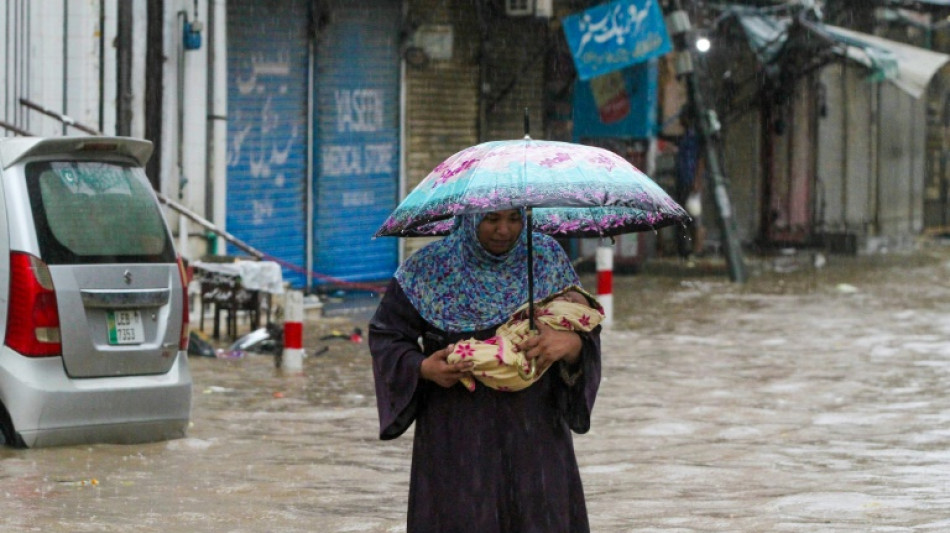
Pakistan's second-largest city Lahore hit by record rain / Photo: © AFP

 EU calls Russia 'reckless' after flares fired at Danish helicopter

 US Treasury chief says to meet Chinese counterpart at weekend

 Trump slams 'horrible' Supreme Court mail-in ballot ruling

 Brazil's crisis-hit Supreme Court probes judge's ties to jailed banker
 Sterling admits dangerous driving after Lamborghini crash

 Ambassador to Thailand plays down anti-Israeli protests

 BingX Evolves into a Multi-Asset Trading Platform, Connecting Users to Global Opportunities

 Flick supporting 'self-confident' Yamal Ballon d'Or bid

 As Ballon d'Or vote nears, stars campaign for the award

 Markets on edge as US Fed meets to tackle high inflation

 International Trading Institute Expands Professional Trader Development Beyond the Master’s in Trading

 Nairobi to host 2029 world athletics championships in African first

 Ukraine winemakers defy war to make a splash at home

 Prominent Greek neo-Nazi exits prison, vows return to politics: AFP

 Saudi Arabia vows to respond 'firmly' to Houthi attacks

 'We unleashed the beast': the world's fears and hopes about AI

 Carragher sees Manchester City’s winning start as challenge to Arsenal

 Oasis fans weigh ticket costs and reunion memories ahead of 2027 tour

 EastEnders previews Kat’s grief after Zoe’s death

 US military confirms Iran war has led to munitions shortfall

 SkySail Strategies Outperforms Wall Street's 30-Year Risk Standard With Proprietary AI Inference Model

 Canada ends refugee family sponsorship exemption over integrity concerns

 Berlin's run-down public spaces at heart of election campaign

 Ribeiro and Richie among celebrity birthdays for September 20–26

 Bob Mackie, costume designer for Cher and Madonna, dies aged 87

Pakistan's second-largest city of Lahore was deluged with record-breaking rainfall on Thursday, the national weather agency said, with hospitals flooded, power interrupted and streets in the metropolis submerged.
The eastern city was lashed by almost 360 millimetres (14 inches) of rain in three hours, the Pakistan Meteorological Department (PMD) said.
"This was record-breaking rainfall," the agency's deputy director Farooq Dar told AFP.
The previous record dates to July 1980, when 332 millimetres fell over three hours.
"Look at all these buckets and how much water has accumulated. We're exhausted from trying to remove the water," Sadam, a 32-year-old shopkeeper, told AFP as he took stock of his considerable losses.
The PMD had forecast a wetter-than-usual monsoon season this year for Pakistan, one of the countries experts say is most vulnerable to extreme weather being spurred by climate change.
Over the past three days, 24 people have been killed by rainfall in the country's mountainous northwestern province of Khyber Pakhtunkhwa, the Provincial Disaster Management Authority said.
In Lahore, a city of 13 million in the eastern Punjab province, one person was killed by electrocution as a result of Thursday's cloudburst, according to local police.
The city's commissioner declared an emergency and said offices and schools would be shut for the day.
Yasir Ali, a 26-year-old resident, said it was a "sad day for the nation".
"For a poor person it is heartbreaking that he's been unable to go to work today," he told AFP.
- 'Pay some attention here' -
Two government hospitals in Lahore reported flooding in their wards, and there were intermittent power outages continuing into the afternoon.
Roads were also submerged, bringing traffic and businesses to a standstill.
Ahmed Khan, 48, who earns a daily wage, appealed to the government "to pay some attention here and resolve this water issue".
Maryam Sharif, the chief minister of Punjab province, posted on X that "the entire government machinery is in the field" to drain the water.
The summer monsoon brings to South Asia about 70 to 80 percent of the region's annual rainfall between June and September.
It is vital for agriculture, but changing weather patterns that scientists attribute to climate change are putting both lives and livelihoods at risk.
Earlier this year Pakistan -- home to 240 million people -- was hit by a succession of heatwaves and this April was the wettest since 1961.
At least 143 people died from lightning strikes and other storm-related incidents in April.
In neighbouring India, at least 160 people, most believed to be labourers and their families, have been killed by torrential rains causing landslides in the southern coastal state of Kerala.
In 2022, a third of Pakistan was submerged by unprecedented monsoon rains that displaced millions of people and cost $30 billion, according to a World Bank estimate.
L.Meier--VB