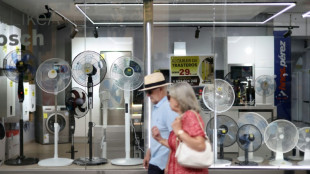
Humanity suffering from 'extreme heat epidemic,' UN chief warns / Photo: © AFP/File

 Foundation Lets Ledger Users Switch to Open Source Without Starting Over

 Canada remains 'most important partner' for US in 'key areas': Carney

 Carrick urges Man Utd to use derby pain as fuel against Brighton

 Turkey police detain dozens over pro-LGBTQ Istanbul rally

 'Kenya's moment' as Nairobi to host 2029 world athletics champs in African first

 China warns against space 'battlefield' after US says weapons deployed

 Denmark says Russian frigate fired flares at helicopter
 EU to propose curbing social media, online games for under 15s

 FX Junction Reaches 40,600 Members and 26 Million Trades

 Prominent Greek neo-Nazi exits prison, vows return to politics

 'Obsessed': explosive state crime inquiry grips South Africa

 Sri Lanka's javelin champ returns to 'broken' welcome

 Lake Energy Secures $80 Million for U.S. Renewable Energy Expansion

 Huge Van Gogh collection reunited for first time since 1984

 Stocks drop, oil climbs and Treasury yields hit 19-year high

 Asian Games cruise ship arrives as accommodation complaints grow

 Giggs names Odegaard as favourite Arsenal player after strong start

 Hospitality leaders ask Burnham to halve VAT amid rising costs

 Worcestershire invited to nominate groups for 2027 King’s volunteer award

 Just add fish: Scientists pursue more rice, less disease in Senegal paddies

 Louisville adds LJ Wells for fifth season of eligibility

 Florida State dismisses athletics director Alford and appoints interim leader

 Saudi Arabia warns it will react 'firmly' to Houthi attacks

 Designer Bob Mackie dies at 87 after career spanning television, stage and fashion

 'Widow's Bay' and 'The Pitt' win big at Emmy Awards

Humanity is suffering from an "extreme heat epidemic," UN Secretary-General Antonio Guterres warned Thursday, calling for action to limit the impacts of heat waves intensified by climate change.
"Billions of people are facing an extreme heat epidemic -- wilting under increasingly deadly heat waves, with temperatures topping 50 degrees Celsius around the world," he said. "That's 122 degrees Fahrenheit. And halfway to boiling."
According to the European Copernicus network, July 21, 22 and 23 were the three hottest days ever recorded worldwide, with July 22 holding the absolute record of 17.16 degrees Celsius (62.9 degrees Fahrenheit).
Guterres repeated his call for humanity to fight its "addiction" to fossil fuels.
"Today, our focus is on the impact of extreme heat. But let's not forget that there are many other devastating symptoms of the climate crisis: ever-more fierce hurricanes. Floods. Droughts. Wildfires. Rising sea levels. And the list goes on," he said.
"To tackle all these symptoms, we need to fight the disease. And the disease is the madness of incinerating our only home. The disease is the addiction to fossil fuels. The disease is climate inaction," he stressed, calling in particular on G20 countries to take action.
While 2023 was the hottest year on record, and 2024 could set a new record, temperatures well above 40C (104F) are increasingly common.
In the space of a year, the 50C threshold has even been exceeded in at least 10 places, from Death Valley in the United States (53.9C on July 7) to Agadir in Morocco, and also in China and India.
The intense heat, often less visible than other devastating impacts of climate change such as storms or floods, is nonetheless more deadly.
This "silent killer" is responsible for around 489,000 deaths per year between 2000 and 2019, compared with 16,000 deaths per year from cyclones, according to the UN's "Call to Action" document published on Thursday.
- Workers exposed -
Extremely high temperatures also have an economic impact, with the UN estimating economic losses from heat stress at work will reach $2.4 trillion in 2030.
According to a report by the International Labor Organization published on Thursday, more than 70 percent of workers were exposed to excessive heat in 2020, 8.8 percent more than in 2000.
"The good news is that we can save lives and we can limit its impact," Guterres said Thursday.
The UN has called for the world community to first act to protect "the most vulnerable" -- including young children, the elderly and also humanity's poorest.
In this context, early warning systems should include extreme heat, warning populations of the arrival of heat waves and informing them of the precautions to take, the document says.
The call to action also recommends an "increase (to) equitable access to and scale up (of) low-carbon cooling."
This would involve investing in passive cooling systems -- which include climate-sensitive urban design measures, reflective surfaces and natural cooling systems -- and the phase-out of climate-warming gases that are used in many cooling systems.
C.Stoecklin--VB