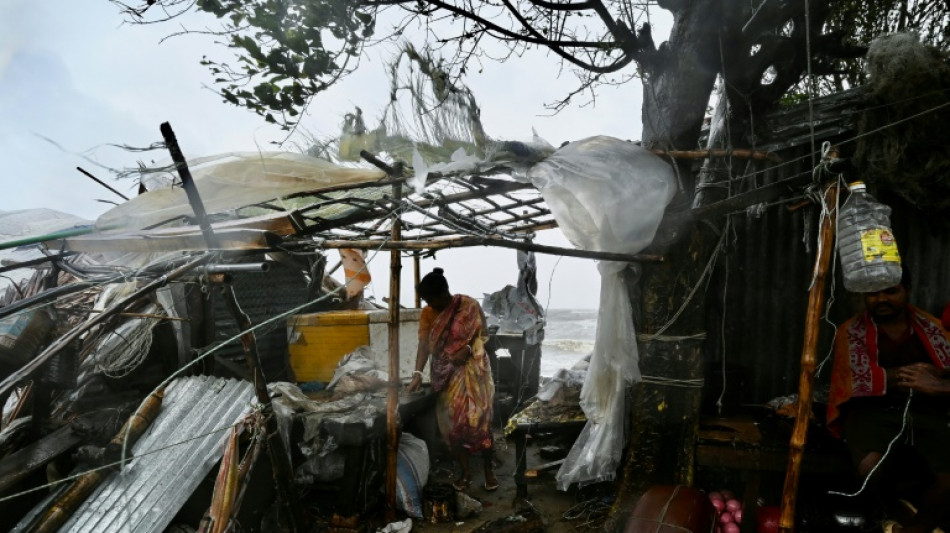
Three dead after cyclone batters Bangladesh and India / Photo: © AFP

 BingX Evolves into a Multi-Asset Trading Platform, Connecting Users to Global Opportunities

 Flick supporting 'self-confident' Yamal Ballon d'Or bid

 As Ballon d'Or vote nears, stars campaign for the award

 Markets on edge as US Fed meets to tackle high inflation

 International Trading Institute Expands Professional Trader Development Beyond the Master’s in Trading

 Nairobi to host 2029 world athletics championships in African first

 Ukraine winemakers defy war to make a splash at home

 Prominent Greek neo-Nazi exits prison, vows return to politics: AFP

 Saudi Arabia vows to respond 'firmly' to Houthi attacks

 'We unleashed the beast': the world's fears and hopes about AI

 Carragher sees Manchester City’s winning start as challenge to Arsenal

 Oasis fans weigh ticket costs and reunion memories ahead of 2027 tour

 EastEnders previews Kat’s grief after Zoe’s death

 US military confirms Iran war has led to munitions shortfall

 SkySail Strategies Outperforms Wall Street's 30-Year Risk Standard With Proprietary AI Inference Model

 Canada ends refugee family sponsorship exemption over integrity concerns
 Berlin's run-down public spaces at heart of election campaign

 Ribeiro and Richie among celebrity birthdays for September 20–26

 Bob Mackie, costume designer for Cher and Madonna, dies aged 87

 Mahomes makes triumphant return as Chiefs rout Broncos 31-10

 Belgium completes outer structure of offshore energy island

 Video documents rescue of injured US airman from Iran

 Asian Games: Bigger than Olympics, young stars and a cruise ship

 Asian Games set for liftoff but will have everyone have a bed?

 Most markets drop as oil extends gains ahead of expected US rate hike

Residents of low-lying areas of Bangladesh and India surveyed the damage on Monday as an intense cyclone that lashed the coast weakened into a heavy storm after killing at least three people, damaging homes and uprooting trees.
Fierce gales and crashing waves battered the coast as Cyclone Remal made landfall on Sunday night, but by midday on Monday, the winds had eased.
"At least three people have died in the cyclone," Zahid Hossain Khan, a spokesman of the disaster management ministry, told AFP
Communications have been limited by the storm, with power lines ripped down.
Cyclones have killed hundreds of thousands of people in Bangladesh in recent decades, but the number of superstorms hitting its densely populated coast has increased sharply, from one a year to as many as three, due to the impact of climate change.
At its peak, Remal's wind speeds hit 111 kilometres (69 miles) per hour, said Muhammad Abul Kalam Mallik, senior weather forecaster at the state-run Bangladesh Meteorological Department.
"The cyclone has unleashed heavy rains in many parts of Bangladesh," Mallik told AFP, adding that it was weakening and turning into a storm.
An AFP reporter in the affected area said there had been heavy rain with extreme wind since Sunday evening, battering tall buildings, uprooting trees and tearing the tin roofs off homes.
While scientists say climate change is fuelling more storms, better forecasting and more effective evacuation planning have dramatically reduced the death toll.
Around a million people in Bangladesh and neighbouring India took shelter, fleeing inland for concrete storm shelters away from the dangerous waves.
Most of Bangladesh's coastal areas are just a metre or two (three to six feet) above sea level, and high storm surges can devastate villages.
Sumita Mondal, 36, who hunkered down overnight inland away from India's coast, said she had fled with only what she could carry.
"My three-year-old son is crying for food," she told AFP by telephone.
- 'Villages are flooded' -
Kamrul Hasan, secretary of the disaster management ministry, said there were no immediate reports of major damage, but said "embankments in several places have been breached or submerged, inundating some coastal areas".
In India's West Bengal, the "cyclone has blown off the roofs of hundreds of houses" and "uprooted thousands of mangrove trees and electricity poles", senior state government minister Bankim Chandra Hazra told AFP.
Electricity was off across large parts of the affected areas.
"Storm surges and rising sea levels have breached a number of embankments," Hazra added. "Some island villages are flooded."
At least 800,000 Bangladeshis fled their coastal villages, while more than 150,000 people in India also moved inland from the vast Sundarbans mangrove forest, where the Ganges, Brahmaputra and Meghna rivers meet the sea, government ministers and disaster officials said.
Mallik, the Bangladeshi weather expert, said the expansive mangrove forests helped dissipate the worst of the storm.
"Like in the past, the Sundarbans acted as a natural shield to the cyclone," he said.
But Abu Naser Mohsin Hossain, Bangladesh's senior forest official for the Sundarbans, said the storm surge had swamped crucial freshwater areas with salt water.
"We are worried," said Hossain. "These ponds were the source of fresh water for the entire wildlife in the mangroves -- including the endangered Bengal tigers."
P.Vogel--VB