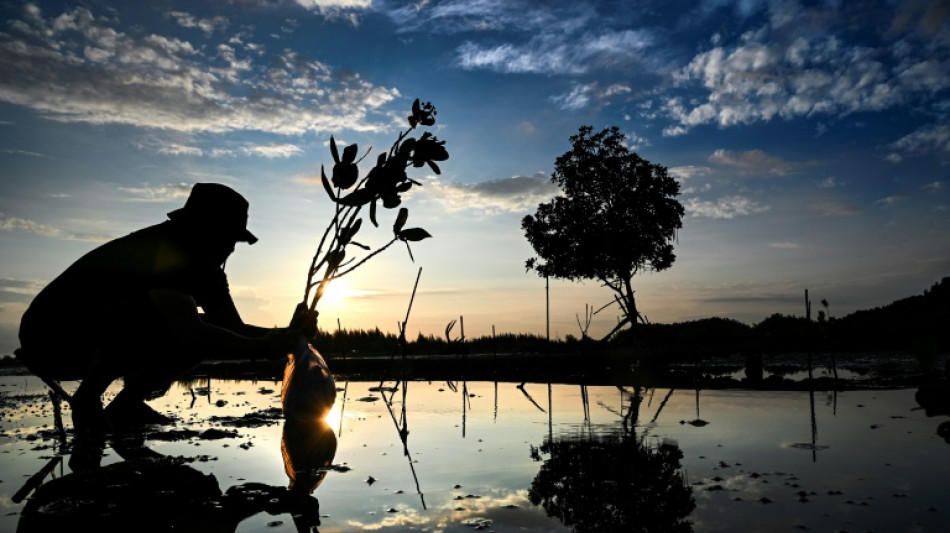
Half of mangrove ecosystems at risk: conservationists / Photo: © AFP/File

 BingX Evolves into a Multi-Asset Trading Platform, Connecting Users to Global Opportunities

 Flick supporting 'self-confident' Yamal Ballon d'Or bid

 As Ballon d'Or vote nears, stars campaign for the award
 Markets on edge as US Fed meets to tackle high inflation

 International Trading Institute Expands Professional Trader Development Beyond the Master’s in Trading

 Nairobi to host 2029 world athletics championships in African first

 Ukraine winemakers defy war to make a splash at home

 Prominent Greek neo-Nazi exits prison, vows return to politics: AFP

 Saudi Arabia vows to respond 'firmly' to Houthi attacks

 'We unleashed the beast': the world's fears and hopes about AI

 Carragher sees Manchester City’s winning start as challenge to Arsenal
 Oasis fans weigh ticket costs and reunion memories ahead of 2027 tour

 EastEnders previews Kat’s grief after Zoe’s death

 US military confirms Iran war has led to munitions shortfall

 SkySail Strategies Outperforms Wall Street's 30-Year Risk Standard With Proprietary AI Inference Model

 Canada ends refugee family sponsorship exemption over integrity concerns
 Berlin's run-down public spaces at heart of election campaign

 Ribeiro and Richie among celebrity birthdays for September 20–26

 Bob Mackie, costume designer for Cher and Madonna, dies aged 87

 Mahomes makes triumphant return as Chiefs rout Broncos 31-10

 Belgium completes outer structure of offshore energy island

 Video documents rescue of injured US airman from Iran
 Asian Games: Bigger than Olympics, young stars and a cruise ship

 Asian Games set for liftoff but will have everyone have a bed?

 Most markets drop as oil extends gains ahead of expected US rate hike

Half of the world's mangrove ecosystems are at risk of collapse due to climate change, deforestation and pollution, according to a study published Wednesday.
The International Union for Conservation of Nature (IUCN), known for its red list of threatened species, has for the first time taken stock of the world's mangroves, evaluating 36 different regions.
IUCN director general Grethel Aguilar said the assessment "highlights the urgent need for coordinated conservation of mangroves -- crucial habitats for millions in vulnerable communities worldwide".
Mangroves are trees or shrubs that grow mainly in seawater or brackish water along coastlines and tidal rivers, in equatorial climes.
Released on the International Day for Biodiversity, IUCN said its findings show that "50 percent of the mangrove ecosystems assessed are at risk of collapse" -- categorised as either vulnerable, endangered or critically endangered.
According to the assessment, 20 percent were at severe risk of collapse.
Mangroves are threatened by deforestation, development, pollution, and dam construction.
However, the risk is increasing due to sea-level rise and the greater frequency of severe storms associated with climate change.
Around 15 percent of the world's coasts are covered by mangroves, covering about 150,000 square kilometres.
- Disastrous disappearance -
Climate change threatens a third of mangrove ecosystems assessed, due to rising sea levels.
According to estimates, at the current rate, a quarter of the global area of mangroves is expected to be submerged in the next 50 years, IUCN said.
The northwest Atlantic Ocean, the northern Indian Ocean, the Red Sea, the South China Sea, and the Gulf of Aden coasts are expected to be particularly severely affected.
"Mangrove ecosystems are exceptional in their ability to provide essential services to people, including coastal disaster risk reduction, carbon storage and sequestration, and support for fisheries," said Angela Andrade, chair of the IUCN commission on ecosystem management.
"Their loss stands to be disastrous for nature and people across the globe."
The study said looking after mangroves was essential for mitigating the effects of climate change, with healthy ecosystems coping better with sea level rise and providing inland protection from the effects of severe storms.
Without significant improvement by 2050, climate change and rising sea levels will lead to the loss of 1.8 billion tonnes of carbon stored in mangroves.
Mangroves currently store nearly 11 billion tons of carbon -- almost three times the amount of carbon stored by tropical forests of the same size.
Maintaining good sediment circulation and allowing mangroves to expand inland will help them cope with sea level rise, IUCN said. It also called for the restoration of mangroves which have already disappeared.
"A very good study of mangrove change globally that was published in 2022 indicates about 5,000 square kilometres of mangrove were lost" between 1996 and 2020, IUCN's Marco Valderrabano told AFP.
P.Staeheli--VB