Climate change pushes Bordeaux winemakers to harvest at night / Photo: © AFP

 Television's A-listers glitter on Emmys red carpet

 US Supreme Court blocks Trump mail-in ballot restrictions

 Dodgers clinch playoff berth in bid for third straight World Series
 Doomers and boosters: who's who in the AI wars

 GAC presents autonomous trucks and MONTX concepts at Hannover show

 EU extends Russia sanction deadline

 Thai wildlife investigators track traffickers through social media

 Trump rejects AI slowdown concerns as UN urges coordinated controls

 US judge postpones new visa rules for foreign students, journalists

 Higher wages draw migrant workers to Kashmir despite attacks

 Oil supply concerns and AI warnings weigh on global markets

 'I am the hoax buster': Trump rejects AI danger warnings

 Macklemore dropped from Ed Sheeran tour after 'free Palestine' speech

 Trump's son confirms Russian businessman paid for post-wedding festivities

 Betis beat winless Villarreal to go third

 Etihad capacity rises as war disruption weighs on annual earnings

 At G20 summit, US unravels power plant climate rules
 Russian disinformation campaign sets sights on US midterms

 England No 8 Pollock could move abroad or switch sports amid contract stand-off

 Canada makes pitch as safe place to invest in 'uncertain world'

 In-form Malen fires Roma to Serie A summit

 IOC visits Lyon amid leadership turmoil for 2030 Winter Olympics

 New York seizes 12 celeb deep-fake porn sites

 Jesse Eisenberg channels emotional intensity into 'The Debut'

 Alarm over AI grows as divided US Congress struggles to act

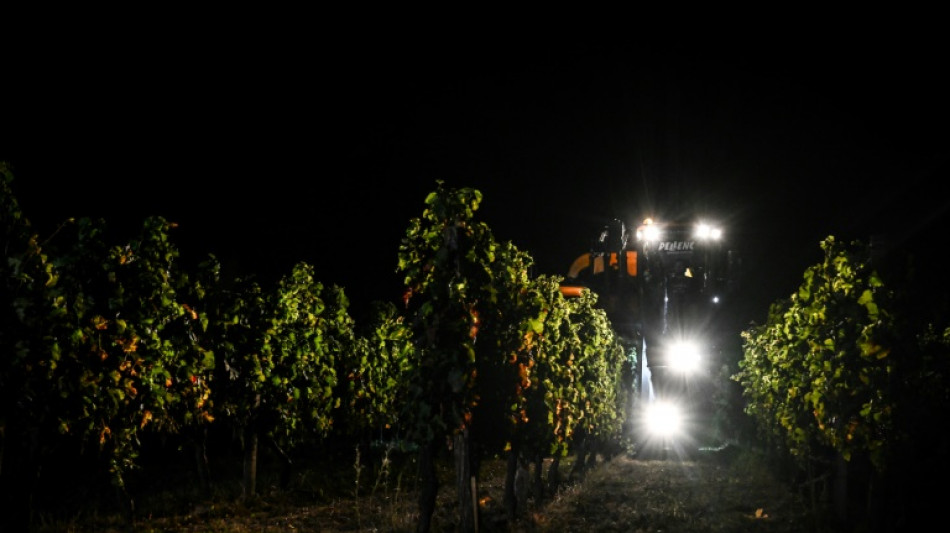
In France's southern Bordeaux region, the grape harvest is often now done at night to ensure the peak freshness required to obtain the best wine but this is also a response to climate change.
With the country sweltering in a late heatwave, it is 20 degrees Celsius (68 degrees Fahrenheit) at five in the morning as a harvester crawls along a row of vines, powerful headlights helping guide its way through the darkness.
"Harvesting at night is done for the quality of the grapes, their freshness and taste," said the driver, Loic Malherbe, who has been at it for three hours already.
"It isn't bad, it's just life at a different rhythm... It's better for the equipment and for people."
It is already a common practice in several winemaking countries with hot summers but one that is likely to become even more common as climate change accelerates.
Harvesting at night can also help financially strapped growers save money, according to Kees Van Leeuwen, a professor of viniculture at Bordeaux Sciences Agro university.
It means they can skip refrigerating grapes while they are being hauled to be pressed, he explained.
"If harvesting is done at night the temperature of the grapes is lower, especially compared to the very hot days we've had this week," he said.
"There is a huge saving in energy use."
- Dry ice -
The harvester dumps the merlot grapes into bins which the vineyard's owner Stephane Heraud hitches to his tractor to haul to the cooperative.
"It's been 15 years that we've harvested the whites and the roses at night, and maybe one day we'll do that for the reds as well," said Heraud, who also heads the cooperative Vignerons de Tutiac.
"If we harvested at night, we'd have wine that is more oxidised, which in terms of taste is not nearly as nice."
Heraud climbs up onto his tractor and spreads dry ice (-80C, -112F) onto the grapes.
This not only helps keep the grapes cool but reduces the oxygen level in the bins as he drives to the cooperative, which is the largest in one of France's protected designation regions with 500 growers.
Tutiac has specialised in roses and accounts for nearly a third of the total produced in the Bordeaux region.
Its pesticide-free rose caused a stir at a blind tasting conducted by the French wine magazine La Revue des vins de France, being placed fourth among roses from the Provence region which traditionally take top marks in the category.
- Earlier harvests -
That night, growers were expected to dump some 500 tonnes of grapes into the various stainless-steel tanks at the wine press, enough to make half a million bottles of wine.
Tutiac's chief oenologist Paul Oui said consumers like roses that are light coloured and clear.
To achieve that "you have to limit the transfer of the colour from the skin to the juice and the earlier and cooler we harvest the more we can limit the transfer", he said.
Night harvesting is already common in Australia and California due to the heat, and the practice is spreading in the Bordeaux region according to Van Leeuwen.
"For whites and roses, one can imagine that it will become common practice," said the specialist.
Nor did he exclude that it might one day concern grapes for red wine, which account for 85 percent of Bordeaux's production.
Rising temperatures make grapes mature faster and push the harvest sooner and into warmer periods, and Heraud confirmed that harvests were indeed happening sooner and sooner.
"I remember when I was small watching my parents harvesting in November," he said.
"Last year, we were finished on September 30...," he added.
"Anyone who says climate change isn't real isn't a Bordeaux winemaker."
J.Marty--VB