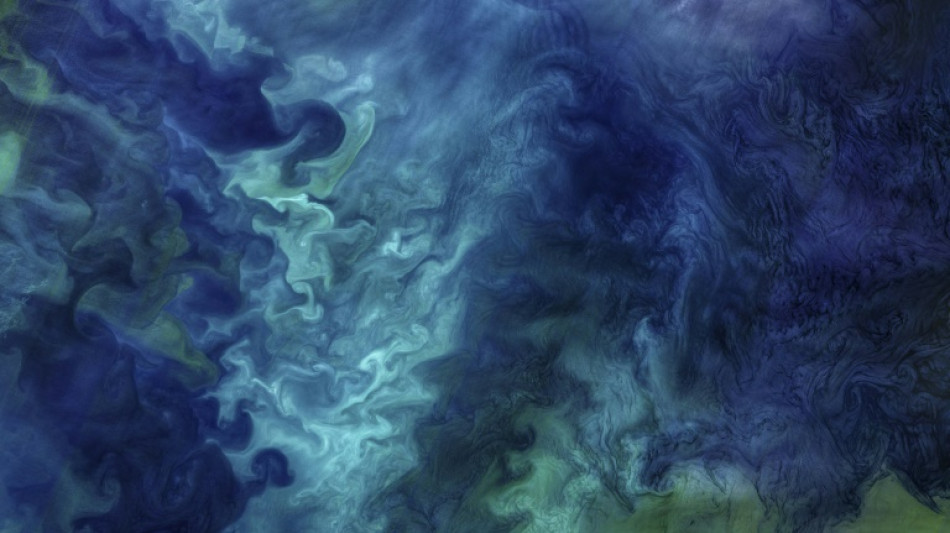
Oceans are changing colour and climate change may be to blame / Photo: © NASA/AFP/File

 Qatar Chamber and Maltese envoy consider business forum

 Spanish PM denies being blackmailed by Morocco

 Doha Islamic finance forum names AlRayan firms as co-lead partners

 Leeds thrash Newcastle to go third in the Premier League

 Zelensky says Ukraine ready for 'de-escalatory steps'

 In-form Malen fires Roma to Serie A summit, Inter on their heels

 Lebanese agency reports Israeli shelling and gunfire in south

 Expert proposes phased digital reform for Arab business schools

 Trump rejects 'hoax' warnings that AI could destroy humanity

 Houthis say Saudi Arabia hits Yemen with 54 strikes after attack on bases

 Why the far right is losing ground in Sweden

 Ex-Ireland fly-half O'Gara extends deal as La Rochelle coach

 Russian attacks on Ukraine railways escalating every week: rail CEO to AFP

 France, Iraq deepen energy, defence ties during Zaidi visit

 Trump says Ukraine, Russia agree not to hit energy targets

 Nigeria's Dangote refinery launches continent's biggest IPO

 Trump blasts 'sick conspiracy' against AI as warnings mount

 For Laura Linney, role in Parkinson's-themed movie marked a turning point

 Doctors face life sentence over Greek pop star's death

 Trump moves to axe power plant climate rules

 Slow the AI race? Investors weigh the potential cost

 Philippine Muslim enclave votes for parliament after deadly shooting

 Germany seeks guarantees from Italy's UniCredit over Commerzbank takeover

 Liverpool will have to accept 'ups and downs', says Iraola

 Inaugural Ultimate a hit with the athletes, says Coe
Over the past 20 years huge swathes of the world's oceans have changed colour, displaying a subtle greening towards the tropics that researchers say points to the effect of climate change on life in the world's seas.
In the new research published on Wednesday, scientists said they had detected shifts in colours across more than half of the world's oceans -- an expanse bigger than Earth's total land area.
Authors of the study in Nature think that is down to changes in ecosystems, and particularly in tiny plankton, which are the centrepiece of the marine food web and play a crucial part in stabilising our atmosphere.
"The reason we care about the colour changes is because the colour reflects the state of the ecosystem, so colour changes mean ecosystem changes," lead author B.B. Cael, of Britain's National Oceanography Centre, told AFP.
The colour of the seas when seen from space can paint a picture of what is going on in the upper layers of the water.
A deep blue would tell you that there is not much life, while if the water is greener it is likely to have more activity, specifically from the photosynthesising phytoplankton, which like plants contain the green pigment chlorophyll.
These produce a significant amount of the oxygen we breathe, are a crucial part of the global carbon cycle and are a foundational part of the ocean food web.
- Life colours -
Researchers are keen to develop ways of monitoring changes in ecosystems in order to track climate changes and enshrine protected areas.
But previous studies have suggested you would need three decades of ocean chlorophyll monitoring to detect a trend because of annual variations.
In the latest study, researchers broadened the colour spectrum, looking at seven hues of ocean colour monitored by the MODIS-Aqua satellite from 2002 to 2022.
These are too subtle for humans to see and would look largely blue to the naked eye.
The authors analysed the observational data to detect a trend above the year-to-year variability and then compared it to computer models of what would be expected with climate change.
They found that the real-world observations tallied closely with the changes predicted.
While the researchers said more work would be needed to find out what exactly those colour changes might mean, they said climate change was very likely to be the cause.
"I've been running simulations that have been telling me for years that these changes in ocean colour are going to happen," said co-author Stephanie Dutkiewicz, of MIT's Department of Earth, Atmospheric and Planetary Sciences at the Center for Global Change Science.
"To actually see it happening for real is not surprising, but frightening. And these changes are consistent with man-induced changes to our climate."
D.Schneider--BTB