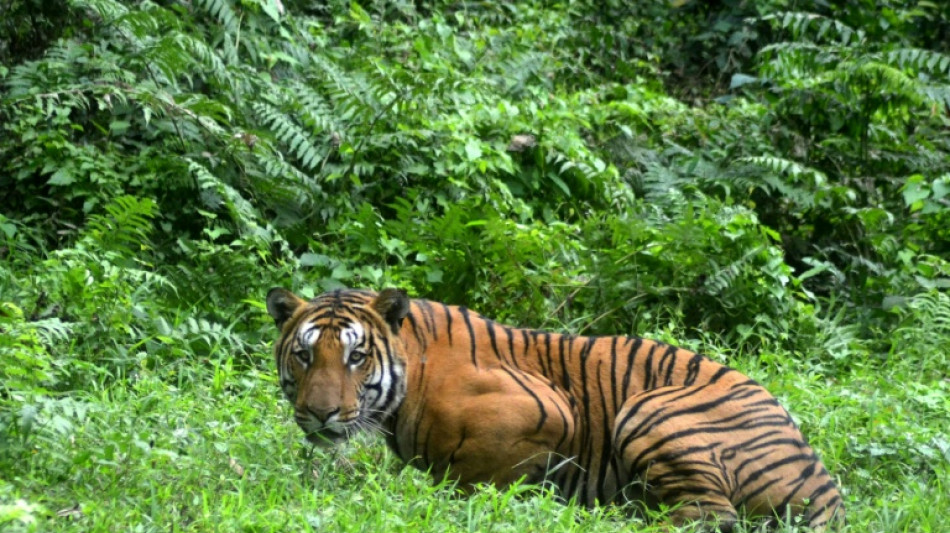
Protecting India's tigers also good for climate: study / Photo: © AFP/File

 England No 8 Pollock could move abroad or switch sports amid contract stand-off

 Canada makes pitch as safe place to invest in 'uncertain world'

 In-form Malen fires Roma to Serie A summit

 IOC visits Lyon amid leadership turmoil for 2030 Winter Olympics

 New York seizes 12 celeb deep-fake porn sites

 Jesse Eisenberg channels emotional intensity into 'The Debut'

 Alarm over AI grows as divided US Congress struggles to act

 PopDEX Surpasses $61M TVL and $2B Trading Volume in Closed Beta

 Oasis announce new 2027 world tour

 Women athletes condemn 'sexualised' Sydney Sweeney commercial

 UN calls for 'urgent action' to rein in AI in face of 'unprecedented risks'

 Russia intensifies attacks seeking to intimidate Ukraine, Europe

 Richarlison not in Spurs League Cup squad: De Zerbi

 French defence group Thales calls on governments to regulate AI

 Three talking points from the Spanish Grand Prix

 Saudi football body vows action against Jota chants, Ronaldo urges life ban

 North Korea win 10-0 in Asian Games football mismatch

 Nigerian oil refinery Dangote launches IPO

 Houthis target Saudi base as Iran denies involvement in Yemen war

 Sweden faces political uncertainty after election thriller

 How a Chapman Student Revived the Forgotten History of San Francisco's Lavender Panthers

 Philippine Muslim enclave heads to polls after deadly shooting

 New coach won't use AI in bid to make South Korea fans happy

 J-VISIONS Vol. 4 Now Online: Read English Articles on Japanese Corporate IR

 In DR Congo streets, ex-hoods get tough on litter -- and locals

India's efforts to protect its endangered tigers have inadvertently helped avoid a large amount of climate change-causing carbon emissions by preventing deforestation, a study said on Thursday.
Three-quarters of the world's wild tigers live in India, but the destruction of their natural habitat have seen their numbers plummet.
The number of tigers roaming the country's forests fell from 40,000 when India gained independence in 1947 to just 1,500 in 2006.
However their number rose above 3,000 this year, according to the latest official figures.
To help their numbers rebound, India has designated 52 tiger reserves where logging and deforestation are heavily regulated.
Aakash Lamba, a researcher at the National University of Singapore and the new study's lead author, told AFP that tigers are an "umbrella species".
This "means that by protecting them we also protect the forests they live in, which are home to an incredible diversity of wildlife," he told AFP.
Forests are a "carbon sink", which mean they absorb more carbon dioxide from the atmosphere than they release, making them a crucial tool in the fight against climate change.
India, the world's third largest emitter of greenhouse gases, has pledged to lower its emissions.
- Million metric tons -
Lamba, who grew up in India, said the team of researchers sought to establish an empirical link between tiger conservation and carbon emissions.
They compared the rate of deforestation in the special tiger reserves to areas where the big cats also live, but are less strictly protected.
More than 61,000 hectares of forest was lost across 162 different areas between 2001 and 2020, according to the study.
More than three quarters of the deforestation was in areas outside of the tiger reserves.
Inside the tiger reserves, almost 6,000 hectares was saved from deforestation between 2007 to 2020. That equates to more than a million metric tons of carbon emissions avoided, the study estimated.
Lamba emphasised the economic impact of those saved emissions in a country that has been hit hard by the effects of climate change -- particularly the agricultural industry.
Taking into account the social cost of those emissions, more than $92 million had been saved, the researchers calculated.
If counted as part of an carbon offset scheme, the avoided deforestation amounted to more than $6 million, they added.
"The financial benefits of avoiding carbon emissions are more than a quarter of the annual expenditure on tiger conservation in India," Lamba said.
"This significant outcome highlights how investments in wildlife conservation not only safeguard ecosystems and wildlife but also benefit societies and economies."
The study was published in the journal Nature Ecology & Evolution.
The findings come after a study published in March suggested protecting or restoring a handful of wild animals such as whales, wolves and otters could help capture 6.4 billion tons of carbon dioxide every year.
L.Dubois--BTB