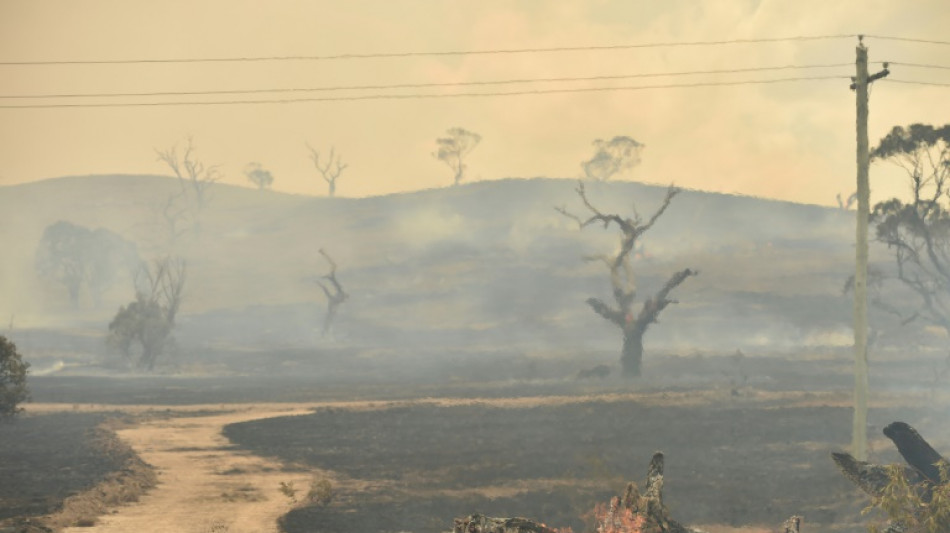
Australian bushfires may have helped trigger La Nina / Photo: © AFP

 England No 8 Pollock could move abroad or switch sports amid contract stand-off

 Canada makes pitch as safe place to invest in 'uncertain world'

 In-form Malen fires Roma to Serie A summit

 IOC visits Lyon amid leadership turmoil for 2030 Winter Olympics

 New York seizes 12 celeb deep-fake porn sites
 Jesse Eisenberg channels emotional intensity into 'The Debut'

 Alarm over AI grows as divided US Congress struggles to act

 PopDEX Surpasses $61M TVL and $2B Trading Volume in Closed Beta

 Oasis announce new 2027 world tour

 Women athletes condemn 'sexualised' Sydney Sweeney commercial

 UN calls for 'urgent action' to rein in AI in face of 'unprecedented risks'

 Russia intensifies attacks seeking to intimidate Ukraine, Europe

 Richarlison not in Spurs League Cup squad: De Zerbi

 French defence group Thales calls on governments to regulate AI

 Three talking points from the Spanish Grand Prix

 Saudi football body vows action against Jota chants, Ronaldo urges life ban

 North Korea win 10-0 in Asian Games football mismatch

 Nigerian oil refinery Dangote launches IPO

 Houthis target Saudi base as Iran denies involvement in Yemen war

 Sweden faces political uncertainty after election thriller

 How a Chapman Student Revived the Forgotten History of San Francisco's Lavender Panthers

 Philippine Muslim enclave heads to polls after deadly shooting

 New coach won't use AI in bid to make South Korea fans happy

 J-VISIONS Vol. 4 Now Online: Read English Articles on Japanese Corporate IR

 In DR Congo streets, ex-hoods get tough on litter -- and locals

Australia's "Black Summer" bushfire catastrophe coughed up so much smoke it may have fuelled the global onset of La Nina in 2020, according to new research published Thursday.
The report, in peer-reviewed journal Science Advances, said the bushfires were "exceptional" in their severity -- pumping out emissions on a scale similar to major volcanic eruptions.
It suggested this led to the formation of vast banks of cloud over the southeastern Pacific Ocean, which soaked up radiation from the sun and led to the cooling of surface water temperatures.
These disruptions could have helped trigger the start of an unusually long La Nina weather pattern, the researchers found.
The "Black Summer" bushfires raged across Australia's eastern seaboard from late 2019 to early 2020, razing swathes of forest, killing millions of animals, and blanketing cities in noxious smoke.
A rare "triple-dip" La Nina shaped global weather patterns between September 2020 and March 2023, whipping up a series of devastating tropical cyclones while exacerbating droughts in other parts of the planet.
Researchers John Fasullo and Nan Rosenbloom, from the National Center for Atmospheric Research in the United States, used modelling to demonstrate how emissions from the bushfires could shift weather patterns.
Bushfire smoke is laden with particles that act as "condensation nuclei", which attract water molecules in the atmosphere, seeding the formation of clouds.
- Atmospheric impact -
This blanket of cloud could cause "widespread surface cooling" in the tropical Pacific Ocean, the modelling showed, which is one of the key ingredients for the start of La Nina.
"The results here suggest a potential connection between this emergence of cool conditions in the eastern Pacific Ocean and the climate response to the Australian wildfire emissions," the paper stated.
Australian climate scientist Tom Mortlock said the bushfires caused clouds to form in a part of the Pacific that plays a crucial role in global climate regulation.
"The southeast corner of the Pacific is a really sensitive and important area for what goes on with El Nino and La Nina," he told AFP.
"Often we see the first signs of an El Nino or La Nina forming in that part of the ocean."
Pete Strutton, from the Australian Centre of Excellence for Climate Extremes, said it demonstrated the sheer scale of the bushfires.
"We've got an event that happened on the land in southeast Australia, which is having an impact on the atmosphere," he told AFP.
A separate team of British researchers last year found that the "Black Summer" bushfires spewed millions of tonnes of emissions into the atmosphere, likely aggravating the Antarctic ozone hole.
Global weather patterns oscillate between cooling La Nina and warming El Nino cycles -- with neutral conditions in between.
J.Fankhauser--BTB