Floods strand people on roofs as typhoon pounds Philippines / Photo: © AFP

 Sabalenka roars back to make Berlin WTA semis

 Narvaez takes Swiss Tour third stage after 100km breakaway

 Europe swelters as temperature records tumble

 French mountain lodges worry over strained water supply

 Heatwave hits more than one in two people in France

 Zverev sets up Fritz semi at Halle Open

 Clark stumbles but still leads by two at US Open

 Ogura pulls off stunner to top Czech MotoGP practices

 Turkey bars public World Cup screening over university entrance exam

 Ebola spreading 'fast' in DR Congo, warns WHO
 The Sun may not engulf Earth after all, scientists say

 Russia signals slower rate cuts amid high Ukraine war spending

 Henry strikes as New Zealand lead England by 100 runs in 2nd Test

 Online threats, insults fuel S.Africa's anti-foreigner hate

 Clark completes first round with two-stroke US Open lead

 Italian FM cancels US visit over reported Trump comments

 Oil prices, shares steady after US-Iran talks postponed
 What did we learn from the hantavirus cruise ship scare?

 Arsenal will start Premier League title defence against Coventry

 'Alter-Ego': An Italian hospital's little robot carer

 French court confirms Moroccan football star Hakimi will stand trial for rape

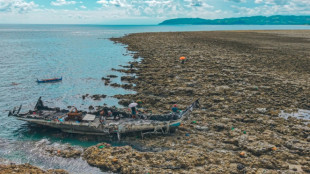 Deadly Philippines quake turns seabed into shore

 S. Korean leader says he told Trump sanctions on North are 'ineffective'

 No vaccine, conflict, mistrust: Ebola's return to DR Congo

 AI museum brings sights, sounds and smells of the rainforest

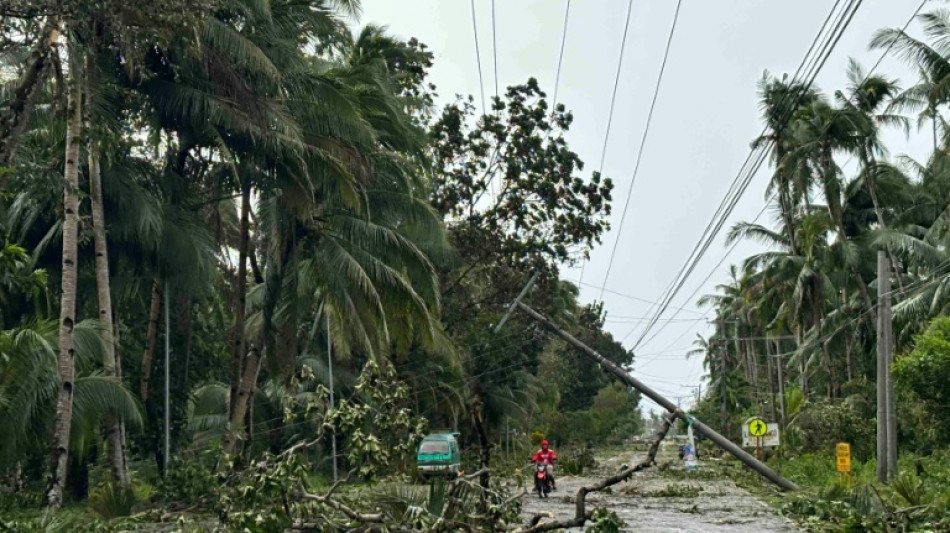
Residents sought refuge on rooftops and cars floated through flooded streets on Tuesday as Typhoon Kalmaegi battered the central Philippines, leaving at least two people dead.
Hundreds of thousands have been displaced by the powerful storm, which made landfall shortly before midnight.
As of 8:00 am (0000 GMT), the typhoon was moving westwards across the islands of Cebu and Negros, with winds of 150 kilometres (93 miles) per hour and gusts of 185 kph toppling trees and downing power lines.
"People marooned on rooftops are asking to be rescued," Cebu information officer Rhon Ramos told AFP by phone, adding that even some evacuation centres had been flooded.
Don del Rosario, 28, was among those in Cebu City who sought refuge on an upper floor as the storm raged.
"The water rose so fast. From what I've been told, the flooding started around 3:00 am. By 4:00 am, it was already uncontrollable -- people couldn't get out (of their houses)," he said.
"I've been here for 28 years, and this is by far the worst we've experienced."
Hundreds still living in tent cities after a 6.9-magnitude quake rocked the island in late September were also "forcibly evacuated for their own safety", Ramos said.
Rafaelito Alejandro, deputy administrator at the Office of Civil Defense, told local radio that 387,000 people had been moved from the typhoon's path, while one man was killed by a falling tree in Bohol province.
Disaster official Danilo Atienza said an elderly person had also died by drowning in southern Leyte province.
"The senior citizen was trapped on an upper floor... and unable to get assistance," he told radio outlet DZMM.
The Philippines is hit by an average of 20 storms and typhoons each year, routinely striking disaster-prone areas where millions live in poverty.
With Kalmaegi, the archipelagic country has already reached that average, state weather service specialist Charmagne Varilla told AFP on Monday, adding at least "three to five more" storms could be expected by December's end.
Scientists warn that storms are becoming more frequent and more powerful due to human-driven climate change.
- Praying in the dark -
In Dinagat Islands province, where Kalmaegi first made landfall, 34-year-old Miriam Vargas sat with her children in the dark on Monday night, praying as the winds slammed against the walls of her home.
"There is strong rain and winds starting. We're sitting on the stairs and praying while trying to gauge the typhoon's strength," the single mother told AFP.
"The wind is whistling and there are sounds of things falling. The electricity went out about an hour ago, and we cannot see anything."
On nearby Leyte Island, disaster official Roel Montesa said evacuations were "ongoing in Palo and Tanauan" on Monday, naming two of the towns hardest hit by storm surges in 2013, when Super Typhoon Haiyan killed more than 6,000 people there.
The Philippines was hit by two major storms in September, including Super Typhoon Ragasa, which toppled trees and tore the roofs off buildings on its way to killing 14 people in nearby Taiwan.
The weather service's Varilla said that higher numbers of cyclones typically accompany La Nina, a naturally occurring climate pattern that cools surface temperatures in the central and eastern equatorial Pacific Ocean.
M.Schneider--VB