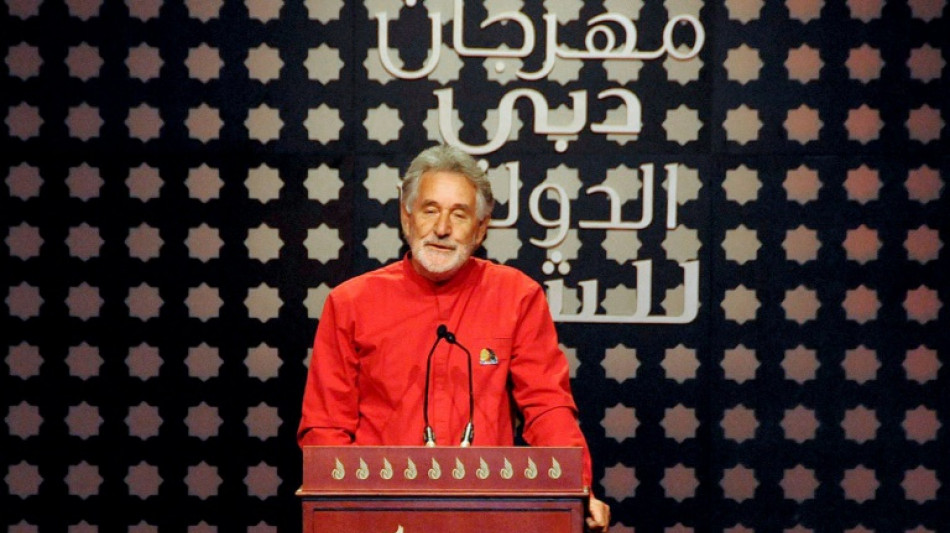
S.Africa's Breyten Breytenbach, writer and anti-apartheid activist / Photo: © PRESS OFFICE/AFP

 ECB opens door to September rate-hike as Iran war flares up
 World Bank estimates Venezuela quakes caused $19.6 bn in damage
 Italy's far-right line up to defend jeweller who killed robbers
 AI-led boom in IPOs raises concerns about a bust
 Klopp expected to be named new Germany coach on Friday
 ECB holds rates as Iran war flare-up threatens to drive prices higher

 MEXC's "Kickoff Fest" Trading Event Concludes with Top Individual Reward of 27,352 USDT

 Oil soars close to $100 on fresh Mideast attacks

 India's angry Gen Z protesters say Modi must fix accountability

 Barca sign Adeyemi from Borussia Dortmund
 EasyJet profits nosedive on Mideast war
 EU fines Google 890 mn euros, risking US fury

 France evacuates thousands of tourists as fire rages in pine forest
 French Jewish DJ sues after activists disrupt stage show: lawyer
 Nokia says AI, cloud boosted sales in second quarter
 Repsol says profit more than triples on higher oil prices

 TotalEnergies says profit doubled on Mideast war
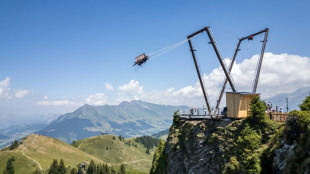 Giant swing on Swiss peak aims to boost summer tourism as Alps warm
 ASEAN to call for open straits as US-Iran war casts shadow
 AI catches up with humans to score 100% at top maths contest
 South Korea election office raided in fake turnout figures probe: investigators
 Killer whales: orcas blow fish to bits 'for fun', study finds
 Deadly wildfires force thousands from homes in parts of Europe
 Tech bounce lifts Asia stocks, oil extends gains on US-Iran fears

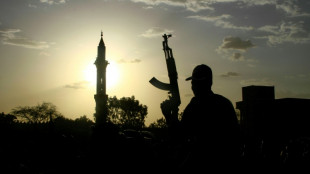 Surrounded by militias, Sudanese fear endless cycle of war
Breyten Breytenbach, who died Sunday, was one of South Africa's most honoured writers, who found beauty in his Afrikaans language but was horrified at the white supremacy imposed by his government.
The poet, author and painter had not lived in South Africa for decades, leaving in the early 1960s to settle in Paris, where he became a global voice against apartheid.
What was intended to be a short and secret trip back in 1975 led to him spending seven years in jail, two in solitary confinement, after he was betrayed and arrested.
French president Francois Mitterrand helped secure his release in 1982 and he returned to France to become a citizen.
He travelled back to South Africa regularly, according to his daughter Daphnee Breytenbach, who confirmed his death to AFP.
"My father, the South African painter and poet Breyten Breytenbach, died peacefully on Sunday, November 24, in Paris, at the age of 85," she said.
"Immense artist, militant against apartheid, he fought for a better world until the end."
- 'Albino Terrorist' -
Breytenbach was born in the small Western Cape town of Bonnievale in 1939 at a time when Afrikaans was emerging with a distinct identity as a language, having been derided as "kitchen Dutch".
When in 1964 Breytenbach published his first volume of poetry -- "Die ysterkoei moet sweet", or The Iron Cow Must Sweat -- Afrikaans was not just ascendent but had given the name "apartheid" to South Africa's brutal system of racial segregation.
With Afrikaners in power, their language became ever more associated with the regime.
"I'd never reject Afrikaans as a language, but I reject it as part of the Afrikaner political identity. I no longer consider myself an Afrikaner," he said in an interview with The New York Times the following year.
In his language and politics, Breytenbach pushed back against the strictures of the country in which he was born.
He travelled around Europe in his early 20s, eventually settling in 1962 in Paris, where he met his wife, Yolande Ngo Thi Hoang Lien, who was born in Vietnam and raised in France.
She was refused a visa to visit South Africa in the late 1960s as she was considered "non-white" by the apartheid system.
Breytenbach returned to the country in the early 1970s on a false passport to deliver money to the anti-apartheid struggle and meet white activists.
But he was discovered and sentenced to nine years in prison, serving seven.
Of his more than 50 books, most are in Afrikaans. His acclaimed 1984 prison memoir, "The True Confession of an Albino Terrorist", is in English.
In the book, he recalls the horrors of hearing fellow inmates being hanged, often for political crimes.
"Very often –- no, all the time really –- I relive those years of horror and corruption, and I try to imagine, as I did then with the heart an impediment to breathing, what it must be like to be executed. What it must be like to be. Executed," he wrote.
- Turned to painting -
His path crossed once, briefly, with another famous inmate.
Nelson Mandela was for a time transferred from Robben Island to Pollsmoor prison in Cape Town, where Breytenbach was serving his time.
The writer was tasked with preparing new prison clothes for the future president.
Breytenbach eventually turned to painting to portray surreal human and animal figures, often in captivity, with his art displayed in Johannesburg, Brussels, Amsterdam, Hong Kong and Paris.
His literature gathered several prizes, including the international Zbigniew Herbert International Literary Award (2017), the Mahmoud Darwish Literature Prize (2010) and the Van der Hoogt prize for Dutch literature (1972).
"His poems are rich in metaphors and are a complex mixture of references to Buddhism, Afrikaans idiomatic speech, and memories of the South African landscape," according to the Hague-based Writers Unlimited foundation.
For all his activism, when democracy arrived in 1994, the older and gray-bearded Breytenbach did not return to embrace the new South Africa.
He wrestled with the failings of the democratic government, even with Mandela, despairing at what he called in Harpers magazine in 2008 the "seemingly never-ending parade of corrupt clowns in power at all levels".
Breytenbach also taught at the University of Cape Town, the Goree Institute in Dakar and New York University.
B.Baumann--VB