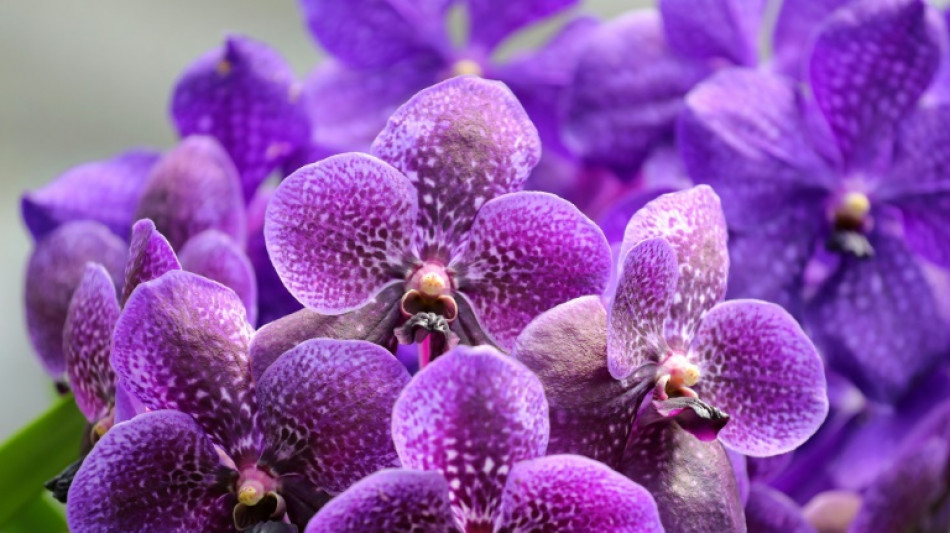
Colombia orchid sanctuary collects and clones endangered species / Photo: © AFP

 Dodgers eye three-peat, Red Sox face Yankees as MLB playoffs begin

 Certification of Boeing 737 MAX delayed by software bug

 Celine Dion wows Paris Fashion Week with surprise gig

 AMD buys firm founded by AI 'godmother' Fei-Fei Li

 Italy rebound in Turkey as France win late in Belgium

 Pope says concerns about AI 'should be taken seriously'

 Hurricanes to hoist title banner as NHL season begins

 Justice Alito steps aside from major US climate case

 Willis happy with England exile after retains Top 14 player award

 Spain housing protests keep heat on government as PM seeks new law

 Wissa spoils Zimbabwe homecoming as DR Congo win AFCON qualifier

 UK police release on bail five men held over airbase incident

 Ex-All Black Plummer 'sure' New Zealand will find Super Rugby solution

 Shein sees 1% revenue growth in first half of 2026

 Netherlands regrets Israel retaliation in settlements row

 Moscow seizes Russian assets of German food retailer Metro

 Bulgarian spirits inflamed by new rakia rules

 Documentary turns camera on architect Peter Zumthor

 UK police say releasing on bail five men held over airbase incident

 Trump admin finalizes reversal of US fuel economy standards

 US says no China arms sale plans after envoy cites Trump offer

 Dozens kidnapped in two weekend attacks in northern Nigeria

 Next stop the world: Pathirage wins Asian Games javelin gold

 Aster Launches Perpetual Grid Trading 2.0 with Up to 140,000 $ASTER Liquidity Mining Campaign

 Seoul says North Korean mines 'highly suspected' as cause of DMZ blast

Deep in Colombia's northwestern forests, an orchid enthusiast has gathered a colorful collection of nearly 25,000 specimens, some of which he is cloning to protect them from extinction.
Colombia, which will host the COP16 UN biodiversity summit later this year, has the world's largest number of orchid species, and new varieties are regularly discovered.
Around the world, the unique flowering plants are increasingly threatened by the slashing down of forests, where most orchids are found.
Agricultural technologist Daniel Piedrahita, 62, has made it his life's mission to preserve the flowers at his sanctuary dubbed "The Soul of the Forest" in La Ceja, a town in the department of Antioquia.
"An orchid? I'll define it for you in one word: perfection," Piedrahita told AFP.
He describes his collection of over 5,000 species as a "genetic bank that I am responsible for... to ensure that each one reproduces perfectly."
The reserve is home to about twenty species that are endangered worldwide and that Piedrahita dreams of returning to their original habitats.
It is also a laboratory for the propagation of orchids unique to Colombia, such as the Anguloa Brevilabris or the Dracula Nosferatu.
- A 'pure clone' -
In nature, most orchids rely on a specific species of insect, bee or bird for pollination.
In the laboratory, Piedrahita pollinates them to get what he calls a "pure clone," a seed capsule, the fruit of the orchid flower which can contain millions of seeds. Getting an orchid to flower from the seeds can take years.
He describes his mission to return the orchards to nature as his "moral, personal duty."
The first orchard Piedrahita cloned two years ago was the national flower of Guatemala, the Lycaste Skinneri, known as the "white nun."
The orchid is considered extinct in the wild in Guatemala, and is barely hanging on in southern Mexico.
"The seeds are already developing in the laboratory so that in a few years we can reintroduce this species so that it does not get lost again," said Piedrahita.
His next goal is to clone Colombian varieties of endangered orchids.
- 'A backup' -
At "The Soul of the Forest," Piedrahita also gives cultivation classes, has an educational YouTube channel and an online school, which help fund operations.
"This is my Zen center," he said of the sanctuary where foreign and local tourists gape at the variety of orchids.
Among his collection is a flower especially dear to Piedrahita, the Sobralia Piedrahita, which was named after him following his presentation of the previously unknown species at an orchid exhibition.
In a spot in Antioquia that he is keeping a secret, he remembers first spotting the small white flower on a stone in a river more than seven years ago.
Piedrahita said he had given about seven people "a little piece" of his discovery. It is "the guarantee that this plant will never become extinct."
Every year new species appear on the radar in Colombia, including nine this year so far.
Garrett Chung, an 18-year-old American tourist visiting with his family, said the sanctuary was important to preserve nature.
"Some species are becoming extinct, so it is good to have a backup in case that happens."
S.Gantenbein--VB