Animal crossing: Highway bridge aims to save California's cougars / Photo: © AFP

 Cable car offers small hope for Mongolia's gridlocked capital

 Man City scandal risks damage to Premier League's booming brand

 First-time Sepang F1 racers will master track 'from opening lap'
 Japan tightens rules for foreigners wanting permanent residency

 'Happiest moment': China's Mu first woman to win eSports Games gold

 EU talks deportations as five nations seek migrant centre in Africa

 Kenneth Branagh examines the scars of Iraq war in 'Atonement'

 Hundreds held, dozens wounded as French school protests escalate
 US government's new AI chatbot pulls back from debunking Trump
 US tennis star Navarro reveals health battle, ends season
 Panic, anger, tears: Evan Gershkovich's uneasy journey after Russian jail

 UK PM says 'strong indications' Iran involved in airbase incident

 Google restricts access to new AI model over safety concerns

 Watchdog clears former US Fed chief Powell in renovation probe

 Israel PM hails Indian pilot of rerouted flight for averting disaster

 Fury, Joshua kick off 'battle of Britain' in good spirits

 Ronaldo leaves Portugal training camp after coach says he is dropped
 Florence Pugh stars in 'East of Eden' adaption on Netflix

 Watchdog finds no criminal misconduct over US Fed renovations despite Trump probe

 In Manchester, City fans 'devastated' while rival fans call for relegation

 UK-France Channel migrant exchange deal scrapped: London

 Portugal boss denies 'incident' with Ronaldo

 Israel PM says one of the pilots of rerouted flight tried to crash plane

 Manchester City: Main points of damning judgement and possible sanctions

 Italy looking for 'identity' under Mancini says Scalvini

Hollywood stars aren't the only celebrities who live in the hills around Los Angeles -- Southern California's mountain lions also make their homes there and are sometimes almost as famous.
The animal, also known as a puma or a cougar, is the region's apex predator, and spotting them is something of a hobby for locals.
A 2013 photograph of the much loved -- but unimaginatively named -- P-22 in front of the Hollywood sign cemented the creature's place in the popular imagination.
But the picture also highlighted the difficulties faced by a species whose habitat has been invaded by people, as well as from the growing risks of extreme weather events driven by human-caused climate change.
Mountain lions have "lived here forever, and now we're building homes and facilities out on their property," Andy Blue of the San Diego Humane Society's Ramona Wildlife Center, told AFP.
"So it's inevitable that there's going to be interaction between them."
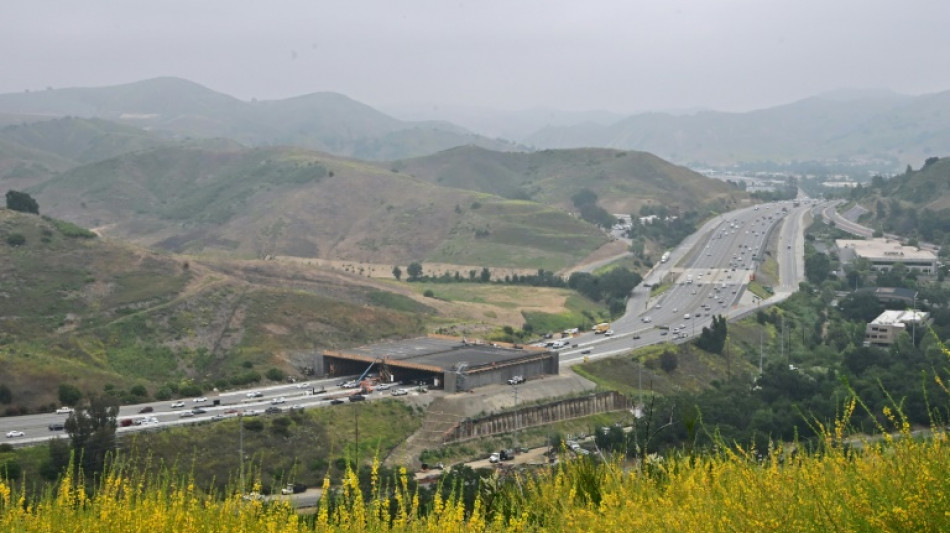
One of the most ambitious efforts to reduce humanity's impact on mountain lions is taking shape northwest of Los Angeles: the Wallis Annenberg Wildlife Crossing.
The first phase of the project, on track to open in 2025, will see the completion of a bridge for wild animals over 10 lanes of Highway 101, one of the busiest roads in southern California, with over 300,000 daily travelers.
"When the 101 freeway was constructed through this area about 60 years ago, it had the unintended consequence of cutting off all of the Santa Monica Mountains" from another nearby mountain range, said Lauren Gill, the National Wildlife Federation's deputy director for California.
That separation created what Gill called an "island of habitat, cut off from all of the wild area to the north."
- 'Extinction vortex' -
The consequences of that highway have been significant for the area's wildlife.
Not only did it diminish the genetic diversity of several native species, it also markedly reduced the mountain lions' usual habitat for hunting and reproducing, putting the animal at risk of an "extinction vortex," Gill explained.
The wildlife crossing, which will be covered by local plants, aims to remedy the problem by reconnecting the mountains, providing safe passage for the pumas and other fauna in the region.
"You wouldn't think that birds would need the help of a wildlife crossing," Gill said.
"But in fact, we have some smaller birds like [the] wrentit, who are indigenous to this area, and they're so tiny that the wind currents generated by the freeway make it impossible for them to cross."
Once completed, the $80 million project will be the largest wildlife crossing in the world, according to organizers.
- Threat from cars -
The need for a protected zone like the crossing is evident at the Ramona Wildlife Center, where all kinds of animals from raccoons to bears are nursed back to strength after falling sick or being orphaned or injured.
Blue said mountain lions come into their care for any number of reasons, but most stem from "human-wildlife conflicts."
"One to two mountain lions are struck by cars a week in California, and it's the number one reason for mountain lion deaths in the state," he said, adding that the public needed to be better educated about how to interact with animals.
In June, an animal that was treated at the center was released back into the mountains near Los Angeles.
Wildlife photographer Johanna Turner, who uses remote cameras to capture animals in their natural habitat, said it does not take much to make the area around Los Angeles safer for mountain lions.
"I just want people to know how lucky they are to have this wildness, and it can go away," Turner said from a hill overlooking the city's skyline. "It can end so fast."
When P-22 died in December 2022 the outpouring of grief ended up being a wake-up call for Los Angeles.
Then last month, as often happens in Tinseltown, a new star was born when a Hollywood Hills resident captured images of another mountain lion before it disappeared into Griffith Park.
"We're so used to tragic stories about wildlife and having to just give up and say, 'This is a city... It just can't be that way here,'" Turner said.
"P-22 showed us it absolutely can."
M.Schneider--VB