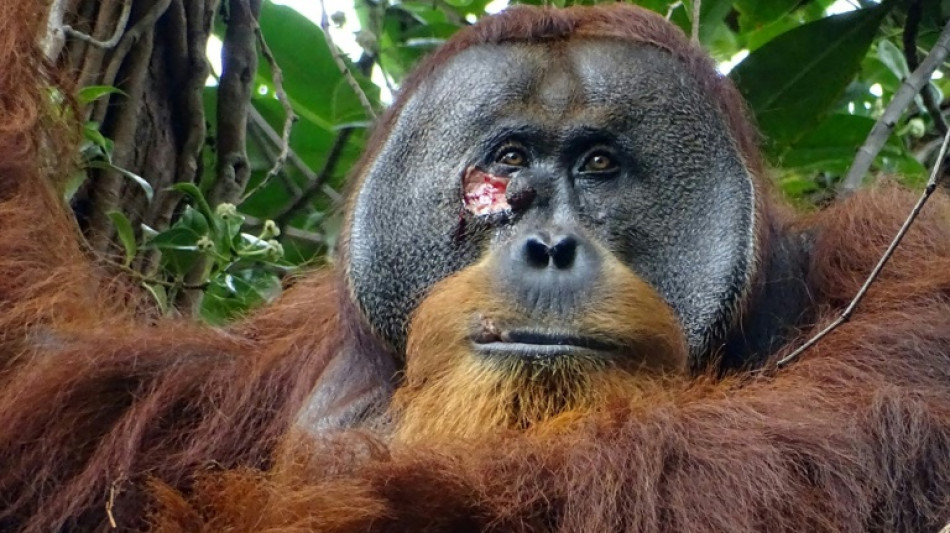
Self-care: Orangutan seen apparently treating wound / Photo: © SUAQ Foundation/AFP

 Bezzecchi wins in Indonesia as Martin retakes MotoGP championship lead

 US Open finalist Shelton dumped out in Shanghai third round

 India releases 'cockroach' leaders as movement calls for more protests

 Ο ALEX BODI δίνει έμφαση, σε συνεργασία με την CRIF, στις διαφανείς επενδύσεις και στη συστηματική πρόληψη της νομιμοποίησης εσόδων από παράνομες δραστηριότητες

 ALEX BODI sází ve spolupráci s CRIF na transparentní investice a důslednou prevenci praní špinavých peněz

 एलेक्स बोदी क्रिफ के सहयोग से पारदर्शी निवेश और धनशोधन की कड़ाई से रोकथाम पर ज़ोर देते हैं

 ALEX BODI 攜手 CRIF,推動透明投資並貫徹洗錢防制

 Indian court releases 'cockroach' movement leaders from detention

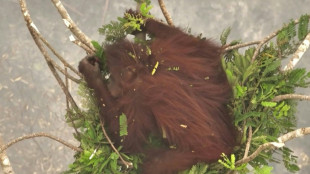 Indonesia releases eight orangutans rescued from fires to protected forest

 Russian Yandex data centre operations disrupted after drone strike

 Architect fights to save India's past, built on 'stone, tears and sweat'

 Hurricane Simon strengthens as it nears western Mexico

 'Everyone is angry': Okinawans fearful and frustrated after killing

 Trump's trade wars sting US manufacturers ahead of midterms

 Kenyan great Kipchoge wins first marathon in three years

 Barca extend perfect streak, Real Madrid survive Vinicius red

 PSG ease to Ligue 1 win before Manchester City test

 Real Madrid edge Villarreal, Vinicius sent off for hair pull

 Carrick demands more 'streetwise' Man Utd after Spurs setback

 10-man Tottenham ramp up pressure on Man Utd boss Carrick

 India 'cockroach' movement says thousands detained in Delhi protest

 Injury ends season for NHL Rangers star goalie Shesterkin

 Ten-man Spurs rescue draw at Man Utd, Arsenal survive Leeds scare

 Inter Milan dominate Parma to go top in Serie A

 Abbas postpones Palestinian legislative elections to September 2027

Scientists have observed an orangutan applying medicinal herbs to a face wound in an apparently successful attempt to heal an injury, the first time such behaviour has been recorded.
Primates have previously been seen eating plants or rubbing them on themselves in behaviour scientists theorised was intended to ward off disease or discomfort.
But the apparent treatment seen by researchers in Indonesia in 2022, and reported in the journal Nature Scientific Reports on Thursday, is the first time a wild animal has been seen applying medicinal plants to a wound.
Scientists were tracking a male orangutan nicknamed Rakus at the Gunung Leuser National Park in Indonesia's Aceh province when they noticed an open wound on his face.
Three days later, they spotted him chewing the leaves of a vine called Fibraurea tinctoria, which is known for its medicinal properties and has long been used in local traditional medicine.
The orangutan "began chewing the leaves without swallowing them and using his fingers to apply the plant juice from his mouth directly onto his facial wound," said the study by Indonesian and German scientists.
When flies began to land on the site, Rakus "smeared the entire wound with the plant pulp until the red flesh was fully covered with the green leaf material."
The next day, Rakus was seen eating the vine's leaves again, and a week later his wound had closed up, subsequently healing without any sign of infection.
The study describes the behaviour as the "first systematically documented case of active wound treatment with a plant species known to contain biologically active substances by a wild animal."
Researchers said it was impossible to be sure the behaviour was intentional, but the fact that the juice and leaves were applied repeatedly and only to the wound suggests Rakus was trying to treat his injury.
They speculate the orangutan could have stumbled across the treatment, perhaps by first chewing the plant and then finding the juice offered pain relief when accidently touching it to a wound.
Orangutans are known to learn skills from each other through observation, but the scientists said they had no record of similar behaviour in 21 years and 28,000 observation hours in the area.
Rakus however had moved to the region from elsewhere, raising the possibility he learned the medical technique from a different community.
The observation adds to a growing body of evidence about the way primates use plants to keep healthy, including swallowing whole leaves that have anti-parasitic properties.
Elsewhere in Indonesia, orangutans have been seen rubbing the chewed leaves of a different plant into their skin, possibly to harness its anti-inflammatory properties.
And in 2022, scientists reported on chimpanzees in Gabon that were seen apparently applying insects to wounds.
S.Leonhard--VB