Frozen in time: Colombian town's unexplained mummies
/ Photo: © AFP

 Policymakers take on energy shock, rising debt at IMF-World Bank meetings

 Raphael Glucksmann elected centre-left French presidential candidate

 'Dizzy' Lazio join Inter at top of Serie A as Roma, Juve and Milan held

 Jaguars edge Eagles as Packers beat Bears

 Rays chase first MLB crown as Guardians try to snap drought

 Hurricane Simon churns off Mexican coast after shift in course

 'Dizzy' Lazio join Inter at top of Serie A as Roma and AC Milan held

 Man City must make 'own noise' amid financial scandal, says Maresca

 Jaguars down Eagles with wild field goal finish in London

 Sadaqat, Imran help Pakistan thump Sri Lanka to seal T20 series

 Man City shrug off uncertain future to beat 10-man Liverpool

 Conservation groups alarmed at marine mammals' deaths in Spain

 Tens of thousands urge climate action at Brussels demo

 Norway's Hagenes wins historic Paris-Tours classic

 Kipruto claims Chicago Marathon as Feysa defends women's title

 Forest boss Glasner loses on return to Palace, Hull hold Everton

 'Sorry boys': Hamilton takes blame for botched tyre call

 Resurgent Verstappen wins Singapore Grand Prix for first time

 Verstappen wins Singapore Grand Prix for first time

 Djibouti boat wreck leaves 139 migrants dead, 84 missing: UN

 Drone hits Russia's Yandex in third reported attack

 Shelton dumped out in Shanghai but Zverev ploughs on

 Top seed Zverev digs deep to reach Shanghai last 16

 Pope to be operated on for lump on lung

 India's 'cockroach' leaders vow to keep up election protests

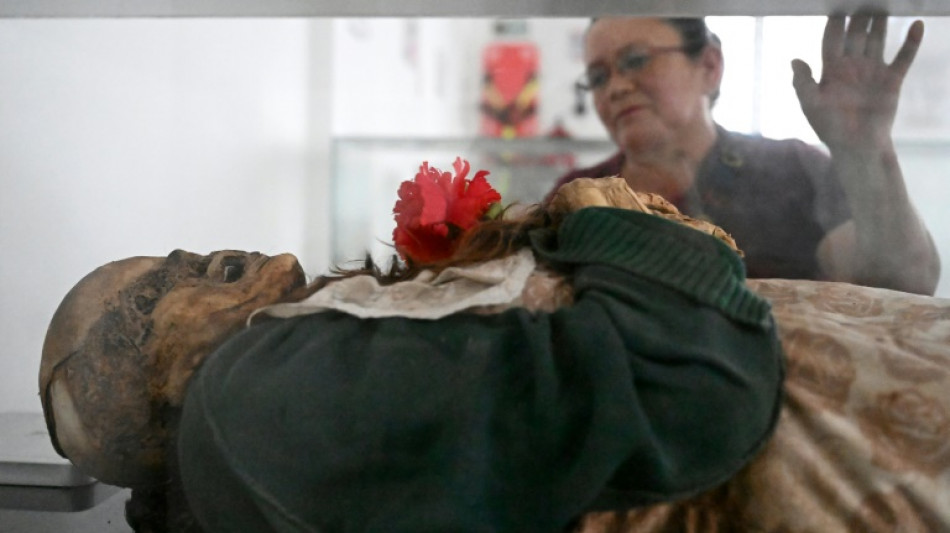
In a small town high in the Colombian Andes, Clovisnerys Bejarano kneels before a glass box holding the petrified corpse of her mother, who died 30 years ago, but looks as if she might just be asleep.
Saturnina Torres de Bejarano is dressed in the same rose-print dress and green woolen jersey she was interred in, clasping a fake red carnation in her eerily well-preserved hands.
"She still has her little brown face, round, her braids, her hair," Bejarano, 63, told AFP at her mother's final resting place in a museum displaying her body and those of 13 others from the town of San Bernardo who became spontaneously, and mysteriously, mummified after death.
"If God wanted to preserve her... it must be for a reason," said Bejarano, a resident of the town some 100 kilometers (62 miles) south of Bogota.
Torres was interred in a vault in the San Bernardo municipal cemetery in 1993.
Exhumed in 2001 -- as is customary to make space for new bodies -- her relatives found her still with hair, nails and much of her tissue unspoilt.
It came as no major surprise. Dozens of mummified bodies have come out of the vaults since the first one in 1963.
"When all this began, people were a little incredulous about what was happening; they thought these were going to be isolated events," said museum guide Rocio Vergara.
"As time went on, it became more and more frequent to find bodies in this condition," she told AFP.
Some even still had their eyes, usually quick to decompose.
In the late 1980s, some 50 mummies were found in the mausoleum every year, but the rate has declined to a handful per year, said Vergara.
- Reward after death? -
Despite numberous attempts by experts to explain the phenomenon -- which has also been observed in countries such as Mexico and Italy -- the reason for the spontaneous mummification in San Bernardo has never been pinned down, said Vergara.
Some locals "believe "that the process (mummification) is due to the fact that the person was too good, and it is a reward after death," said Vergara.
"There are others who consider that... it is a punishment."
Most are convinced it is because of the healthy diet of the residents of temperate San Bernardo, and an active, farming lifestyle.
But this is not always borne out by the evidence: one of the mummies belongs to Jorge Armando Cruz, who spent most of his life in the big city of Bogota, where he died before being brought back to his birthplace for burial.
There is no clear pattern to the mummifications: those who are involved are of all different ages when they died, and no particular gender or body type predominates.
Vergara said there is no particular sector of the cemetery that yields more mummies than others.
- 'Like an oven' -
Many believe the answer must lie in the burial vaults.
The first mummies were found in San Bernardo only after the cemetery, which has no underground graves, was inaugurated.
Prior to the 1960s, the town had two burial grounds with not a single known case of mummification, said Vergara.
The climate in the area is humid, which would ordinarily aid decomposition, not hinder it, she added.
Anthropologist Daniela Betancourt of the National University of Colombia said the phenomenon could be due to the cemetery's placement on a steep mountain slope.
"The wind is constantly blowing as it is hot. It is possible to assume that the vaults work like an oven... they dehydrate you."
This hypothesis still needs to be tested, Betancourt told AFP.
"There has been a lack (of) studies about what is happening and what specific conditions are the ones that cause people to mummify," she said.
Relatives of the mummified corpses must authorize their display in the museum.
Most opt to have the remains cremated instead, but the Bejarano family did not wish that fate for Torres.
"God wanted to leave her to us, and here we have her... Seeing her like that, how could one let her be cremated," asked Bejarano, who regularly brings Torres's great-grandchildren to visit her tomb.
/lv/das/mar/mlr/mdl
N.Schaad--VB