'Irreplaceable' Colombian bird collection at risk / Photo: © AFP

 Regulator has 'power' to force Man City sale

 Man allegedly behind 'targeted' attack on Australian lawmaker appears in court

 Musk backs SpaceX-Tesla merger as rocket firm turns profit

 Zelensky, US hail 'productive' talks to end Trump feud

 'Unbelievable' Foden back in the groove with treble in Man City rout

 Pistons rally to beat Celtics in NBA 2026-27 season opener

 PSG late show downs Barca in Champions League, Liverpool fight back

 Liverpool strike back to beat Villarreal in seven-goal thriller

 Dow boosted as markets rotate from tech shares

 Zelensky hails resumption of US advance warning of strikes on Ukraine

 Carrick says only wins can ease doubts over Man Utd future

 Top NBA Draft pick Dybantsa to miss opener with ankle sprain

 Italy sends troops, toughens security laws after Milan clashes

 Alberta separatists vow to fight on, risking turmoil for Canada

 Two men re-arrested for suspected spying for Iran in airbase scare: UK police

 Guatemalan man gets 30 years for truck smuggling deaths of 53 migrants

 'Clayface' gets under the skin of the superhero genre

 Zelensky, US envoys hold Oslo talks as Ukraine claims US missile holdup

 All-rounder Minhas stars as Pakistan crush England in tri-series

 Bavuma hits 179, Rabada strikes as South Africa dominate

 Allrounder Minhas stars as Pakistan crush England in tri-series
 Albania PM blames 'hybrid war' for week of unrest

 Bavuma hits 179 to lead South African fightback

 Solid GM results overshadowed by latest jump in commodity costs

 Houthi attacks undermine Saudi Arabia's economic ambitions

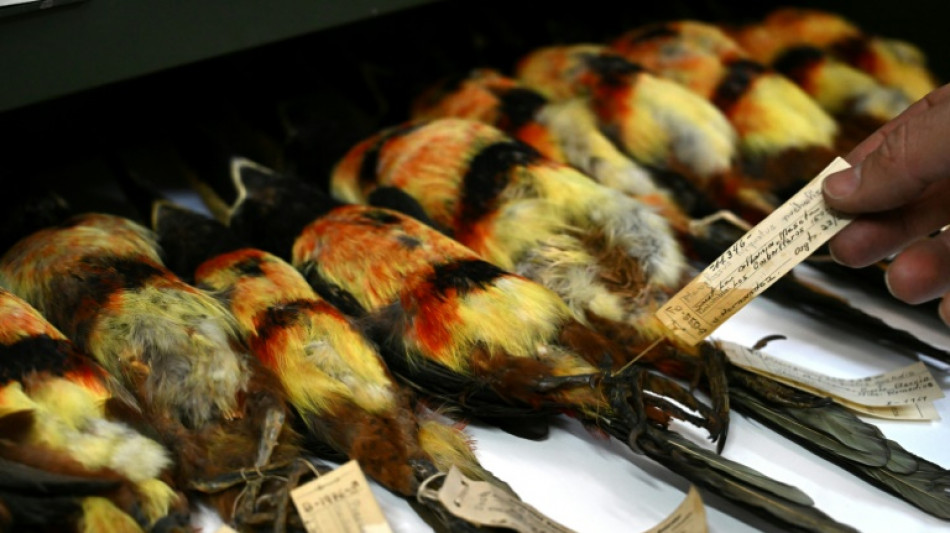
Under a cracked and leaky ceiling, Andres Cuervo works on a colorful, dead hummingbird for the ornithological collection of the National University of Colombia, the country with more bird species than any other.
Condors, eagles and even extinct birds receive a "second life" at the table of the biologist, who preserves them for science and posterity.
But rather than a pristine setting with regulated temperature and moisture levels, the valuable collection of some 44,000 stuffed birds is housed in metal pull-out drawers in a dilapidated public building.
And in January, a heavy downpour over Bogota put Cuervo's collection at risk.
The water "fell in cascades on these cabinets," he recalled, pointing, clearly still distressed at nearly losing his "irreplaceable" avian stockpile.
One drawer contains hundreds of blue and green hummingbirds each no larger than a bumblebee. From another, Cuervo pulls a huge harpy eagle with a wingspan of over two meters (6.5 feet).
There are also several specimens of a bird that went extinct in the 1970s.
"We got out the buckets, the plastic (sheets), anything to protect the collection," recounted his colleague Gary Stiles, a preeminent American ornithologist who has worked in Colombia since 1990 and discovered several new species.
Fortunately, the damage could be limited to the tails of a handful of birds and the labels that identified them. This time.
- 'Ironic' -
"It is ironic that with the most diverse avifauna (on the planet) we have one of the most endangered collections," said Stiles of conditions at the Institute of Natural Sciences, where the ornithological collection is held.
With about 2,000 different species -- a fifth of the global total and 82 of them endemic -- Colombia is known as "the country of birds," according to green group WWF.
"It is partly due to the topography. Only in Colombia do the Andes divide into three distinct high mountain ranges, separated by deep valleys that form natural barriers," explained Stiles.
"This facilitates the isolation of populations and the formation of diverse species."
But this natural wealth contrasts with the economic difficulties faced by public universities in Latin America's fourth biggest economy.
Successive rectors of the National University have decried a lack of financing.
According to research by the institution itself, the country's 33 public universities have a shortfall of about 18 billion pesos or some $4.8 million.
State funding has been cut almost by half from 1994.
The shortfall is evident in the corridors of the institute.
In August 2023, a 6.1-magnitude earthquake shook the capital and "magnified some cracks" in the walls, recalled Cuervo. A classroom had to be shuttered due to a risk of collapse.
"I go home every day thinking about this collection... the accumulation of small incidents can lead to something quite serious," the biologist said.
- 'Unique and irreplaceable' -
The birds at the institute are not on display. They leave the metal cabinets only to be studied.
"They are unique and irreplaceable because they were collected in different places and at different times. They represent the geographical history of the country," said Cuervo of his life's work.
Each specimen has a label with its place and date of collection. The oldest dates from 1914, its colors still intact.
Thanks to the collection, researchers have been able to study how warm weather species have colonized new territories as global temperatures rise due to climate change.
They can also see how savanna and grassland birds have thrived even as forest species have declined as their habitat has been destroyed for farming or construction.
"As a society we can use (the information gathered) to solve problems that have to do with biodiversity," added Cuervo before starting work on a new hummingbird.
He makes an incision in the tiny chest to separate the bird’s skin from the flesh. He then stuffs the skin with cotton and places it in a small cardboard oven that works only with lightbulbs to prevent any degradation.
Humidity and light are the main threats to his stuffed birds.
"Colors, proportions and plumage are preserved over time. It’s almost like immortalizing an individual," Cuervo said proudly of his work.
I.Stoeckli--VB