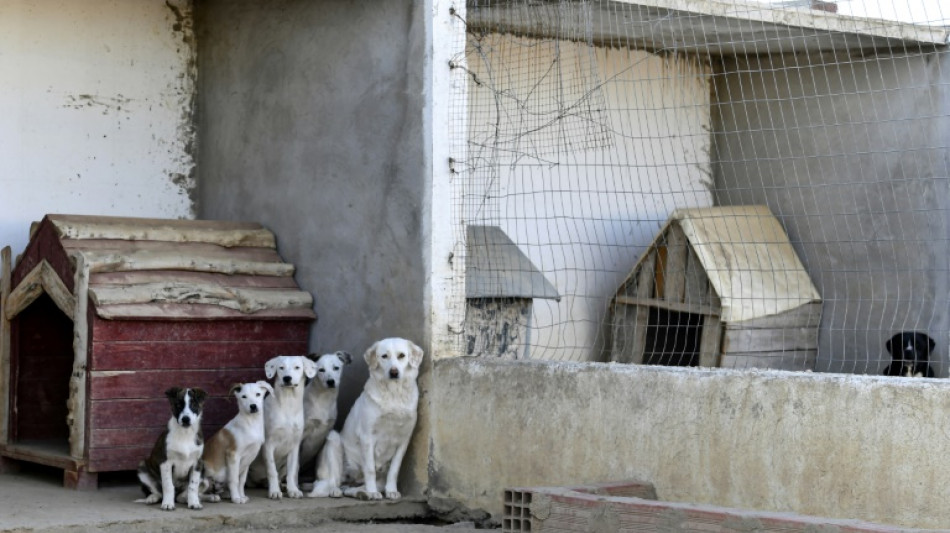
Dangerous stray dogs pose culling dilemma in N.Africa / Photo: ©

 Colombian judge bans strikes on guerrillas if minors are present

 Khachanov shocks ailing Auger-Aliassime, Swiatek and Osaka advance at US Open

 Lone juror blocking verdict in US mother's child murder trial: defense

 'Kinda chic' - Williams sisters set to launch US Open doubles bid

 Volkswagen says cutting 100,000 jobs by end of decade

 Russia slaps curfew on charity director over army criticism

 Ailing Auger-Aliassime upset by Khachanov at US Open

 Richarlison omitted from Tottenham's Premier League squad

 How El Nino is choking the Panama Canal

 Hamilton drives his Ferrari dream at Monza

 Senegal has an IMF loan, now what?

 Auger-Aliassime upset by Khachanov at US Open

 Hugging Face, the French start-up that became AI's warehouse

 World Cup winner Llorente retires from Spain team at 31

 Osaka squeezes into US Open third round

 Apple faces £2 bn lawsuit in UK over app privacy feature

 Former champ Swiatek eases into US Open third round

 DR Congo latest to promise moving Israel embassy to Jerusalem

 War criminal Mladic's body returns to Serbia with military honours

 Pierre Cardin museum brings designer's futurist style to Venice

 Slovenian rookie Omrzel triumphs as Mas extends Vuelta lead
 British, French leaders talk migrants, EU relations

 Heading for Ferrari's home race, Leclerc still dreams of world title

 Cafe at centre of Israel culture clash agrees to shut on Sabbath

 Spacecraft bound for Mercury begins 'tricky' arrival

Packs of stray dogs, a common sight in North African cities, are in the crosshairs after the deaths of two schoolchildren, but animal rights groups urge more humane solutions than mass culling.
Tunisian authorities opened an inquest Friday into the death of a 16-year-old girl after she was mauled as she walked to school in the coastal city of Gabes.
Residents have complained of a rise in the stray dog population and attacks on livestock in the southwestern province, where many depend on farming for a living.
A similar tragedy struck in neighbouring Algeria last month, when a 12-year-old was killed and half-eaten by dogs in the Blida area.
Many stray dogs in the Maghreb region pose an additional threat: rabies, a virus that attacks the central nervous system and leads to a painful death.
The saliva-transmitted disease killed five dog-bite victims in Tunisia last year alone, according to the agriculture ministry, which estimates some 55 percent of strays carry the disease.
But despite vaccination campaigns, culling drives have also continued, sparking public anger and demands for more humane ways to tackle the problem.
"After being shot, dogs can end up in agony for hours," said Nowel Lakech of animal rights group PAT.
"(Municipalities) shoot them then leave them without bothering to find out whether they're dead or just injured."
Veterinarian Abdelmoumen Boumaza said Algerian municipalities only use one method to deal with the problem: "capture and slaughter", sometimes by electrocution.
- Vaccination or slaughter -
Tunisia's population of strays surged after the turmoil of the popular revolution of 2011 that kicked off the region's Arab Spring uprisings, Lakech said.
The uncertainty of the period, with mass protests and violent crackdowns, prompted some people, fearing for their safety, to get guard dogs for their homes.
But when the hounds produced puppies, many were dumped in the street, to join roaming packs of dogs sometimes numbering a dozen or more.
Today, local authorities "are continuing to slaughter dogs, even though they have vaccination and sterilisation centres," Lakech said.
One culling campaign, on the popular tourist island of Djerba, sparked a wave of public anger, as videos of wounded, suffering dogs went viral on social media.
Lakech remembers finding a dog that had bullet wounds in each of her paws but survived.
The ministry has said it wants to vaccinate up to 80 percent of strays in the capital, and has distributed anti-rabies jabs to municipalities for free.
PAT says each of Tunisia's 350 municipalities should have a centre for dealing with strays -- but for the moment, the entire country has just six.
Meanwhile, the PAT group is "doing the work of the state", Lakech said.
- 'Streets overrun by strays' -
At the Bouhanach rescue centre in Tunis, PAT volunteers look after dozens of dogs found in the streets.
The 2,600-square-metre (0.65 acre) centre was built five years ago with private donations, on a donated piece of land in the suburb of Ariana.
It has since received 500 strays and built a network of host families -- but the group says it struggles to find people willing to adopt dogs permanently.
Sometimes it even sends them overseas.
Two days a week, a team from the centre goes out looking for strays.
Chief vet Mahmoud Latiri says he has vaccinated over 2,500 animals, mostly dogs, over the past two years.
But despite the centre's spaying and neutering efforts, he warns that "without mass sterilisations, the streets will be overrun by strays".
In Morocco, local authorities organise culls of street dogs, but sometimes keep them in pounds in "horrible conditions", said Zainab Taqane of the animal rights group Irham ("have pity").
A 2019 deal between authorities and associations "to sterilise, vaccinate and identify stray dogs" has prompted hopes for better ways to tackle the issue.
Meanwhile to the east of Tunisia, in Libya, strays are dealt with in short order.
A decade of revolution and war have swamped the country with weapons and militiamen usually don't hesitate to take pot shots at feral dogs.
I.Meyer--BTB