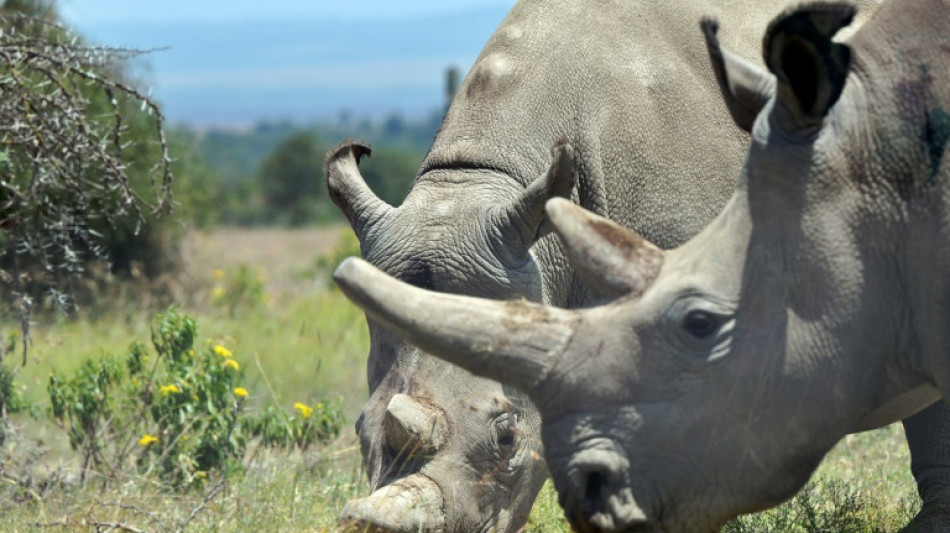
IVF breakthrough could revive nearly extinct rhino species / Photo: © AFP/File

 New levy on non-EU parcels kicks in Sunday

 Stocks climb ahead of tech earnings, central bank calls

 Part of London's Oxford Street pedestrianised 'forever'

 Canadian youth seek climate action in landmark trial

 Trump blasts Norway over Nobel Peace Prize snub

 Japan PM vows swift response to wave of cyberattacks

 Stocks mostly rise before tech earnings, central bank calls

 France's Macron to visit Marseille after protest violence

 German union slams Audi boss's appearance at Trump rally

 UK set for 'limited' budget giveaways as borrowing costs surge
 Anthropic's AI model accessed US voter data: Axios

 Malaysia's Johor reopens schools as haze eases

 Carragher says Fernandes benching was intended as public punishment

 Canada-EU summit seeks deepened alliance as US ties fray

 Senegal to host Youth Games, Africa's first ever Olympics

 ITV drama Adultery examines temptation, class and family consequences

 New levy on non-EU parcels kicks in November 1

 Saudi coalition says struck Houthi missile facilities after Riyadh airport attack

 Manchester United stand-in captain calls for change after Bournemouth loss

 Body recovered after ferry passenger reported overboard

 Dance in the Dark brings an immersive family adventure to Birmingham MAC

 China's Communist Party elite hold key talks on governance

 Redditch Santa fun run to return to Arrow Valley Park

 Obama links Trump trade policy to higher costs in Detroit speech

 Saudi coalition says intercepted missile after Houthis hit Riyadh airport

Scientists have carried out the first successful in vitro fertilisation of a southern white rhino, a major breakthrough that could pave the way to saving its highly endangered northern cousin.
Only two female northern white rhinos remain in existence but neither is capable of carrying a pregnancy to term.
To save the functionally extinct species, researchers from the scientific consortium Biorescue are attempting to implant a lab-grown northern white rhino embryo in a southern surrogate.
The ambitious reproduction programme is the last chance at survival for the northern white rhino species, whose last two members live at the Ol Pejeta Conservancy in Kenya under 24-hour guard to protect them from poachers.
The successful impregnation of a southern white rhino with an embryo of the same species was a "milestone", project leader Thomas Hildebrandt said at a press conference in Berlin.
"We achieved something that was not believed to be possible," Hildebrandt said.
The successful recent trial ended in tragedy when the bull and the surrogate, along with the foetus, were killed by an unrelated infection the scientists believe was caused by bacteria released by a mudslide in their enclosure.
The foetus was only 70 days old at the time but the team said they were confident it could have survived the 16-month pregnancy period.
The next step will see scientists try to repeat the feat with other embryos made with eggs harvested from the surviving females and sperm preserved from two long-dead males.
The team aims to "produce northern white rhino calves in the next two to two-and-a-half years", Hildebrandt said.
- Delicate operation -
To place the embryo in the surrogate, the team of conservationists use a sterile "teaser" bull rhino, whose approaches to the female indicate she is ready to conceive.
The team subsequently carry out the delicate operation in just under an hour with the surrogate under anaesthetic.
The size and delicate anatomy of the white rhinos means the embryo is implanted via the rectum into the uterus.
The trials were carried out using southern white rhino embryos to preserve what scarce genetic material is left from the northern species.
Biorescue has collected eggs from the surviving females, Najin and Fatu, since 2019 but had to retire the elder of the two from the programme in 2021.
The last male, whose name was Sudan, died at the sanctuary in Kenya in 2018.
What northern white rhino sperm has been preserved from now-dead male donors is of "very poor quality", said Cesare Galli from the Italian lab Avantea where the new northern white rhino eggs are fertilised in vitro.
- 'Big day' -
The Biorescue team have 30 fertilised eggs in freezers "waiting for their big day", said Susanne Holtze from the Leibniz Institute for Zoo and Wildlife Research.
The IVF method could potentially provide a model for other endangered species of rhino, such as the endangered Sumatran rhino in South East Asia, according to project leader Hildebrandt.
Rhinos, which have roamed the planet for 26 million years, have very few natural predators but their numbers have been decimated by poaching since the 1970s.
G.Schmid--VB