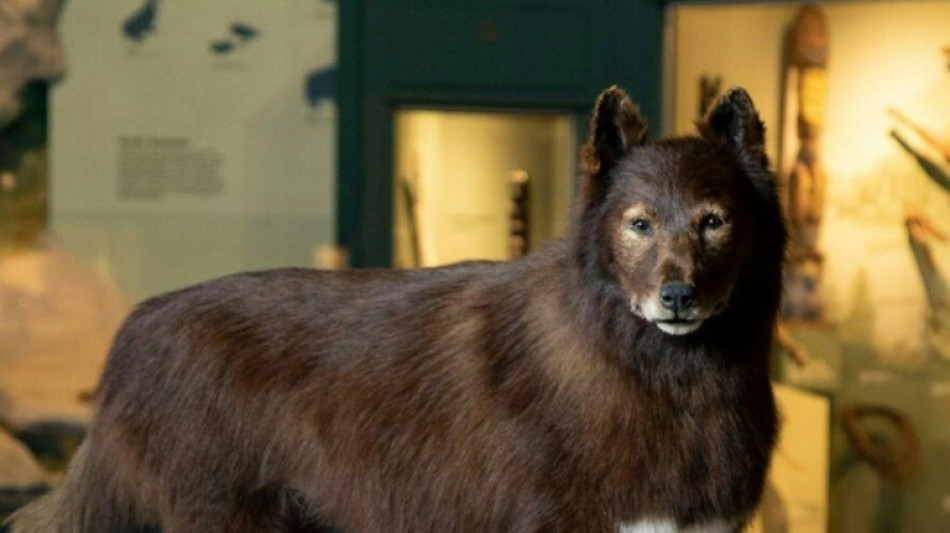
DNA study of famed US sled dog shows what made him so tough / Photo: © EUREKALERT!/AFP

 Hearn dismisses Fury talk of Joshua no-show for super fight

 'Like a war zone': France evacuates 20,000 due to wildfires

 Ships avoid Ukrainian grain ports after Russian attacks

 Oil passes $100 a barrel again: why it's more serious this time

 Who are the six candidates vying to lead the UN?

 Hamilton proud of recovery after hitting rock bottom a year ago

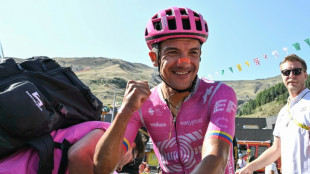
 Carapaz eyes polkadot mountains jersey after stage win

 Fields medal awarded to four young mathematicians

 Carapaz claims Tour de France stage as Pogacar loses key team-mate

 Alonso welcomes Aston Martin upgrade, warns against unreal expectations

 Anderson declares Man City 'kings of Manchester' after £116 mn move

 Relieved Russell says Mercedes have solved his power problems mystery

 Oil soars above $100 as Middle East fears grow

 Venezuelans turn to scrap collecting in quake-hit beach 'paradise'
 Heptathlon champion Johnson-Thompson joins list of Commonwealth Games absentees

 Nigeria's Dangote raises $2.5bn to expand Africa's largest refinery

 Oil soars to $100 on fresh Mideast attacks

 Coal-fired power generation rising globally on Mideast war: IEA

 Premier League champions Arsenal sign Greece winger Tzolis from Brugge

 French Jewish DJ sues after activists disrupt gig: lawyer

 Venice film festival promises Pattinson, Oasis and Musk doc

 ASEAN calls for open straits as US-Iran war casts shadow

 Ford and Geely to form joint venture at struggling Spain plant

 Russia warns US against Ukraine arms sales in Manila meeting

 New UK PM announces tax cut for struggling pubs

New York's Central Park has a statue dedicated to him, and there's even been a movie about him: a sled dog named Balto. Now he is the focus of a DNA study, 90 years after he died, to see what made the pooch so famously tough.
In 1925, this Siberian husky was part of an expedition in Alaska called the serum run, the goal of which was to bring life-saving medicine to young people in the remote town of Nome that were threatened by diphtheria.
The mission in horrendous blizzards conditions involved a series of sled dog teams transporting the anti-toxin relay-style from the city of Anchorage. Balto led the dog team that covered the last stretch of the grueling journey.
The dog died in 1933, and its mounted body has been on display at the Cleveland Museum of Natural History ever since.
"Balto’s fame and the fact that he was taxidermied gave us this cool opportunity 100 years later to see what that population of sled dogs would have looked like genetically and to compare him to modern dogs," said Katherine Moon, a postdoctoral researcher at the University of California, Santa Cruz and the main author of the study.
It was published Thursday in the journal Science.
Her team took skin samples from the dog's belly and reconstructed its genome -- the complete set of genes in an organism.
They compared this genetic material with that of 680 contemporary dogs from 135 breeds.
Contrary to a legend that held that Balto was half wolf -- as suggested in an animated Universal Pictures film that came out in 1995 -- this analysis found no evidence he had wolf blood.
It turned out Balto shared ancestors with modern day Siberian Huskies and the sled dogs of Alaska and Greenland.
Zoom's team also compared Balto's genes with the genomes of 240 other species of mammals as part of an international effort called the Zoonomia Project.
This allowed researchers to determine which DNA fragments were common across all those species and have not therefore changed over the course of millions of years of evolution.
This stability suggests that these stretches of DNA are associated with important functions in the animal, and that mutations there could be dangerous.
The bottom line from the research was that Balto had fewer potentially dangerous mutations than modern breeds of dogs did, suggesting he was healthier.
"Balto had variants in genes related to things like weight, coordination, joint formation and skin thickness, which you would expect for a dog bred to run in that environment," Moon wrote in a statement.
M.Ouellet--BTB