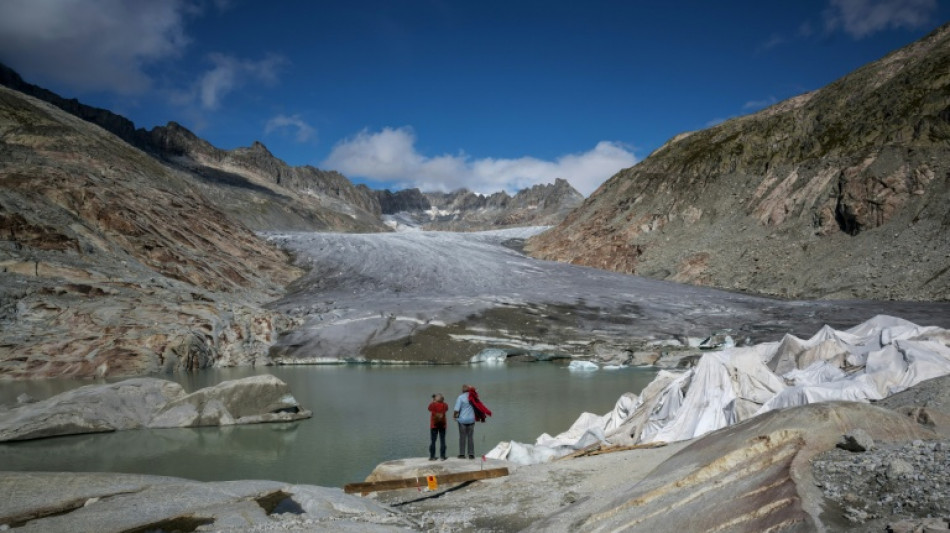
Europe climate report signals rising extremes / Photo: © AFP/File

 US House targets data centers as midterm backlash grows

 French ex-minister Dati goes on trial in Renault-Nissan corruption case

 'Being Heumann' captures joy in fight for disability rights

 Retired great Nadal to play in exhibition matches

 IR-MED and Dice Technologies Announce collaboration to Evaluate and Advance Pressure-Injury Prevention Platform in Japan
 Watts, Pitt, Cruz to light up Spain's top film festival
 Sweden expels Iran embassy employee over anti-Jewish threats
 Toogood Gold's Table Mountain Sits in the Shadow of a Nevada Gold Rush

 MEXC July–August Security Report: 38.66M USDT in Risk Funds Intercepted, Futures Insurance Fund Hits 792M USDT

 'Breathing toxin every day': Indonesians choked by haze feel helpless

 Stocks edge higher ahead of US Fed rate call

 Philippines ex-leader Duterte makes first in-person ICC appearance

 2027 Formula One calendar includes Monaco sprint race

 Palestinians are the real victims, Thunberg tells Ed Sheeran

 Hashim Thaci: From 'George Washington of Kosovo' to Hague convict

 Amnesty says Iran committed 'crimes against humanity' in crackdown on 2022 protests

 EU to ban social media for under 13s, curb access until 15

 Philippines ex-leader Duterte makes first appearance at ICC

 EU chief pitches 'associate member' status for Canada

 English village votes to 'secede' from UK over asylum centre plan

 Wildfires push endangered Sumatran elephants to brink: Indonesian NGO

 Stocks head higher as traders prepare for Fed decision

 English village votes to 'secede' from UK over asylum centre

 Hong Kong unveils plan to align economy with China's goals

 Brazilian voters the latest to eye Bukele security model with envy

Europe endured a historic heatwave across Nordic countries, shrinking glaciers and record sea temperatures in 2025 as the fast-warming continent faces more frequent climate extremes, a new report showed Wednesday.
"The climate indicators ... are quite worrying," Mauro Facchini, a European Commission official, told journalists.
The European State of the Climate report underscores the urgent need for the region to adapt to global warming and accelerate its transition to clean energy, another EU official said.
Here are some key findings of the report published by the EU's Copernicus Climate Change Service and the World Meteorological Organization (WMO):
- Record heatwaves -
At least 95 percent of the region experienced above-average annual temperatures, with Britain, Norway and Iceland recording their warmest year on record, according to the report.
"Since 1980, Europe has been warming twice as fast as the global average, making it the fastest warming continent on Earth," WMO Secretary-General Celeste Saulo said in a briefing on the report.
"Heatwaves are becoming more frequent and severe. And in 2025, we saw long duration heatwaves from the Mediterranean to the Arctic Circle," Saulo said.
Sub-Arctic Finland, Norway and Sweden -- a region dubbed Fennoscandia -- experienced a record three-week heatwave in July, with temperatures reaching 30C within the Arctic Circle.
Parts of Fennoscandia had almost two weeks of "strong heat stress" -- when temperatures feel hotter than 32C. In an average year, the region will normally have up to two days of strong heat stress.
In Turkey, temperatures reached 50C for the first time in July while 85 percent of the Greek population was affected by extreme temperatures close to or above 40C.
Large parts of western and southern Europe were hit with two significant heatwaves in June, including most of Spain, Portugal, France and southern parts of Britain.
A third major heatwave struck Portugal, Spain and France in August.
Europe and the rest of the world could face another extremely hot summer as the El Nino weather phenomenon, which pushed global temperatures to record highs in 2024, is expected to return in the middle of the year.
- Melting ice -
Glaciers across Europe recorded a net mass loss in 2025, with Iceland experiencing its second-largest ever melt.
Europe's glaciers are found in mountainous areas such as the Alps, northern Scandinavia, Iceland and Greenland's periphery.
"Glaciers across Europe and globally are projected to continue to lose mass throughout the 21st century, regardless of the emission scenario," the report said.
The Greenland Ice Sheet lost round 139 billion tonnes of ice -- "equivalent to losing 100 Olympic-sized swimming pools every single hour", said Samantha Burgess, strategic lead for climate at the European Centre for Medium-Range Weather Forecasts (ECMWF), which operates Copernicus.
It raised the global mean sea level by 0.4 mm.
Europe's snow cover, meanwhile, was the third lowest on record.
- Renewables rise -
For the third year running, renewable energy produced more of Europe's electricity than fossil fuels, accounting for 46.4 percent of the continent's power generation.
Solar power's contribution reached a record 12.5 percent.
"But that's not sufficient. We need to speed up," said Dusan Chrenek, principal advisor at the European Commission's climate office. "We need to work on transitioning away from fossil fuels."
- Other extremes -
Europe's annual sea surface temperature was the highest on record for the fourth consecutive year.
A record 86 percent of the European ocean region had at least one day with "strong" marine heatwave conditions.
Such heatwaves have an impact on biodiversity, notably on seagrass meadows in the Mediterranean which act as natural sea barriers and are sensitive to high temperatures.
"They are biodiversity hotspots housing thousands of fish per acre and are critical nursery habitats," said Claire Scannell, one of the report's authors and principal meteorologist officer at Ireland's weather service.
The area burnt by wildfires, meanwhile, reached a record 1,034,550 hectares.
Storms and floods killed at least 21 people and affected 14,500 across Europe, though flooding and extreme rainfall were less widespread than in recent years.
T.Germann--VB