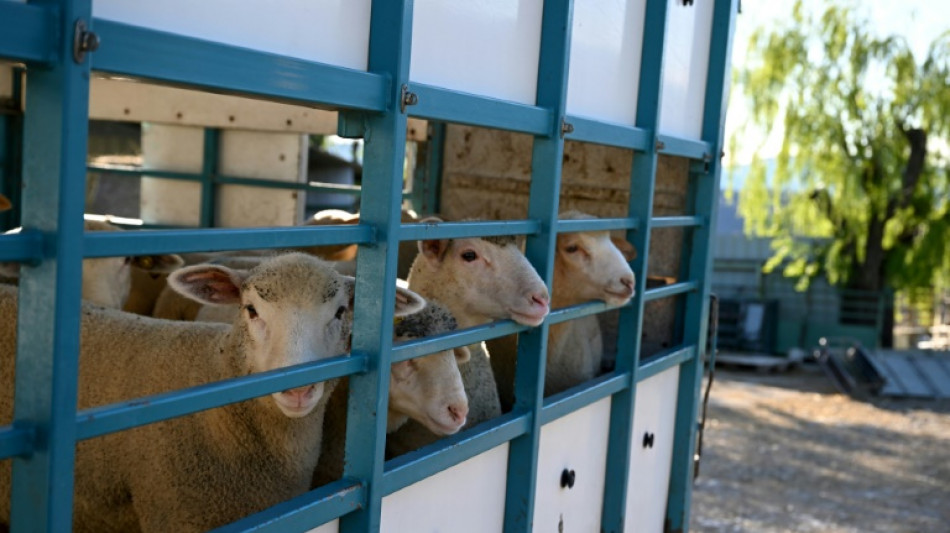
Silence of the lambs as French livestock slaughtered for Easter / Photo: © AFP

 Oil passes $100 a barrel again: why it's more serious this time

 Who are the six candidates vying to lead the UN?

 Hamilton proud of recovery after hitting rock bottom a year ago

 Carapaz eyes polkadot mountains jersey after stage win

 Fields medal awarded to four young mathematicians

 Carapaz claims Tour de France stage as Pogacar loses key team-mate

 Alonso welcomes Aston Martin upgrade, warns against unreal expectations

 Anderson declares Man City 'kings of Manchester' after £116 mn move

 Relieved Russell says Mercedes have solved his power problems mystery

 Oil soars above $100 as Middle East fears grow

 Venezuelans turn to scrap collecting in quake-hit beach 'paradise'

 Heptathlon champion Johnson-Thompson joins list of Commonwealth Games absentees

 Nigeria's Dangote raises $2.5bn to expand Africa's largest refinery

 Oil soars to $100 on fresh Mideast attacks

 Coal-fired power generation rising globally on Mideast war: IEA

 Premier League champions Arsenal sign Greece winger Tzolis from Brugge

 French Jewish DJ sues after activists disrupt gig: lawyer

 Venice film festival promises Pattinson, Oasis and Musk doc

 ASEAN calls for open straits as US-Iran war casts shadow

 Ford and Geely to form joint venture at struggling Spain plant

 Russia warns US against Ukraine arms sales in Manila meeting

 New UK PM announces tax cut for struggling pubs

 Supporters flood India's 'cockroach' protesters with food

 Modi vows punishment for exam leaks fuelling India protests

 Norway set to make formal complaint to FIFA over Balogun red card saga
The bleats and human voices have fallen away in an abattoir in southern France, leaving a line of lambs crowding forward to the sound of clanging metal.
As each young sheep passes through the black tarp that shields the slaughtering room from view, it is stunned by a claw that sends an electric current through its skull.
One of the largest sheep abattoirs in France, Sisteron kills 350 animals per hour as it operates at full speed, ahead of the feast days of the three major monotheist religions -- Christianity, Islam and Judaism -- which all fall in April this year.
AFP journalists were granted access to the slaughtering procedure, at a time when the wider industry has faced waves of criticism from activists working undercover to capture videos of animals being mistreated.
The production line at Sisteron in southeast France, renowned for its quality lamb, an abattoir worker uses a frequently sharpened blade to bleed a lamb while another hangs the animal by its back legs.
Within ten minutes, it will be in a fridge after the first butchering steps.
"The lambs have to be in the shops by Thursday" ahead of Easter weekend, sheep farmer and abattoir chief Guillaume Garcin says.
Garcin insists that his business is "hyper-vigilant about animal welfare", calling it a "moral" duty that pushes him beyond regulatory requirements.
Nevertheless, around a quarter of the lambs killed here are meant for the halal market.
Kosher and halal practices are often contested by animal rights advocates, as the animals cannot be stunned for the ritual slaughter -- something allowed for with an exception in French law.
Garcin says that the abattoir simply "can't give up 25 percent" of its business.
- 'No shouting, no-one's angry' -
At the ramp where lambs are unloaded, signs warn that the process is watched over by CCTV.
Past cases of mistreatment have drawn written reprimands and "it doesn't happen anymore," Garcin says.
Video surveillance has even been added inside the slaughterhouse, although a political push to make it compulsory across France came to nothing.
"We shouldn't be afraid to show that there can be good things here too," Garcin says, as images that have escaped from abattoirs in recent years have mostly come from animal rights activists.
"There's no shouting, no-one's angry, we keep an eye on things," says Christophe Chavagnac, head of the Alpes Provence Agneaux company that brings most of the meat slaughtered in Sisteron to market -- while adding that, "in any case, things end the same way."
Garcin whistles to urge the 10 lambs he has brought out of his truck into one of the large pens carpeted with straw and fitted with drinking troughs.
Where ten years ago workers might have used sticks to shove animals into line, these days they use their hands to guide them into the narrow concrete passage towards the slaughter room.
"Off they go," Garcin sighs, adding that "it's not the happiest time of year".
Every part of the lambs -- including their heads, which are cut off and hung on a separate rail -- goes to clothing or food for humans and pets.
"You can see that the animals are respected right to the end," Garcin said.
E.Schubert--BTB