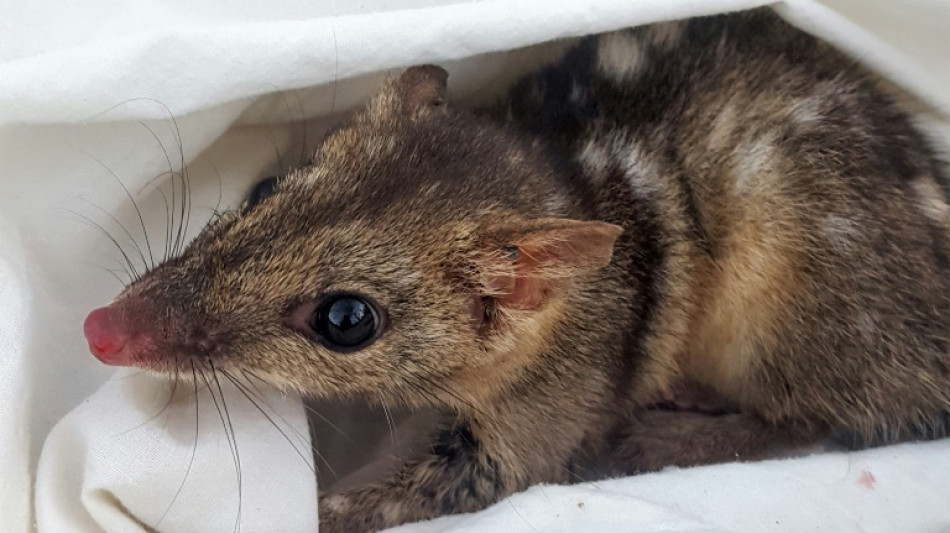
Relentless sex drive may threaten survival of quolls / Photo: © UNIVERSITY OF QUEENSLAND/AFP

 ECB opens door to September rate-hike as Iran war flares up
 World Bank estimates Venezuela quakes caused $19.6 bn in damage

 Italy's far-right line up to defend jeweller who killed robbers

 AI-led boom in IPOs raises concerns about a bust

 Klopp expected to be named new Germany coach on Friday

 ECB holds rates as Iran war flare-up threatens to drive prices higher

 MEXC's "Kickoff Fest" Trading Event Concludes with Top Individual Reward of 27,352 USDT

 Oil soars close to $100 on fresh Mideast attacks

 India's angry Gen Z protesters say Modi must fix accountability

 Barca sign Adeyemi from Borussia Dortmund

 EasyJet profits nosedive on Mideast war

 EU fines Google 890 mn euros, risking US fury

 France evacuates thousands of tourists as fire rages in pine forest

 French Jewish DJ sues after activists disrupt stage show: lawyer

 Nokia says AI, cloud boosted sales in second quarter

 Repsol says profit more than triples on higher oil prices

 TotalEnergies says profit doubled on Mideast war

 Giant swing on Swiss peak aims to boost summer tourism as Alps warm

 ASEAN to call for open straits as US-Iran war casts shadow

 AI catches up with humans to score 100% at top maths contest

 South Korea election office raided in fake turnout figures probe: investigators

 Killer whales: orcas blow fish to bits 'for fun', study finds

 Deadly wildfires force thousands from homes in parts of Europe

 Tech bounce lifts Asia stocks, oil extends gains on US-Iran fears

 Surrounded by militias, Sudanese fear endless cycle of war

For male northern quolls, sex is a death sentence.
The cute marsupials native to northern Australia are the world's largest semelparous mammal, which means that the males drop dead after their first breeding season.
But what exactly causes them to die has remained a mystery.
Research published on Wednesday suggests that the males are depriving themselves of rest in their relentless pursuit to mate with females, potentially threatening the survival of their already endangered species.
Hoping to shed light on this sex-driven death frenzy, a team of researchers strapped tiny backpacks carrying tracking devices to seven male and six female northern quolls on Groote Eylandt, an island off the coast of Australia's Northern Territory.
The data, collected over 42 days that included breeding season, was entered into a machine learning algorithm which analysed different quoll behaviours.
The males were found to be far more active than females, who live for up to four breeding seasons.
And while females rested or laid around nearly 24 percent of the time, the proportion for males was just seven percent, according to a study published in the journal Royal Society Open Science.
The study's lead author, Joshua Gaschk of the University of the Sunshine Coast, told AFP that the "males didn't seem to be sleeping anywhere near as much as they should".
For the first time, "we might have a smoking gun" for what is causing the males to die after breeding, he said.
Smaller relatives of the northern quoll, such as the antechinus, are also semelparous.
But research has found that their males die from internal haemorrhaging and infection due to escalating stress hormones during mating season -- which is not what is killing the northern quolls.
- 'Mating frenzy' -
Gaschk said the yearly male die-off could threaten the survival of the northern quoll, which has been badly affected by the introduction of non-native cane toads, cats and foxes to Australia.
But the carnivorous marsupials have been using this extreme breeding strategy, also known as suicidal reproduction, "for thousands of years -- there's got to be a benefit to it," Gaschk said.
Indeed on Groote Eylandt, an island with no cane toads and few cats, the northern quolls are "not just surviving, but doing really well", he said.
Adrian Bradley of the University of Queensland, who was not involved in the study, called the new research "significant".
Bradley said he was quite certain that the "mating frenzy" of smaller semelparous marsupials like the antechinus is "stimulated as an irresistible response to the release of perfume-like pheromones from the cloacal glands of females."
The amount of weight lost during these frenzies likely explains why only smaller members of the dasyuridae family are semelparous, he said.
But for the larger northern quoll, Bradley warned it was not yet "possible to conclusively say" why some "males generally do not survive the breeding season," calling for further research.
R.Adler--BTB