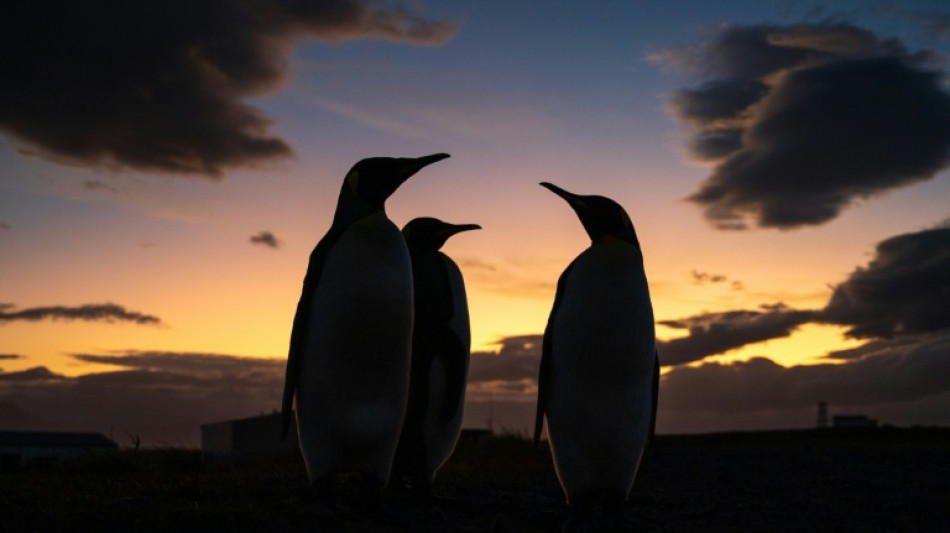
Satellite mapping finds new colony of Emperor penguins / Photo: © AFP/File

 ECB opens door to September rate-hike as Iran war flares up

 World Bank estimates Venezuela quakes caused $19.6 bn in damage

 Italy's far-right line up to defend jeweller who killed robbers

 AI-led boom in IPOs raises concerns about a bust

 Klopp expected to be named new Germany coach on Friday

 ECB holds rates as Iran war flare-up threatens to drive prices higher

 MEXC's "Kickoff Fest" Trading Event Concludes with Top Individual Reward of 27,352 USDT

 Oil soars close to $100 on fresh Mideast attacks

 India's angry Gen Z protesters say Modi must fix accountability

 Barca sign Adeyemi from Borussia Dortmund

 EasyJet profits nosedive on Mideast war

 EU fines Google 890 mn euros, risking US fury

 France evacuates thousands of tourists as fire rages in pine forest

 French Jewish DJ sues after activists disrupt stage show: lawyer

 Nokia says AI, cloud boosted sales in second quarter

 Repsol says profit more than triples on higher oil prices

 TotalEnergies says profit doubled on Mideast war

 Giant swing on Swiss peak aims to boost summer tourism as Alps warm

 ASEAN to call for open straits as US-Iran war casts shadow

 AI catches up with humans to score 100% at top maths contest

 South Korea election office raided in fake turnout figures probe: investigators

 Killer whales: orcas blow fish to bits 'for fun', study finds

 Deadly wildfires force thousands from homes in parts of Europe

 Tech bounce lifts Asia stocks, oil extends gains on US-Iran fears

 Surrounded by militias, Sudanese fear endless cycle of war

Satellite mapping technology has discovered another new colony of the highly threatened Emperor penguins in Antarctica, researchers revealed Friday.
The find, announced by the British Antarctic Survey (BAS) to mark Penguin Awareness Day, brings the total number of known emperor penguin breeding sites around Antarctica's coastline to 66.
It is the latest in a series of Emperor penguin breeding sites detected using the satellite technology.
The birds, which are endemic to Antarctica and the biggest of the 18 penguin species at around 1.2 metres (nearly four feet) tall, face almost complete annihilation due to climate change and the loss of sea ice.
The US Fish and Wildlife Service last year placed Emperor penguins, which need sea ice to breed, on its endangered species list, calling the move "an alarm bell" and "call to action".
Recent projections suggest that under current warming trends, 80 percent of colonies will be quasi-extinct by the end of the century.
Scientists from the BAS uncovered the latest site, home to around 500 birds, by identifying signs of penguin excrement, known as guano, on the landscape at Verleger Point in West Antarctica.
Guano stains the snow and rock terrain brown and is easy to spot, while the flightless birds themselves are too small to be seen from satellites.
- 'Good news' -
The researchers studied images from the EU's Copernicus Sentinel-2 satellite mission and compared them with high resolution footage from the MAXAR WorldView3 satellite.
Peter Fretwell, who studies wildlife from space at BAS and was lead author of the research revealing the find, called it "exciting" but cautioned that the existential risk to the birds remained.
"Whilst this is good news, like many of the recently discovered sites, this colony is small and, in a region badly affected by recent sea ice loss," he said.
Emperor penguins are found in areas that are very hard to study because they are remote, inaccessible and extremely cold, with temperatures dropping as low as minus 60 Celsius (-76 Fahrenheit), according to the BAS.
Its researchers have for been looking for new colonies 15 years by searching satellite images for penguin guano.
The technology also helped the BAS detect a "catastrophic" breeding failure among the second largest Emperor colony in Antarctica between 2016 and 2019.
Nearly all chicks born over the three years died as their icy Antarctic habitat shrank due to abnormally warm and stormy weather breaking up the critical sea ice.
Emperors came to global fame with a 2005 documentary, "March of the Penguins", portraying their annual trek across the icy wastes, and the 2006 cartoon movie "Happy Feet".
E.Schubert--BTB