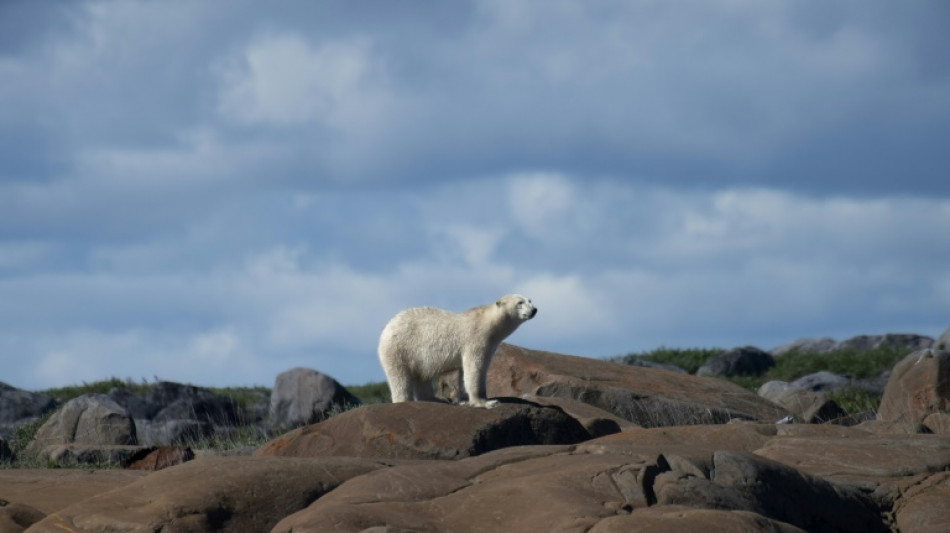
Polar bear hell: An ice pack that keeps receding / Photo: © AFP

 Repsol says profit more than triples on higher oil prices

 TotalEnergies says profit doubled on Mideast war
 Giant swing on Swiss peak aims to boost summer tourism as Alps warm

 ASEAN to call for open straits as US-Iran war casts shadow

 AI catches up with humans to score 100% at top maths contest

 South Korea election office raided in fake turnout figures probe: investigators
 Killer whales: orcas blow fish to bits 'for fun', study finds

 Deadly wildfires force thousands from homes in parts of Europe

 Tech bounce lifts Asia stocks, oil extends gains on US-Iran fears

 Surrounded by militias, Sudanese fear endless cycle of war

 Commonwealth Games 'where champions are made' despite slimmed down model, argues president
 Trump family project in Albania has already caused 'irreparable' damage: NGOs

 Bollywood blast master keeps it real with fire and fury

 Tearful fights, edible offerings: A glimpse into the Maradona trial
 What's the deal with peptides? The hyped market under US review

 Tesla shares fall as Musk touts ambitious -- and costly -- plans
 Houthis claim Red Sea tanker strikes as US hits Iran again

 Wildfires ravage parts of southern France, Italy and Spain

 Alphabet beats expectations in second quarter, cloud revenue nearly doubles
 Trump threatens Iran infrastructure, Tehran vows 'eye for eye'

 US teen withdraws lawsuit against Meta over social media addiction
 Lebanon PM says Beirut working for 'complete Israeli withdrawal'

 EU conditionally clears Paramount bid for Warner Bros.

 Philipsen snaps 'horrible' drought with Tour de France stage 17 victory

 US trial of Venezuela's Maduro set for June 2027

Sprawled on rocky ground far from sea ice, a lone Canadian polar bear sits under a dazzling sun, his white fur useless as camouflage.
It's midsummer on the shores of the Hudson Bay and life for the enormous male has been moving in slow motion, far from the prey that keeps him alive: seals.
Every year from late June, when the bay ice disappears -- shrinking until it dots the blue vastness like scattered confetti -- the bears must move onto shore to begin a period of forced fasting.
But that period is lasting longer and longer as temperatures rise.
The whole annual rhythm of the polar bear is in peril, and birth rates are dropping as they scavenge for food.
"There could be a beluga whale carcass they might be able to find, (or a) naive seal near shore, but generally they're just fasting. They lose nearly a kilogram of body weight every day that they're on land," said Geoff York, a biologist for Polar Bears International (PBI). An AFP team joined him on an expedition.
In the Arctic, global warming is occurring three or four times faster than elsewhere in the world, recent studies indicate.
According to a 2020 report published in the journal Nature Climate Change, this means the near-extinction of this iconic animal is approaching: From 1,200 individuals in the 1980s, the polar bear population in western Hudson Bay has dropped to about 800 today.
These days, this super predator of the Arctic sometimes has to feed on seaweed, as a mother and her cub were seen doing not far from the port of Churchill, the Manitoba town and self-declared "polar bear capital."
They are also moving closer to the cities. In Churchill, the bears a few years ago began frequenting the waste disposal site, a source of easy - but harmful - food for them.
Since then, the town has taken precautions. The dump is now guarded by cameras, fences and patrols. Across Churchill, people leave cars and houses unlocked in case someone needs to take refuge quickly after a bad encounter with this large carnivore.
The emergency number for the wildlife protection unit is posted on many walls.
Some areas, like schoolgrounds, are more closely monitored.
When they get an urgent call, Ian Van Nest, the provincial officer of the unit, and his colleagues jump into their pickup truck armed with a rifle and a spray can of repellent, wearing protective vests.
Sometimes the bears can be scared off with just "the horn on your vehicle," Van Neste said. Other times the animals need to be sedated, then kept in cages until winter rolls around and they are freed.
The fate of the polar bear should alarm everyone, said Flavio Lehner, a climate scientist at Cornell University, who notes that the Arctic is a good barometer of planetary health.
And since the 1980s, data show, the bay's summer ice pack has decreased by nearly half.
J.Horn--BTB