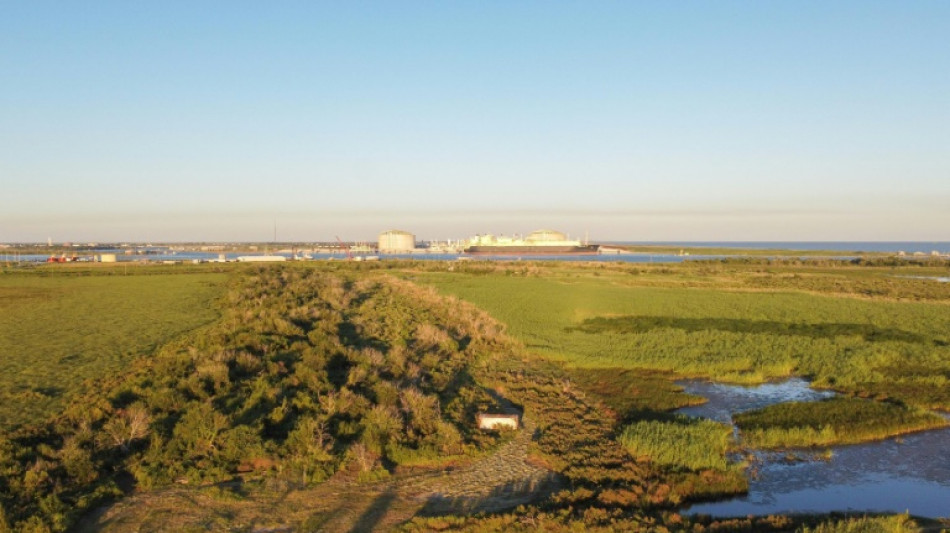
Along US Gulf Coast, huge gas plants jostle for space / Photo: © AFP

 Repsol says profit more than triples on higher oil prices

 TotalEnergies says profit doubled on Mideast war
 Giant swing on Swiss peak aims to boost summer tourism as Alps warm

 ASEAN to call for open straits as US-Iran war casts shadow

 AI catches up with humans to score 100% at top maths contest

 South Korea election office raided in fake turnout figures probe: investigators

 Killer whales: orcas blow fish to bits 'for fun', study finds

 Deadly wildfires force thousands from homes in parts of Europe

 Tech bounce lifts Asia stocks, oil extends gains on US-Iran fears

 Surrounded by militias, Sudanese fear endless cycle of war

 Commonwealth Games 'where champions are made' despite slimmed down model, argues president
 Trump family project in Albania has already caused 'irreparable' damage: NGOs

 Bollywood blast master keeps it real with fire and fury

 Tearful fights, edible offerings: A glimpse into the Maradona trial
 What's the deal with peptides? The hyped market under US review

 Tesla shares fall as Musk touts ambitious -- and costly -- plans
 Houthis claim Red Sea tanker strikes as US hits Iran again

 Wildfires ravage parts of southern France, Italy and Spain

 Alphabet beats expectations in second quarter, cloud revenue nearly doubles
 Trump threatens Iran infrastructure, Tehran vows 'eye for eye'

 US teen withdraws lawsuit against Meta over social media addiction
 Lebanon PM says Beirut working for 'complete Israeli withdrawal'

 EU conditionally clears Paramount bid for Warner Bros.

 Philipsen snaps 'horrible' drought with Tour de France stage 17 victory

 US trial of Venezuela's Maduro set for June 2027

As war rages in Ukraine, and Europe thirsts for fuel, the liquified natural gas (LNG) industry along the US Gulf Coast is preparing to expand -- a distressing development to some nearby neighbors.
"It's our life they took here," says Travis Dardar from the doorstep of his camper trailer.
An imposing LNG export terminal -- a massive facility that receives and liquefies gas from pipelines, then transfers the LNG to ships for export -- will soon loom next to his house, forcing him and his wife to move.
Another plant is also planned where he fishes, imperiling his shrimp and oyster business.
"This is way more catastrophic than any hurricane," Dardar says, adding that people can rebuild after a hurricane.
In this marshy coastal region between Texas and Louisiana, the proliferation of LNG export terminal projects has unsettled residents, who consider the plants to be a threat to their coast, their serenity and their way of life.
"We don't know what they're going to do next. We know one thing: We can't live here," Dardar says.
- The Ukraine fallout -
Last March, a few weeks after the first salvos of the Russian invasion of Ukraine, President Joe Biden pledged to increase LNG deliveries to Europe, which has traditionally been heavily dependent on Russian gas.
US suppliers have exported 1,574 billion cubic feet (44.6 billion cubic meters)of LNG to Europe so far in 2022, a sharp rise from the 917 billion cubic feet (26 billion cubic meters) in 2020, according to the Center for Liquefied Natural Gas, a Washington-based trade group that represents the sector.
The United States has become the world's largest exporter of LNG, an industry centered around the energy-rich Gulf of Mexico, with its infrastructure and strategic location.
This area alone has five of the seven active US export terminals and 22 of the 24 projects submitted to the authorities for construction.
This activity, in turn, brings many jobs, promises Charlie Riedl, executive director of the Center for LNG. As long as the terminal construction projects meet environmental criteria, the government should "authorize them without delay," he says.
- Noise, light and emissions -
But some residents see the coasts of Louisiana and Texas as "sacrifice zones," says John Allaire, another resident.
"You've got the noise, you've got the light, you've got the air pollution. And you got the fact that they converted several hundred acres of wetlands into a big concrete pad over there," adds Allaire from his boat, pointing to the new LNG export terminal near his home.
Allaire dejectedly watches the waves caused by the huge LNG tankers that erode the shoreline. Sludge from dredging covers his beach.
He is also concerned about the consequences on wildlife. The project planned for the land along his property is located on a wetland that is home to a critically endangered bird, the black rail.
"It's really horrifying to see this (Biden) administration that came in touting environmental justice and the climate crisis... to be approving these kinds of facilities," says Kelsey Crane, in charge of public policy at the association Earthworks.
- High cancer rates -
Many petrochemical facilities are already visible across the Sabine River in Port Arthur, Texas.
Near the Cheniere Energy terminal -- which last year paid nearly $1.5 million in fines for cracks in its tanks -- activist John Beard leads a "toxic tour" of the area, joined by other environmentalists.
In June, an explosion caused the temporary closure of the Freeport LNG terminal further south, reminding residents of the immediate risks posed by the plants.
But Beard, head of the Port Arthur Community Action Network, also denounces the long-term effects on the health of residents who are largely minorities.
In Port Arthur, the population is predominantly African-American or Hispanic, and a quarter of them live below the poverty line, according to the US Census Bureau.
The county has a 25 percent higher cancer death rate than the rest of the state, according to the Texas Cancer Registry.
Beard believes that the gas industry did not choose this area by chance: "They take the path of least resistance and that is with the poor and those who don't have access to lawyers, and who are not as educated or knowledgeable.”
N.Fournier--BTB