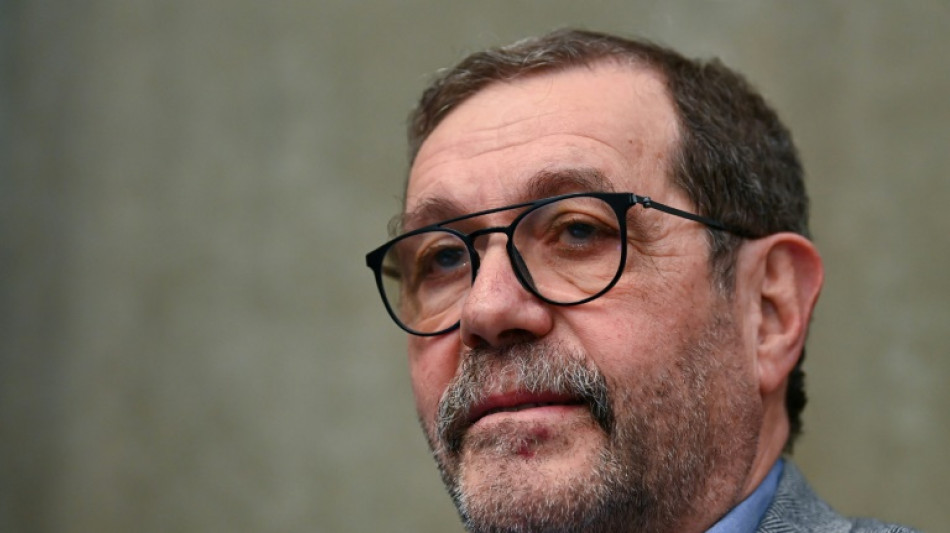
Alain Aspect, Nobel-winning father of quantum entanglement / Photo: © AFP

 Modi vows punishment for exam fraud fuelling India protests
 Six candidates in race to lead UN set for televised debate

 Comic-Con kicks off with Marvel's return

 Dutch riders dreaming of crazy party corner of Alpe d'Huez

 Houthis target Red Sea shipping as US hits Iran
 Record-equalling Red Sox streak halted at 15 wins

 Messi-less Miami beat Fire 3-2 to spoil Lewandowski's MLS debut

 Mercedes expect Hungary challenge from Hamilton and Ferrari
 In Ghana, one man's race to save critically endangered fish
 Wilson captain, Slipper absent in Kiss's first Wallabies squad
 New Mideast fighting puts eurozone rate-setters on alert

 Venezuelans search for animal companions lost in the quakes
 Argentine Football Association says US did not detain its president
 June heatwave cost UK economy more than £1bn: study

 Google-parent Alphabet beats expectations, cloud revenue nearly doubles
 US announces civilian nuclear deal with Saudi Arabia
 Tesla shares dip after profit misses expectations

 Red Sox tie club record with 15th straight MLB win

 US eyes offshore nuclear reactors

 The Sterling Announces Luxury Cocktail Lounge Concept and Investor Showcase in Orlando
 Inter Miami signs Brazil veteran Casemiro but MLS probes deal
 White House accuses China's Moonshot of stealing Anthropic AI

 Pogacar sweating on Yates's fitness ahead of Tour Queen stage

 Ukrainian soldiers and civilians welcome new army commander

 UK fintech Revolut valuation soars to $115 bn: source
Alain Aspect, who won a long-expected Nobel Physics Prize on Tuesday, not only helped prove the strange theory of quantum entanglement but also inspired a generation of physicists in his native France, according to former students and colleagues.
Quantum entanglement is the theory -- famously dismissed by Albert Einstein -- that when a particle is split into two, the properties of the two new particles remain connected, as if by an invisible piece of string, regardless of how far apart they are.
It remained a theory until Aspect and his team proved the phenomenon in a laboratory experiment for the first time in 1981, entangling two photons -- units of light -- at a distance of 12 metres (40 feet).
The experiment helped pave the way for what Aspect has called the "second quantum revolution", which has led to a range of new technologies including quantum computing, encryption and more.
"Quantum strangeness has dominated my whole life as a physicist," Aspect told AFP in a 2010 interview.
His experiment finally settled a debate from more than 60 years earlier between Einstein and one of the fathers of quantum physics, Denmark's Niels Bohr.
Bohr believed in quantum entanglement but Einstein -- whose work helped predict the phenomenon -- famously argued against it, calling it "spooky action at a distance".
"Bohr wins from a certain point of view," Aspect said in an interview published by the Nobel Foundation after his win on Tuesday.
"But Einstein wins because he spotted something extraordinary," he added.
Aspect said he was proud to be on the same list of Nobel-winners who have "totally changed physics".
Awarded along with Austrian physicist Anton Zeilinger and John Clauser from the United States, Aspect emphasised the importance of international scientific collaboration "at a time when the world is not so nice, and where nationalism is taking over in many countries".
- 'Tireless teacher' -
Aspect, the son of a teacher, was born in Agen in southwest France in 1947.
He came second in the French education physics exam, and is currently professor at Paris-Saclay University and at Ecole Polytechnique. Now 74, he is married and has two children.
Aspect has already racked up many awards, including the gold medal from France's CNRS research institute, as well as sharing the 2010 Wolf Prize in physics with Zeilinger and Clauser.
Aspect had been expected to win the Nobel for years, with Chris Phillips, a physicist at Imperial College London, saying "the prize was long overdue".
"It's one of the most deserved prizes we've had for a while," he added.
"We have all been waiting for this for a long time! We are very proud," said France's minister for higher education and research, Sylvie Retailleau, who knew Aspect from her time as a physicist.
"He is one of those mentors in physics. A whole community today works under his leadership," said Retailleau, a former president of Paris-Saclay University.
Aspect is also a "tireless teacher" who gives acclaimed lectures, she added.
Former student Georges-Olivier Reymond, who is now the head of French start-up Pasqal which is working on developing a quantum processor, said it was "fantastic" that Aspect had won the Nobel.
"Everything I have done in my career is thanks to him," Reymond said.
With his experiment, "Aspect pulled off a feat that surprised us all," Reymond said. "It was so different from what we learned at school... it inspired generations of students."
"I can still hear him saying, when I was just 20 years old... 'you have to create quantum start-ups -- it's the future'," Reymond said.
"He was right."
C.Meier--BTB