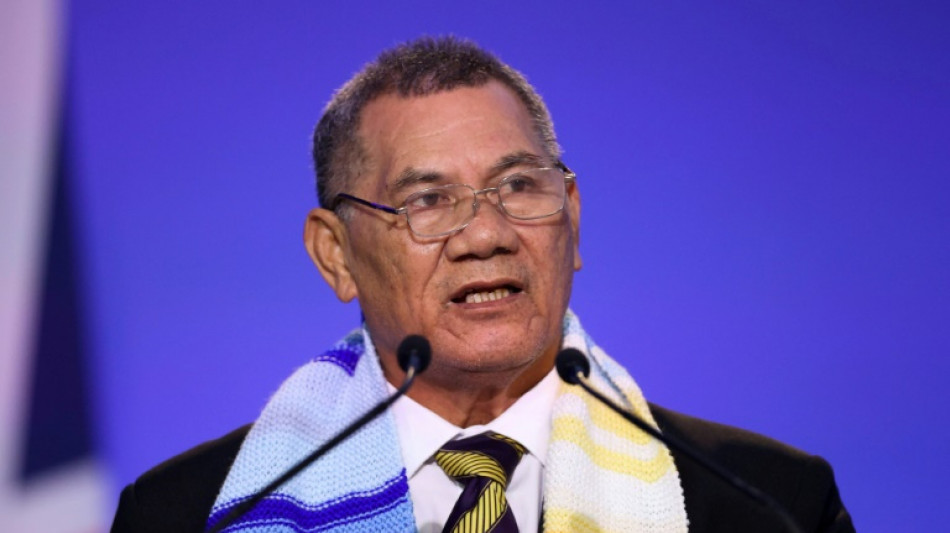
As tiny Tuvalu sinks, PM fights to save the archipelago's identity / Photo: © POOL/AFP/File

 Houthis target Red Sea shipping as US hits Iran
 Record-equalling Red Sox streak halted at 15 wins
 Messi-less Miami beat Fire 3-2 to spoil Lewandowski's MLS debut
 Mercedes expect Hungary challenge from Hamilton and Ferrari

 In Ghana, one man's race to save critically endangered fish
 Wilson captain, Slipper absent in Kiss's first Wallabies squad
 New Mideast fighting puts eurozone rate-setters on alert

 Venezuelans search for animal companions lost in the quakes
 Argentine Football Association says US did not detain its president

 June heatwave cost UK economy more than £1bn: study

 Google-parent Alphabet beats expectations, cloud revenue nearly doubles
 US announces civilian nuclear deal with Saudi Arabia

 Tesla shares dip after profit misses expectations

 Red Sox tie club record with 15th straight MLB win

 US eyes offshore nuclear reactors

 The Sterling Announces Luxury Cocktail Lounge Concept and Investor Showcase in Orlando
 Inter Miami signs Brazil veteran Casemiro but MLS probes deal

 White House accuses China's Moonshot of stealing Anthropic AI
 Pogacar sweating on Yates's fitness ahead of Tour Queen stage

 Ukrainian soldiers and civilians welcome new army commander

 UK fintech Revolut valuation soars to $115 bn: source

 German FM, on Africa tour, eyes business ties amid US, China pressure

 Rubio says at ASEAN meeting he expects 'positive' US visit by China's Xi

 Philipsen wins Tour de France 17th stage

 DonnaPro Introduces AI-Trained Executive Assistants for European CEOs

The flag of Tuvalu contains nine yellow stars -- one for each of the islands that make up the tiny Pacific archipelago, home to some 11,000 people.
Today, however, two of those atolls are on the verge of being swallowed by rising sea levels as a result of the global climate crisis that has already done irreversible harm and will likely leave the nation uninhabitable in the coming decades.
What happens to a country when it disappears beneath the waves, when all its people are forced to leave?
"That is exactly the idea behind the Rising Nations Initiative -- to convince members of the UN to recognize our nation, even if we are submerged underwater, because that is our identity," Prime Minister Kausea Natano told AFP on the margins of the UN General Assembly.
Vague promises and messages of sympathy from the international community have done little for Pacific atoll countries, which began a push Wednesday for a formal legal process to retain their statehood, should the worst come to pass.
The plan aims to reaffirm the international community's commitment to Tuvalu and other island nations' sovereignty.
It would also create a repository for the islands' cultural heritage and designate them as UNESCO World Heritage sites, as well as increase financial support for adaptation measures.
Already, the situation is dire.
As so-called "floating islands" that aren't directly connected to the ground below, atolls sit on top of "lenses" of freshwater, which are increasingly permeated by saltwater as oceans rise.
That has left them dependent on rainwater for drinking and agriculture -- and Tuvalu is now into its sixth month of drought.
"We have to deploy desalination plants, but they are very expensive, they consume very high amounts of electricity," explained Natano.
The archipelago's islands barely break the surface of the ocean, reaching 15 feet at the highest point, but more like four or five feet in other places.
This leaves the islands prone to exceptionally high "King Tides" that wash away root crops, including former island staples taro and cassava, and salt the earth, added Natano.
The circumstances are deeply inequitable: Pacific island nations are among the least responsible for planetary heating, accounting for just 0.03 percent of global emissions.
But even if the world's polluting nations correct course and meet the goal of limiting warming to 1.5C, it could be too late to save the most vulnerable countries like the Marshall Islands and Tuvalu.
- 'We live as a community' -
Natano recalls that more people began leaving -- to New Zealand, Australia and the United States -- after devastating Cyclone Pam struck in 2015, though for now, opportunities for migration remain limited by tough border policies.
"In Tuvalu we live as a community," said Natano, visibly moved. "Even the people who leave don't want to go, they just look at their children and grandchildren and know they have to look for a future for them."
The country has joined calls for so-called "loss and damage" compensation from rich nations based on their historic and ongoing contribution to the climate crisis, but the issue remains contentious.
Natano still hopes, however, to get the assistance his country needs so the people can remain on their land.
There are preliminary discussions on ways to formally apply for a separate identity within other countries, but these are a "last resort," he said.
"When you're in Australia, you will become Australian, same for New Zealand," he added.
"We want to stay in our country, practice our culture and traditions and maintain our legacy."
L.Janezki--BTB