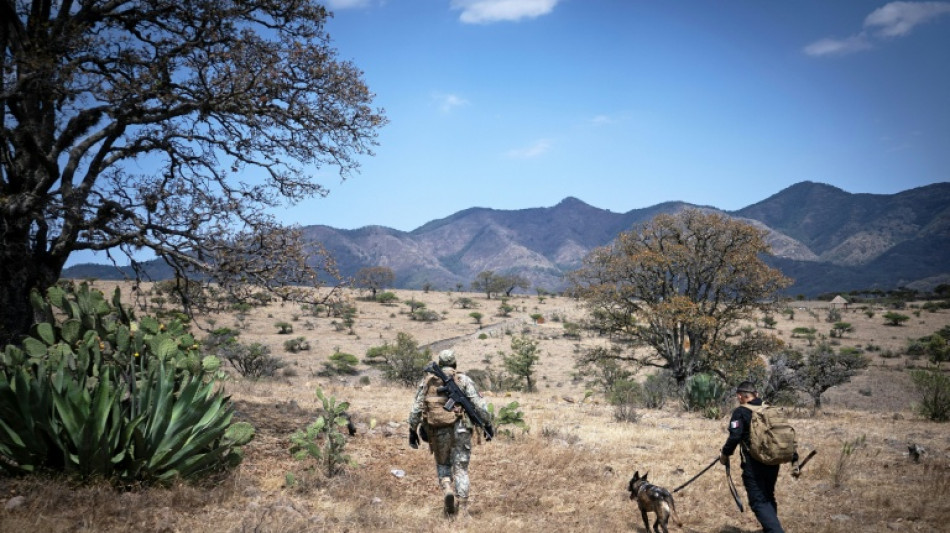
Using AI to help find Mexico's legions of missing children / Photo: © AFP

 Asian stocks rise as tech bounces from rout, eyes on Warsh

 Saudi organisers say 2027 Asian Cup 'on schedule' after attacks

 Right-wing Brazil influencers on 'mission' to seal Bolsonaro win

 Using AI to help find Mexico's legions of missing children

 Fiji to deploy solar-powered Australian military drones at sea

 'Multiple victims' in Oregon elementary school shooting, police say

 'Multiple victims' in Oregon elementary school shooting: police

 ChangeNOW Announces NOW AI After Resolving Website Integration Vulnerability

 Argentine demonstration over education cuts ends in clashes

 Argentine protesters, police clash at demo over university funding

 US stocks end higher as AI shares stabilize

 School roof collapse kills 32 children, teacher in Pakistan

 Lyon down Palace in Europa League, Sunderland leave it late

 UniCredit says receives ECB green light for Commerzbank takeover

 New York City pension fund asks Anthropic to delay IPO

 Venezuela's Maduro denies US torture charges as 'false accusations'

 Somalia sets May presidential election despite insecurity

 Chelsea's Caicedo eager to be more of a leader

 Rahm reaches separation deal with LIV in bankruptcy court

 UN chief urges nations to end 'war on nature'

 Newcastle boss Jaissle says Fernandez-Pardo just needs a goal

 Infantino offers apology but 'no answers' at FIFA meeting over World Cup plan

 Don't exclude Turkey from 'Made in Europe' plan: minister to AFP

 French duo Justice to score 'GTA VI': game maker

 El Nino a 'terrifying' threat to coral reefs: UN biodiversity expert

Veronica Rosas is one of tens of thousands of Mexican mothers looking for a child that has disappeared into a vortex of violence fueled by brutal cartel turf wars.
Now artificial intelligence may be able to help the loved ones of Mexico's legions of disappeared.
Two new AI tools are being developed to help in the search for the more than 134,000 people being sought.
Rosas' son, Diego, went missing at the age of 16 in the central town of Ecatepec in September 2015 after leaving his home to meet some friends.
The state prosecutor's office said he was kidnapped by a criminal gang but have not established which group, why, or whether Diego is still alive.
"It's been 11 years and I still don't know where Diego is. There's no line of investigation leading us to find out what happened to my son," Rosas, 52, told AFP at one of the demonstrations held regularly in Mexico City to demand justice.
Cases like Diego's have prompted two universities to develop AI tools they hope will provide answers.
Regresa (Return) was developed by Mexico's main public university, UNAM. It uses anthropometry -- human body measurements -- to create an image of how the faces of minors, which remain frozen in time in missing persons posters, may have changed over time.
With investigations generally dragging on for years, these updated likenesses are a recurring demand of the families.
Countries like the United States, India and China already use facial recognition and age progression software to search for kidnapped children.
In Mexico, some prosecutors' offices use the technology but most software relies on open-source photo databases that don't reflect typical Mexican traits.
Regresa's developers took a different approach.
They created their own image bank from hundreds of photos and data from 75 Mexican volunteers to make portraits that feature more typically Mexican features.
Anthropologist Ana Juarez, one of the project's founders, explained that Regresa also uses different technology to age the children.
"Many software programs only work with facial contours or textures, or add filters that simulate wrinkles. We seek to develop a scientific approach that shows how a person grows in craniofacial terms," she explained to AFP, referring to imagining that predicts the developments of the skull.
- Peace boxes and posters -
In Mexico, the inaction of authorities over many years has prompted many families to carry out their own investigations.
AI is also being used by an anthropologist at the private Ibero-American University to help facilitate those searches.
Emiliano Zolla is mapping the missing by gender, age and the circumstances of their disappearance, in the hope that it will help families refine their search.
Among his observations, based on data about cases in the State of Mexico, the country's most populous, are that many of the missing are young women who disappear either going to or returning from school or work.
The use of AI could be a game-changer, Rosas said, on learning about Regresa from AFP.
"This initiative is very important because they're not the little people who were taken back then," she said.
Rosas has erected a makeshift mailbox bearing a picture of 16-year-old Diego on Mexico City's main avenue to receive clues as to his whereabouts or greetings for him on his birthday.
Karla Lechuga created a search collective after the disappearance of her 19-year-old son, Jeshua Cisneros, in 2025.
Groups like hers have installed dozens of "peace boxes" in churches across the country to gather information.
They also post photos of their missing loved ones in public spaces and urge criminal groups to provide anonymous tipoffs.
"We have found some people alive, unfortunately others not," Lechuga said.
C.Stoecklin--VB