From 1800s to modern pharma: a Nobel-winning chemistry quest / Photo: © AFP

 Southampton boss Eckert given suspended ban over 'Spygate'
 Russia warns of 'false' information as second plague case reported
 IEA ready to release more oil reserves if necessary

 HSBC 'consults' over UK unit job cuts amid AI adoption
 UK court quashes five ex-traders' Libor rate rigging convictions
 XM Receives “Global Customer Experience Leader Award 2026” at the TrustFinance Performance Awards

 Stocks slide as oil climbs on Mideast flareup
 Heavy casualties in Ukraine after Russian strikes
 French wine harvest set to hit historic low

 Kyiv 'cannot agree' to EU membership limiting food exports: minister

 Arteta targets more Arsenal glory after signing new deal until 2030

 Russell hit with Singapore grid penalty for taking new power unit

 Spotify expands audiobooks to more than 180 markets

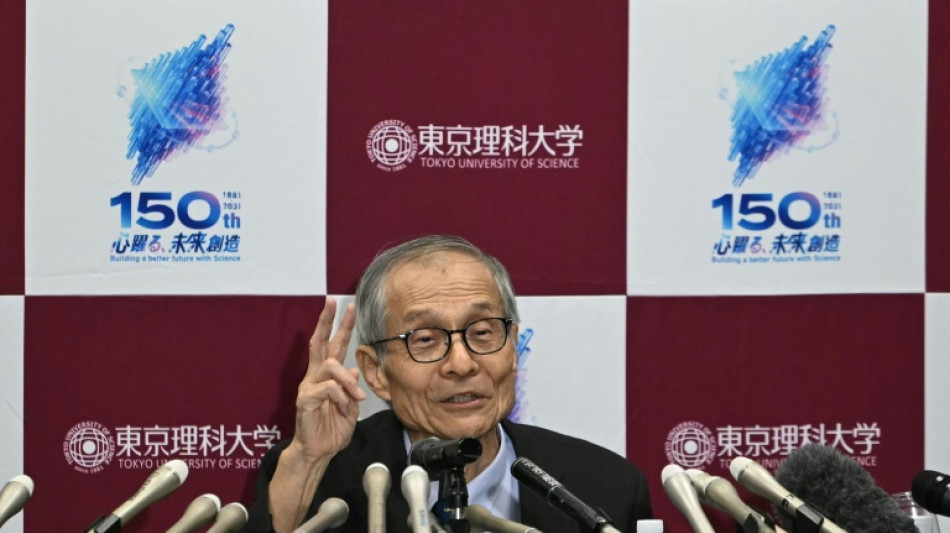
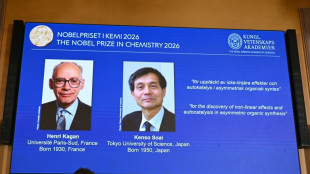 French-Japanese duo wins chemistry Nobel for solving molecular 'mystery'
 England's Nations League surge helps heal World Cup wounds

 Mayor of opposition stronghold Izmir defects to Erdogan party
 Mertens beats Gauff to set up Swiatek clash at China Open
 Benin full of pride at role in Messi's last dance

 France suspends stun grenade use at student protests ahead of PM speech

 Indonesian court hears 'negligence' complaint against state over fires, haze
 Rubio in Greece to urge against Western civilisation 'decline'

 Micron workers at Taiwan plant vote in favour of strike

 In 'The Social Reckoning,' Jeremy Allen White takes on Facebook's 'frightening' ambition

 Chip industry activists call for South Korea to recognise cancer cases
 Famine-scarred southern Madagascar braces for El Nino

Wednesday's Nobel chemistry prize crowned a series of advances that started in the 19th century and led to breakthroughs for modern pharmaceutical manufacturing.
The work taught scientists how to produce a chosen form of certain molecules, "crucial for making things like drugs or even flavours and fragrances," said Phillip Broadwith, an editor at the Royal Society of Chemistry's magazine Chemistry World.
Here are the steps that led France's Henri Kagan and Japan's Kenso Soai to solve a "chemical mystery", according to the Nobel committee.
- Louis Pasteur -
In 1848 French chemist Louis Pasteur shone polarised light on tartaric acid. Some molecules bent the light to the left, others to the right.
This two-handed form was dubbed "chirality" and the two opposite mirror forms "enantiomers".
Later discoveries revealed that in living organisms, amino acids and sugars are present in just one of these two mirror forms -- but when produced in a test tube, both forms occurred.
"Incredibly, molecules that are mirror images of each other can have completely different effects on biological systems," said Broadwith.
The Nobel committee noted that among many drug molecules, "one has the therapeutic effect, while the other can cause unnecessary and sometimes harmful side effects."
- 'Asymmetric' reaction -
Building on Pasteur's findings, in 1904 German chemist Willy Marckwald performed the first "asymmetric" chemical reaction.
Using a one-handed molecule as a catalyst, he found that this generated slightly more of one enantiomer than the other.
If this effect could be amplified, it could be possible for just one of the mirror-image forms to be produced from an artificial reaction -- just as it occurs in a living being.
- Maths basis -
Next, British physicist Charles Frank in 1953 proposed a mathematical explanation for homochirality.
His model suggested a tiny initial imbalance of one "hand" over the other could lead to that form predominating in a chemical reaction under certain conditions.
The challenge was on to stage a reaction that met all his conditions.
- Enter Kagan -
In the 1980s Kagan discovered how to greatly amplify the production of one of the molecules by manipulating the composition of a "chiral" catalyst.
His breakthrough "non-linear" process enabled the production of purer chemicals.
In 2001, US scientists William Knowles and Barry Sharpless and Japan's Ryoji Noyori won the Nobel chemistry prize for work on "asymmetric catalysis".
Kagan was not included in the award.
- Soai: 'autocatalysis' -
Inspired by Kagan's findings, Kenso Soai in 1995 honed the process.
He identified a molecule that could trigger the catalyst to reproduce and yield yet more of the chosen molecule in a process called "autocatalysis".
In 2003 Soai developed a reaction yielding a chemical that was 99.99 percent composed of one single enantiomer.
"Other than life itself, no one had ever achieved this feat," the Nobel committee said.
"The Soai reaction is one of the most spectacular chemical experiments ever conducted."
S.Spengler--VB